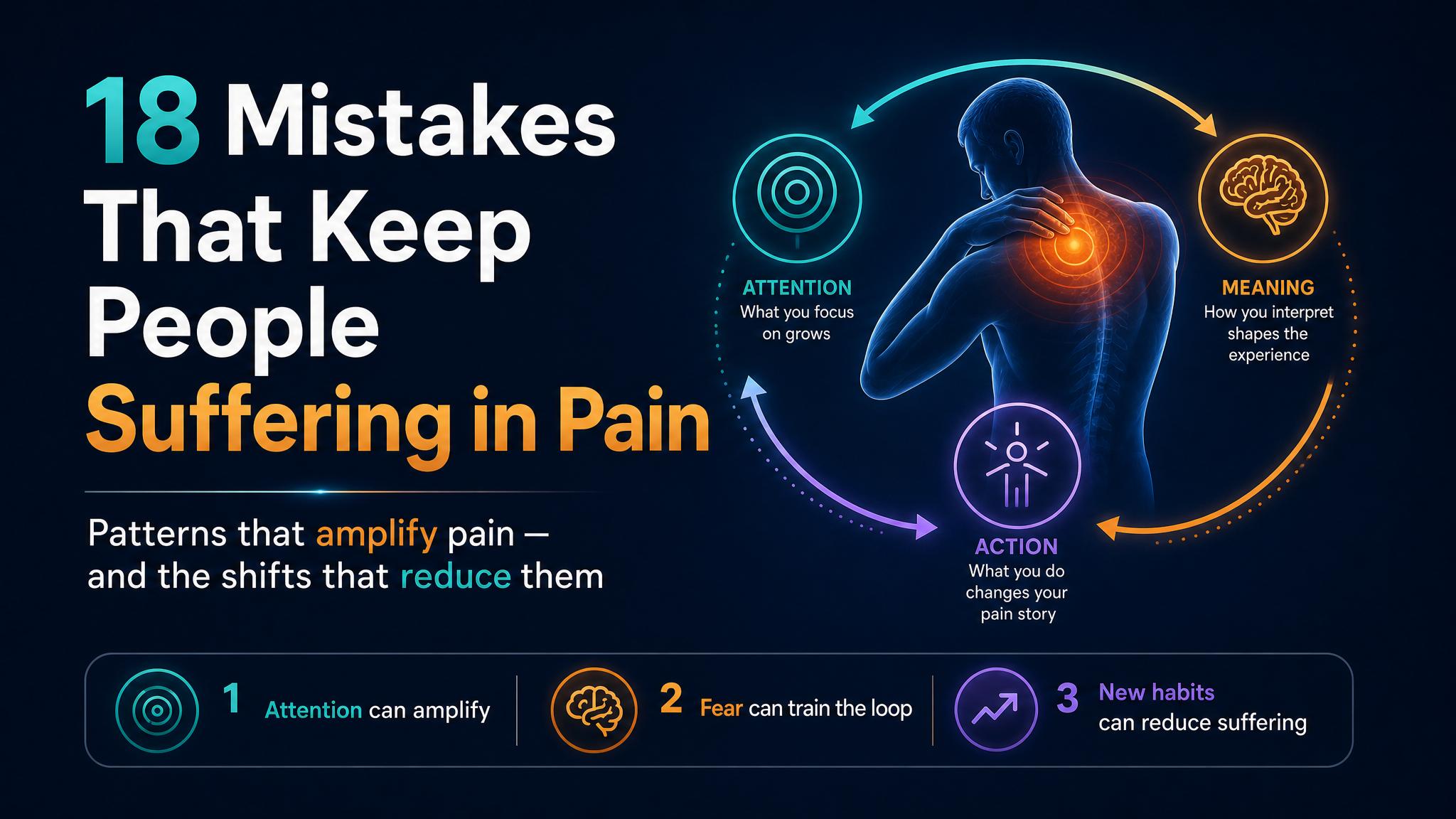
How fear, attention, identity, and avoidance keep the nervous system organized around pain
Pain often becomes more intense and more persistent not because one thing is wrong, but because many small patterns keep reinforcing each other. A frightening interpretation increases tension. Tension increases vigilance. Vigilance increases symptom monitoring. Symptom monitoring strengthens fear. And before long, life starts revolving around the problem.
That is why people can be intelligent, disciplined, motivated, and deeply committed to healing, yet still feel stuck. The issue is not always effort. Sometimes the effort itself is wrapped around urgency, control, over-checking, and fear of what pain means.
The 18 mistakes in this article reveal the patterns that quietly keep suffering active. Some are mental. Some are behavioral. Some are social. Some are emotional. Together, they teach the brain and nervous system to keep treating pain as the center of the story.
Pain rarely stays amplified by symptoms alone.
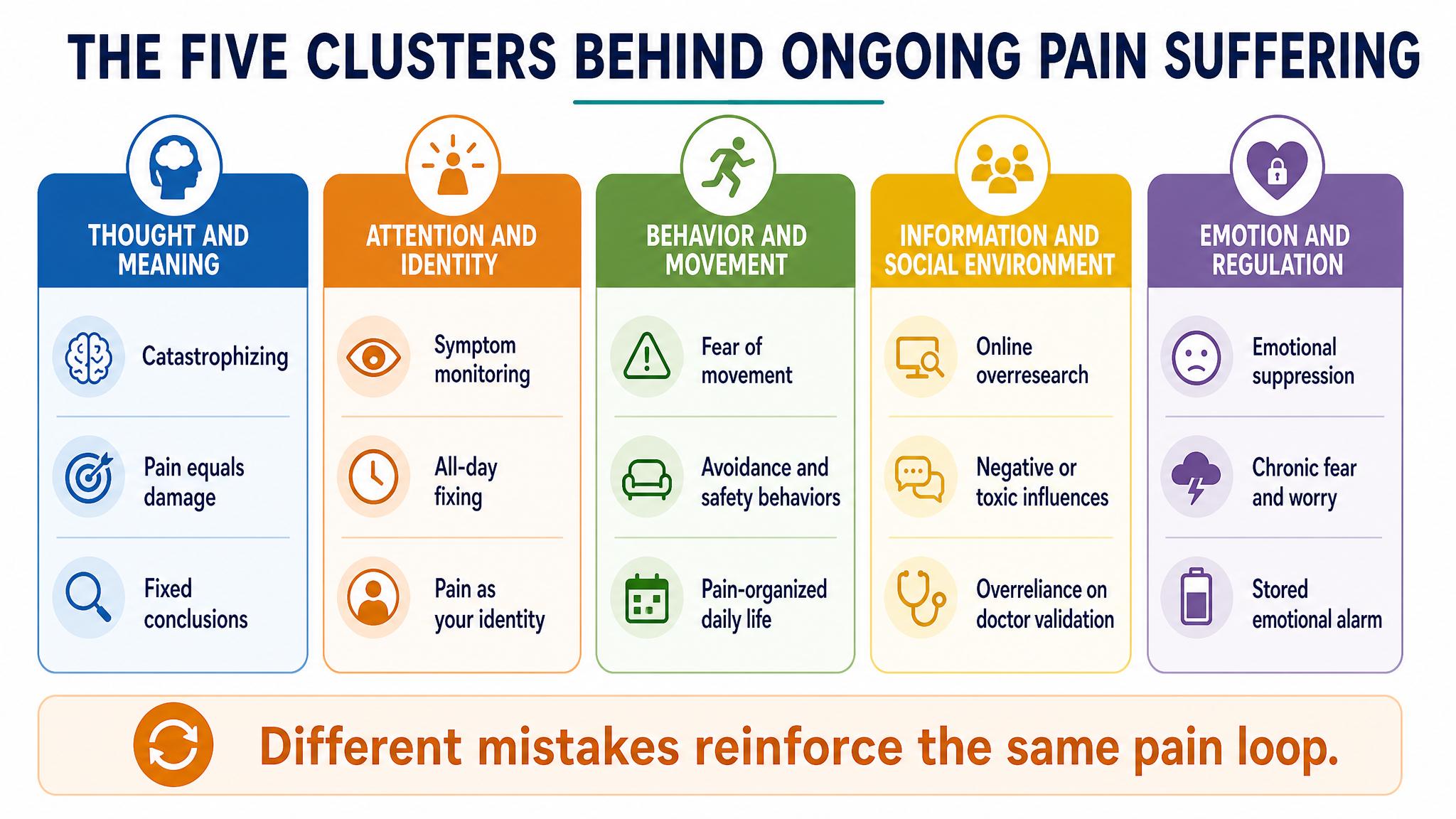
Figure: The 18 mistakes cluster into repeating patterns of threat, attention, behavior, identity, and unresolved alarm.
Why These 18 Mistakes Work So Powerfully
At first glance, these 18 mistakes can look unrelated. Some are mental. Some are behavioral. Some are social. Some are emotional. But underneath, most of them do one of four things: they increase threat, narrow attention, reduce flexibility, or make pain more central to identity.
That combination is what makes suffering stick. Pain may begin with a real symptom, injury, diagnosis, or stress load. But suffering becomes more durable when the system keeps being taught that danger is constant, the future is closed, movement is risky, emotion is unsafe, and the self is defined by the problem.
What you repeat becomes what the system expects.
Summary Table: The Five Clusters
When these patterns are grouped, the article becomes easier to apply. You can see not only what keeps pain central, but which cluster is doing the heaviest lifting in your own system.
| Cluster | Examples | What it reinforces | Better direction |
|---|---|---|---|
| Thought and meaning mistakes | Catastrophizing, pain-equals-damage beliefs, hopelessness, fixed conclusions | Teach the brain to expect danger and permanence | Grounded interpretation and realistic possibility |
| Attention and identity mistakes | Obsessive monitoring, all-day fixing, pain talk, diagnosis as identity | Keep pain central in awareness and self-definition | Flexible attention and a broader identity |
| Behavior and movement mistakes | Fear-avoidance, helplessness, shrinking life around pain | Reduce capacity, confidence, and flexibility | Graded action, exposure, and agency |
| Information and social-environment mistakes | Research spirals, toxic groups, extreme dependence or mistrust | Increase alarm, confusion, and externalization | Discernment and supportive input |
| Emotion and regulation mistakes | Suppressing distress, storing fear, unprocessed emotional alarm | Keep the protection system switched on | Emotional processing and regulation |
The Reinforcement Sequence Beneath Many Pain Mistakes
A symptom shows up. The mind interprets it. Fear rises. Attention narrows. Protection behaviors increase. Those protection behaviors then confirm that pain is important, dangerous, or permanent. Many of the 18 mistakes feed that same reinforcement sequence from different entry points.
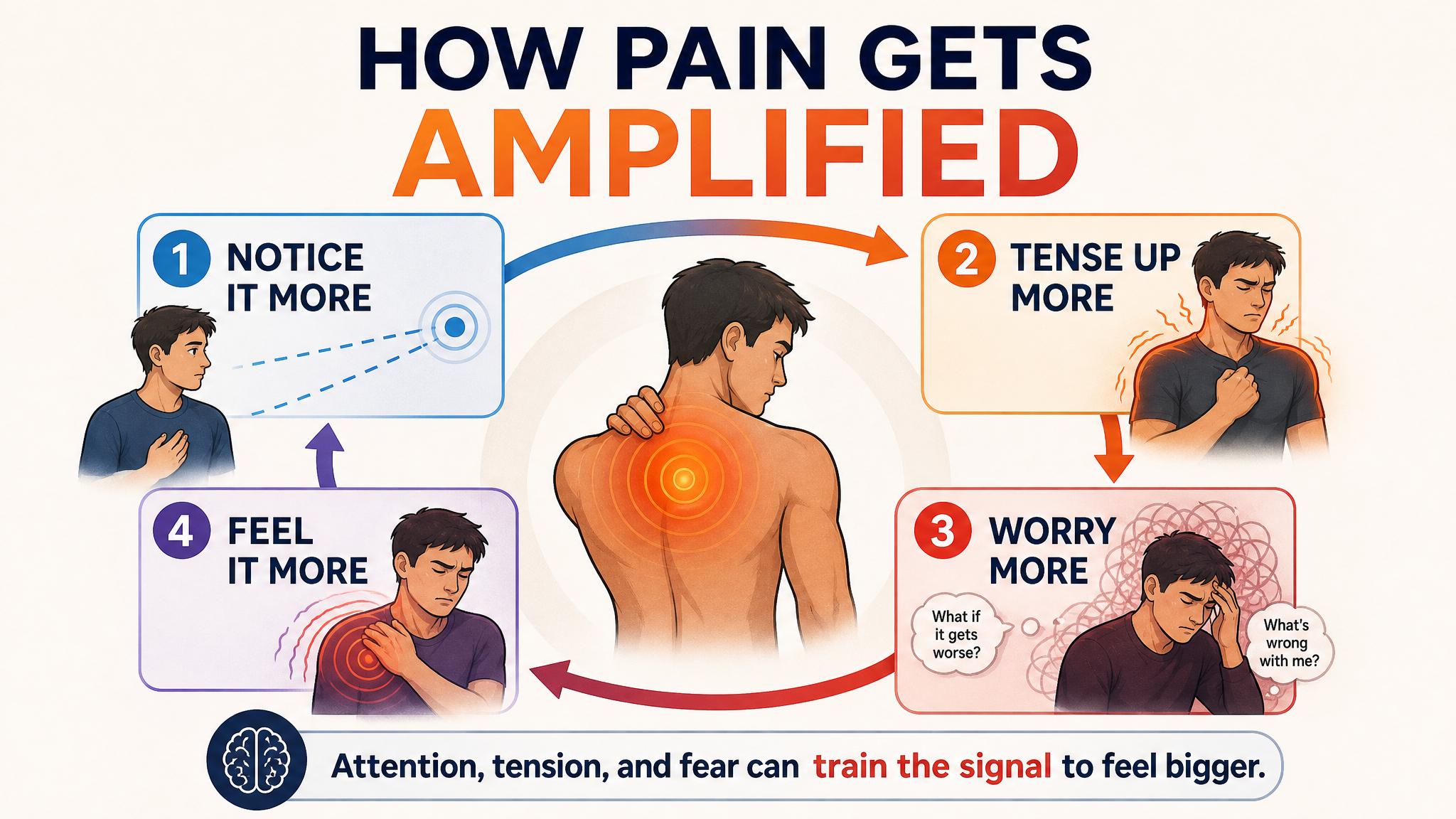
Figure: Different pain mistakes feed the same reinforcement sequence through meaning, vigilance, or protective behavior.
Thought and meaning mistakes
These patterns teach the brain to predict danger before the moment has had a chance to speak for itself. The body becomes organized around anticipation, certainty, and protection.
Catastrophizing
Imagining a hopeless future or “this will never end.” Creates chronic stress and wires the brain to expect more pain.
When the mind keeps rehearsing the worst-case future, the body does not treat that as abstract thought. It treats it as threat prediction. The nervous system prepares for what the mind keeps expecting.
The shift is not fake positivity. It is replacing fearful certainty with grounded interpretation. Hard is not the same as hopeless.
Watching the calendar for results
Impatience and self-doubt (“Why am I not better yet?”) activate the stress response and reinforce hopelessness.
When healing becomes a daily exam, the body feels pressure instead of safety. Every symptom becomes evidence that something is failing.
Measure consistency of practice more than speed of change. Pressure rarely creates regulation.
“Pain = damage” belief
Assuming every sensation signals injury keeps the brain in protection mode and movement avoidance.
This belief tells the system that sensation must always be feared. As long as pain is automatically equated with damage, the body has little reason to soften.
Learning that pain and damage are not always the same can change fear, movement, and willingness to re-engage.
Expecting pain to be permanent
Learned helplessness suppresses motivation and neuroplastic change.
If the future is already defined as hopeless, practice loses energy before it even begins. The system stops looking for evidence of change.
Hope does not need to be dramatic. It only needs to leave the door open enough for the nervous system to keep learning.
Fixed mindset
Believing change is impossible prevents neuroplastic rewiring and blocks healing behavior.
A fixed mindset closes the loop before practice even starts. The nervous system learns through repetition, but repetition depends on some belief that change is still worth attempting.
A learning mindset does not promise instant results. It simply keeps change possible.
Meaning is chemistry.
Attention and identity mistakes
These patterns keep pain central in awareness and self-definition. The more attention stays locked, the more important pain becomes to the system.
Constant fear, focus, and anxiety about symptoms
Keeping attention glued to pain trains the brain to prioritize it.
Attention acts like training. What the brain is asked to notice over and over becomes easier to notice and harder to ignore.
The way out is not neglecting the body. It is widening awareness so symptoms are not the only thing the system is rehearsing.
Trying to “fix” the pain all day long
Makes life revolve around pain, strengthening the pain identity.
The day becomes organized around correction, checking, and managing. Pain stops being one part of life and starts becoming the center of it.
Supportive action helps. All-day fixing usually does not. The nervous system needs signals that life is bigger than the problem.
Measuring and monitoring symptoms obsessively
Tracking pain levels all day increases attention bias and pain amplification.
Obsessive tracking can look responsible, but it often becomes a ritual of danger surveillance. The brain learns that symptom status must be checked constantly.
Use tracking sparingly and intentionally. Pay more attention to function, stability, and recovery than to endless symptom scoring.
Using medical labels as identity
Gives pain authority and turns a symptom into self-definition.
A diagnosis can be useful information, but it becomes costly when it hardens into identity. The self becomes smaller and the pain story becomes larger.
You can have a diagnosis without becoming the diagnosis. The self must stay larger than the label.
Talking about pain constantly
Anchors attention and social identity around the problem instead of healing.
Language tells the brain what matters. When pain becomes the main topic of conversation, it becomes easier for the brain to keep pain central all day.
Balance matters. Pain may need a voice, but it should not become the only voice in life.
Over-focusing on pain sensations
Magnifies intensity through neural amplification and stress chemistry.
When sensation becomes the main object of awareness all day, the nervous system keeps increasing the gain. The world gets smaller and pain gets louder.
Flexible attention is a pain skill. The brain needs safe non-pain-centered experience to remember that symptoms are not the whole environment.
Attention is training.
Identity shapes behavior.
Behavior and movement mistakes
These patterns shrink life. They reduce confidence, reduce movement, and teach the body that action must stay small and guarded.
Letting life be consumed by pain
Allowing pain to become the organizing principle of daily existence (“Pain owns me”).
When pain determines the schedule, identity, emotional climate, and future, the nervous system keeps learning that all of life is organized around threat management.
Recovery becomes more possible when life opens again into meaning, relationships, purpose, and movement.
Low self-efficacy
Believing you have no influence over pain reduces engagement in helpful actions.
When people believe they have no influence, the system stops expecting change. Helplessness becomes one more layer of suffering.
Small wins matter. One calmer breath, one better flare response, one successful walk can begin to restore agency.
Fear of movement / fear-avoidance
Avoiding activity out of fear of worsening pain leads to de-conditioning and hypersensitivity.
Avoidance can bring short-term relief, but it often teaches the body that movement is dangerous. Then confidence drops and sensitivity rises.
Trust is usually rebuilt through graded movement, not by waiting for fear to vanish before moving.
Fear changes movement.
Information and social-environment mistakes
These patterns keep the mind externally agitated, uncertain, and vulnerable to fear reinforcement from the outside world.
Endless online research
Fuels anxiety, fear, and confusion, keeping the nervous system on high alert.
Search spirals often create more possibilities to fear than pathways to heal. The mind stays busy, but the system stays activated.
Useful information calms and guides. Compulsive searching usually agitates and fragments attention.
Toxic pain-support groups
Repetitive complaining and symptom comparison normalize suffering and reinforce fear.
Not all support is regulating. Some groups teach helplessness, social comparison, and pain-centered identity more than they teach healing.
The right support offers understanding without turning suffering into the group’s main identity.
Believing doctors blindly / not believing them at all
Either absolute dependence or constant mistrust keeps you externally focused and powerless.
Both extremes reduce agency. Blind dependence weakens self-trust. Chronic mistrust keeps the system in vigilance and conflict.
The healthier middle is collaboration: ask questions, stay engaged, use expertise, and keep responsibility.
Emotion and regulation mistakes
These patterns keep hidden load inside the body. Distress may not be spoken, but it often continues to shape tone, tension, and nervous-system state.
Avoiding emotions or suppressing distress
Unprocessed emotions keep the body’s alarm system active.
Unfelt emotion rarely disappears. More often it stays active as tension, sympathetic activation, shutdown, fatigue, or chronic unease.
Emotional processing is part of reducing total load. What the body no longer has to store, it no longer has to guard so intensely.
Suppressed emotion keeps the alarm running.
A Practical Map of the 18 Patterns
The grid below works as a fast visual index. It is useful when you want to identify which pattern tends to show up first for you: fearful thinking, checking, life-shrinking behavior, over-research, or stored emotional load.
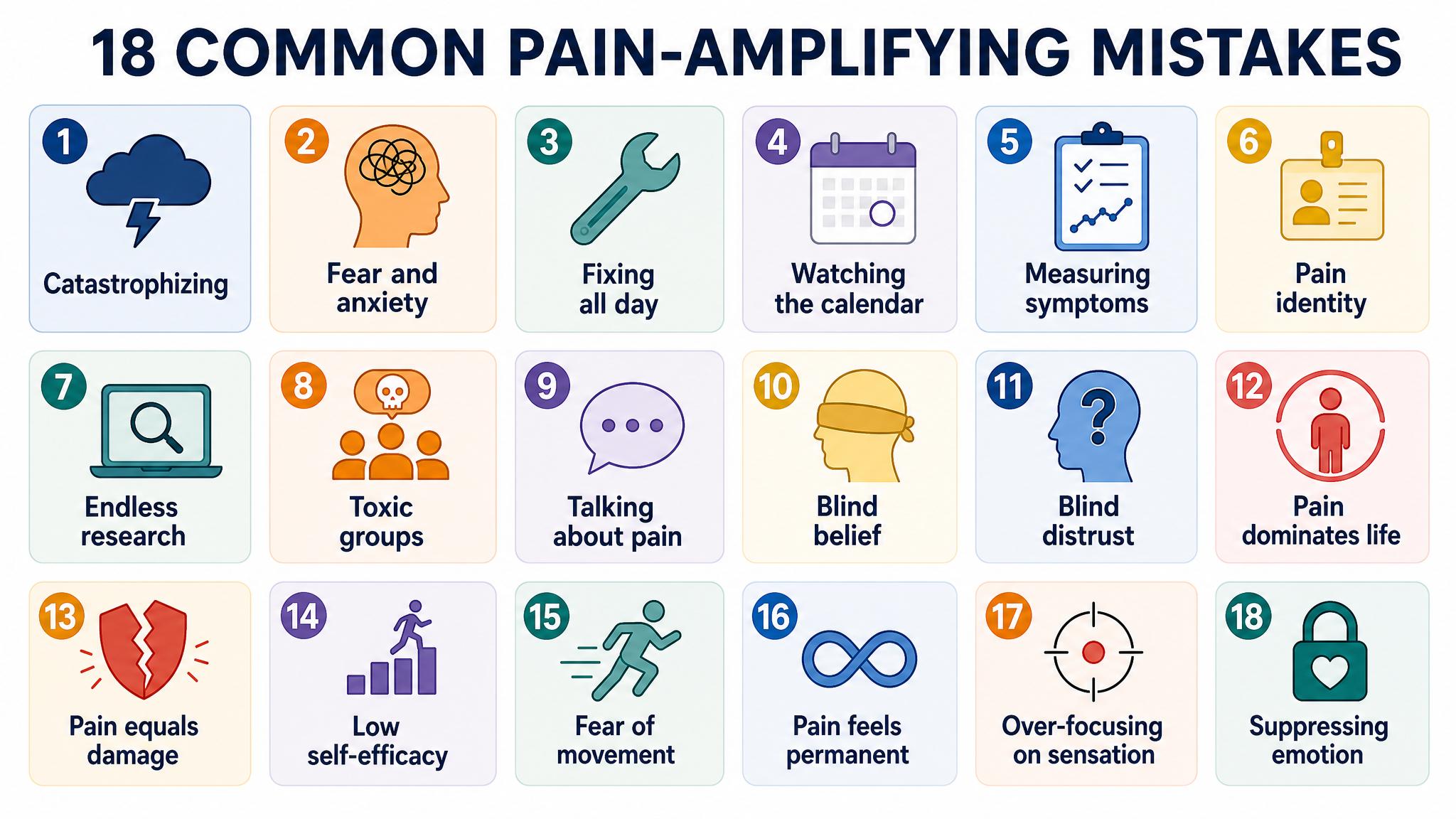
Figure: The 18 mistakes are different on the surface, but many pull in the same direction: they keep pain cognitively, emotionally, and behaviorally central.
What to Build Instead
Most pain-reinforcing mistakes are not solved by force. They are replaced by better conditions: safer interpretation, wider attention, steadier identity, graded action, better environments, and more honest emotional processing.
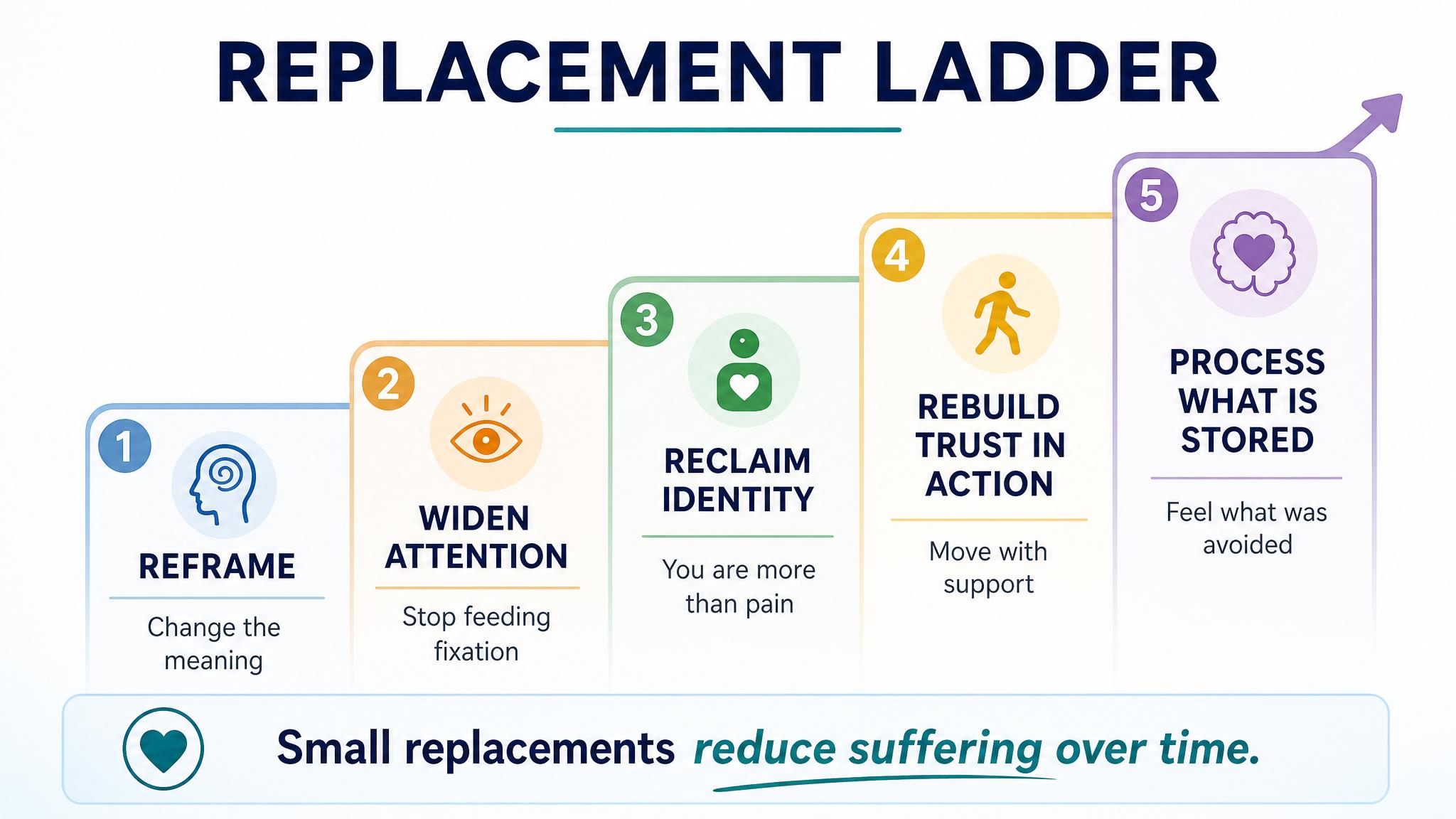
Figure: The goal is not perfect control. It is changing the conditions that keep pain organized around protection.
Recovery grows when pain stops being the center of the self.
Table: The 18 Mistakes and the Direction That Replaces Them
This reference table keeps the article practical by turning each pain-reinforcing habit into a clearer recovery direction.
| Mistake | Why it keeps pain central | Cluster | Better direction |
|---|---|---|---|
| Catastrophizing | Imagining a hopeless future or “this will never end.” Creates chronic stress and wires the brain to expect more pain. | Thought and meaning mistakes | The shift is not fake positivity. It is replacing fearful certainty with grounded interpretation. Hard is not the same as hopeless. |
| Constant fear, focus, and anxiety about symptoms | Keeping attention glued to pain trains the brain to prioritize it. | Attention and identity mistakes | The way out is not neglecting the body. It is widening awareness so symptoms are not the only thing the system is rehearsing. |
| Trying to “fix” the pain all day long | Makes life revolve around pain, strengthening the pain identity. | Attention and identity mistakes | Supportive action helps. All-day fixing usually does not. The nervous system needs signals that life is bigger than the problem. |
| Watching the calendar for results | Impatience and self-doubt (“Why am I not better yet?”) activate the stress response and reinforce hopelessness. | Thought and meaning mistakes | Measure consistency of practice more than speed of change. Pressure rarely creates regulation. |
| Measuring and monitoring symptoms obsessively | Tracking pain levels all day increases attention bias and pain amplification. | Attention and identity mistakes | Use tracking sparingly and intentionally. Pay more attention to function, stability, and recovery than to endless symptom scoring. |
| Using medical labels as identity | Gives pain authority and turns a symptom into self-definition. | Attention and identity mistakes | You can have a diagnosis without becoming the diagnosis. The self must stay larger than the label. |
| Endless online research | Fuels anxiety, fear, and confusion, keeping the nervous system on high alert. | Information and social-environment mistakes | Useful information calms and guides. Compulsive searching usually agitates and fragments attention. |
| Toxic pain-support groups | Repetitive complaining and symptom comparison normalize suffering and reinforce fear. | Information and social-environment mistakes | The right support offers understanding without turning suffering into the group’s main identity. |
| Talking about pain constantly | Anchors attention and social identity around the problem instead of healing. | Attention and identity mistakes | Balance matters. Pain may need a voice, but it should not become the only voice in life. |
| Believing doctors blindly / not believing them at all | Either absolute dependence or constant mistrust keeps you externally focused and powerless. | Information and social-environment mistakes | The healthier middle is collaboration: ask questions, stay engaged, use expertise, and keep responsibility. |
| Letting life be consumed by pain | Allowing pain to become the organizing principle of daily existence (“Pain owns me”). | Behavior and movement mistakes | Recovery becomes more possible when life opens again into meaning, relationships, purpose, and movement. |
| “Pain = damage” belief | Assuming every sensation signals injury keeps the brain in protection mode and movement avoidance. | Thought and meaning mistakes | Learning that pain and damage are not always the same can change fear, movement, and willingness to re-engage. |
| Low self-efficacy | Believing you have no influence over pain reduces engagement in helpful actions. | Behavior and movement mistakes | Small wins matter. One calmer breath, one better flare response, one successful walk can begin to restore agency. |
| Fear of movement / fear-avoidance | Avoiding activity out of fear of worsening pain leads to de-conditioning and hypersensitivity. | Behavior and movement mistakes | Trust is usually rebuilt through graded movement, not by waiting for fear to vanish before moving. |
| Expecting pain to be permanent | Learned helplessness suppresses motivation and neuroplastic change. | Thought and meaning mistakes | Hope does not need to be dramatic. It only needs to leave the door open enough for the nervous system to keep learning. |
| Over-focusing on pain sensations | Magnifies intensity through neural amplification and stress chemistry. | Attention and identity mistakes | Flexible attention is a pain skill. The brain needs safe non-pain-centered experience to remember that symptoms are not the whole environment. |
| Avoiding emotions or suppressing distress | Unprocessed emotions keep the body’s alarm system active. | Emotion and regulation mistakes | Emotional processing is part of reducing total load. What the body no longer has to store, it no longer has to guard so intensely. |
| Fixed mindset | Believing change is impossible prevents neuroplastic rewiring and blocks healing behavior. | Thought and meaning mistakes | A learning mindset does not promise instant results. It simply keeps change possible. |
The 18 Mistakes, One by One
Below is the full long-form blog breakdown of all 18 patterns. Each point has the same core message: what repeatedly feels protective in the short term may be training pain to stay central in the long term.
1. Catastrophizing
Imagining a hopeless future or “this will never end.” Creates chronic stress and wires the brain to expect more pain.
When the mind keeps rehearsing the worst-case future, the body does not treat that as abstract thought. It treats it as threat prediction. The nervous system prepares for what the mind keeps expecting.
The shift is not fake positivity. It is replacing fearful certainty with grounded interpretation. Hard is not the same as hopeless.
2. Constant fear, focus, and anxiety about symptoms
Keeping attention glued to pain trains the brain to prioritize it.
Attention acts like training. What the brain is asked to notice over and over becomes easier to notice and harder to ignore.
The way out is not neglecting the body. It is widening awareness so symptoms are not the only thing the system is rehearsing.
3. Trying to “fix” the pain all day long
Makes life revolve around pain, strengthening the pain identity.
The day becomes organized around correction, checking, and managing. Pain stops being one part of life and starts becoming the center of it.
Supportive action helps. All-day fixing usually does not. The nervous system needs signals that life is bigger than the problem.
4. Watching the calendar for results
Impatience and self-doubt (“Why am I not better yet?”) activate the stress response and reinforce hopelessness.
When healing becomes a daily exam, the body feels pressure instead of safety. Every symptom becomes evidence that something is failing.
Measure consistency of practice more than speed of change. Pressure rarely creates regulation.
5. Measuring and monitoring symptoms obsessively
Tracking pain levels all day increases attention bias and pain amplification.
Obsessive tracking can look responsible, but it often becomes a ritual of danger surveillance. The brain learns that symptom status must be checked constantly.
Use tracking sparingly and intentionally. Pay more attention to function, stability, and recovery than to endless symptom scoring.
6. Using medical labels as identity
Gives pain authority and turns a symptom into self-definition.
A diagnosis can be useful information, but it becomes costly when it hardens into identity. The self becomes smaller and the pain story becomes larger.
You can have a diagnosis without becoming the diagnosis. The self must stay larger than the label.
7. Endless online research
Fuels anxiety, fear, and confusion, keeping the nervous system on high alert.
Search spirals often create more possibilities to fear than pathways to heal. The mind stays busy, but the system stays activated.
Useful information calms and guides. Compulsive searching usually agitates and fragments attention.
8. Toxic pain-support groups
Repetitive complaining and symptom comparison normalize suffering and reinforce fear.
Not all support is regulating. Some groups teach helplessness, social comparison, and pain-centered identity more than they teach healing.
The right support offers understanding without turning suffering into the group’s main identity.
9. Talking about pain constantly
Anchors attention and social identity around the problem instead of healing.
Language tells the brain what matters. When pain becomes the main topic of conversation, it becomes easier for the brain to keep pain central all day.
Balance matters. Pain may need a voice, but it should not become the only voice in life.
10. Believing doctors blindly / not believing them at all
Either absolute dependence or constant mistrust keeps you externally focused and powerless.
Both extremes reduce agency. Blind dependence weakens self-trust. Chronic mistrust keeps the system in vigilance and conflict.
The healthier middle is collaboration: ask questions, stay engaged, use expertise, and keep responsibility.
11. Letting life be consumed by pain
Allowing pain to become the organizing principle of daily existence (“Pain owns me”).
When pain determines the schedule, identity, emotional climate, and future, the nervous system keeps learning that all of life is organized around threat management.
Recovery becomes more possible when life opens again into meaning, relationships, purpose, and movement.
12. “Pain = damage” belief
Assuming every sensation signals injury keeps the brain in protection mode and movement avoidance.
This belief tells the system that sensation must always be feared. As long as pain is automatically equated with damage, the body has little reason to soften.
Learning that pain and damage are not always the same can change fear, movement, and willingness to re-engage.
13. Low self-efficacy
Believing you have no influence over pain reduces engagement in helpful actions.
When people believe they have no influence, the system stops expecting change. Helplessness becomes one more layer of suffering.
Small wins matter. One calmer breath, one better flare response, one successful walk can begin to restore agency.
14. Fear of movement / fear-avoidance
Avoiding activity out of fear of worsening pain leads to de-conditioning and hypersensitivity.
Avoidance can bring short-term relief, but it often teaches the body that movement is dangerous. Then confidence drops and sensitivity rises.
Trust is usually rebuilt through graded movement, not by waiting for fear to vanish before moving.
15. Expecting pain to be permanent
Learned helplessness suppresses motivation and neuroplastic change.
If the future is already defined as hopeless, practice loses energy before it even begins. The system stops looking for evidence of change.
Hope does not need to be dramatic. It only needs to leave the door open enough for the nervous system to keep learning.
16. Over-focusing on pain sensations
Magnifies intensity through neural amplification and stress chemistry.
When sensation becomes the main object of awareness all day, the nervous system keeps increasing the gain. The world gets smaller and pain gets louder.
Flexible attention is a pain skill. The brain needs safe non-pain-centered experience to remember that symptoms are not the whole environment.
17. Avoiding emotions or suppressing distress
Unprocessed emotions keep the body’s alarm system active.
Unfelt emotion rarely disappears. More often it stays active as tension, sympathetic activation, shutdown, fatigue, or chronic unease.
Emotional processing is part of reducing total load. What the body no longer has to store, it no longer has to guard so intensely.
18. Fixed mindset
Believing change is impossible prevents neuroplastic rewiring and blocks healing behavior.
A fixed mindset closes the loop before practice even starts. The nervous system learns through repetition, but repetition depends on some belief that change is still worth attempting.
A learning mindset does not promise instant results. It simply keeps change possible.
Companion Animation: The Attention-Fear-Protection Loop
Several of these mistakes involve attention bias, vigilance, catastrophizing, and repeated monitoring. This companion animation shows how a loop becomes self-reinforcing when the same signals are practiced over and over.
Closing Perspective
These 18 mistakes matter because they often feel normal, responsible, or even disciplined. People monitor because they want certainty. They search because they want answers. They avoid because they want safety. They tighten because they want control. But if those responses repeatedly communicate danger, the system learns danger more deeply.
A better direction is not denial. It is wiser interpretation, gentler attention, broader identity, safer action, more regulated information intake, and more honest emotional processing. That is how a system begins to stop organizing life around pain alone.
The goal is not obsession with pain reduction. The goal is changing the conditions that keep pain organized around protection.
Which of these patterns has been disguising itself as caution, discipline, or responsibility in your own life? That question often reveals more than asking how to eliminate pain as quickly as possible.

Rami Bareket
Rami Bareket is an NLP Master Trainer and hypnotherapist with over 30 years of entrepreneurial experience and 20 years as a combat medic. Through NLP, hypnosis, and integrative transformation work, he helps high performers create fast and lasting change from the inside out.
Read Full Bio