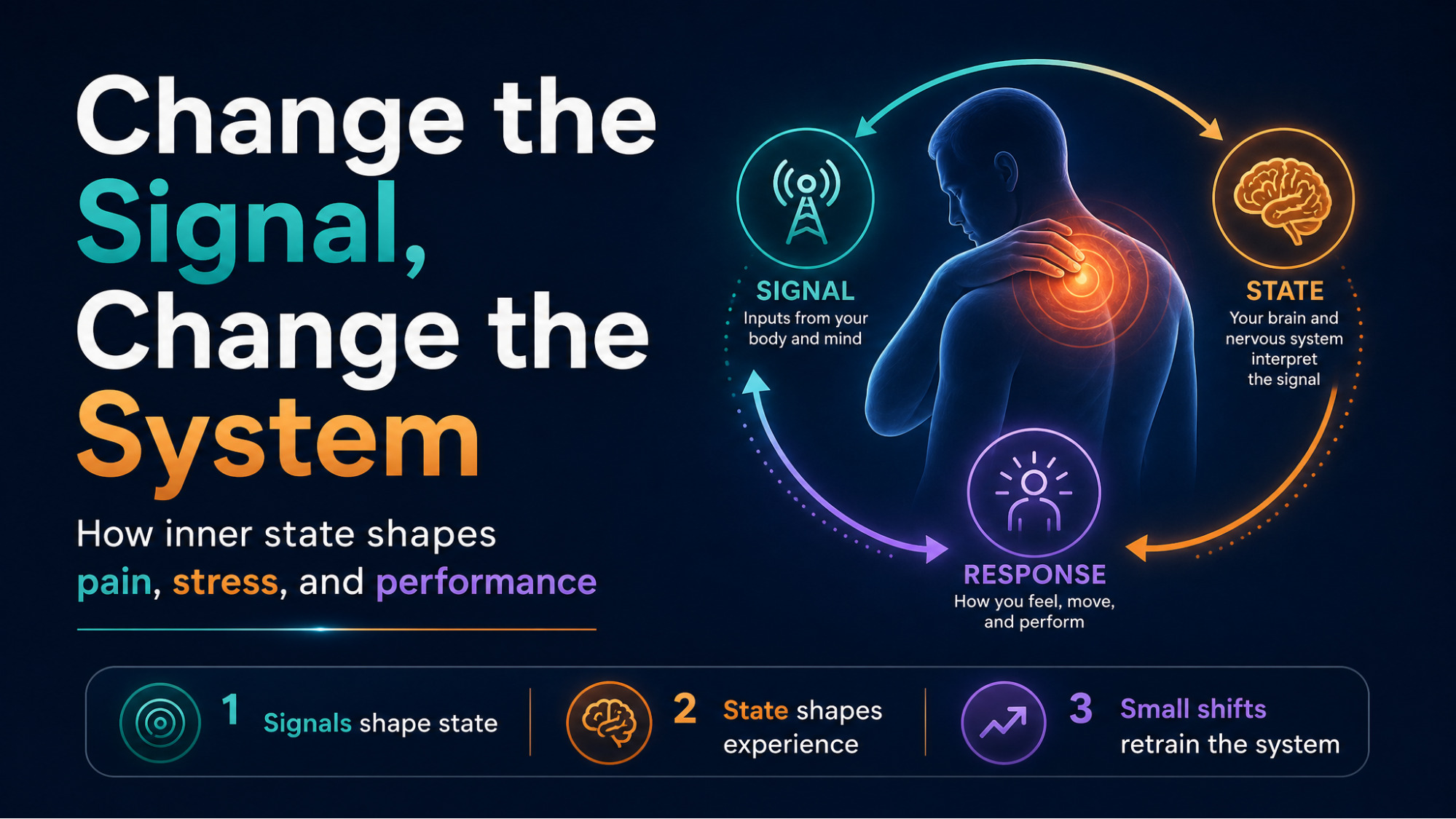
Quick read. This blog explains how the body reads internal and external signals, why stress can amplify pain and pressure, and how small repeated shifts in breath, attention, meaning, identity, and environment can help retrain the system.
Tesla is often remembered for saying that if you want to understand the universe, you should think in terms of energy, frequency, and vibration.
Whether we take that quote as inspiration, metaphor, or scientific curiosity, one idea inside it is very useful for healing and performance:
Not just words.
Not just thoughts.
Not just symptoms.
Signals.
The nervous system is constantly reading signals from inside and outside of you. It reads your breathing, posture, muscle tension, facial expression, emotional tone, internal dialogue, environment, memories, expectations, and perceived level of safety.
Then it asks a simple question:
Am I safe enough to repair, recover, focus, digest, connect, and perform?
Or:
Do I need to protect, tighten, brace, scan, defend, and survive?
This is where pain, stress, performance, and healing begin to meet.
Your Body Is Not Just a Machine
Many people still think of the body as a machine.
Something hurts, so something must be broken.
Something feels tight, so the muscle must be the problem.
Energy drops, so the body must be weak.
Pain increases, so damage must be increasing.
Sometimes that is true. Pain can come from injury, inflammation, illness, tissue damage, posture, sleep disruption, nutritional imbalance, or medical conditions. Pain should always be respected and, when needed, medically evaluated.
But pain is not only a mechanical event.
Pain is also a nervous system event.
Your body does not simply report what is happening in the tissues. It interprets what is happening through the brain, the nervous system, emotion, memory, attention, expectation, and perceived threat.
This is why the same physical sensation can feel mild on one day and unbearable on another.
Your Nervous System Is Always Listening
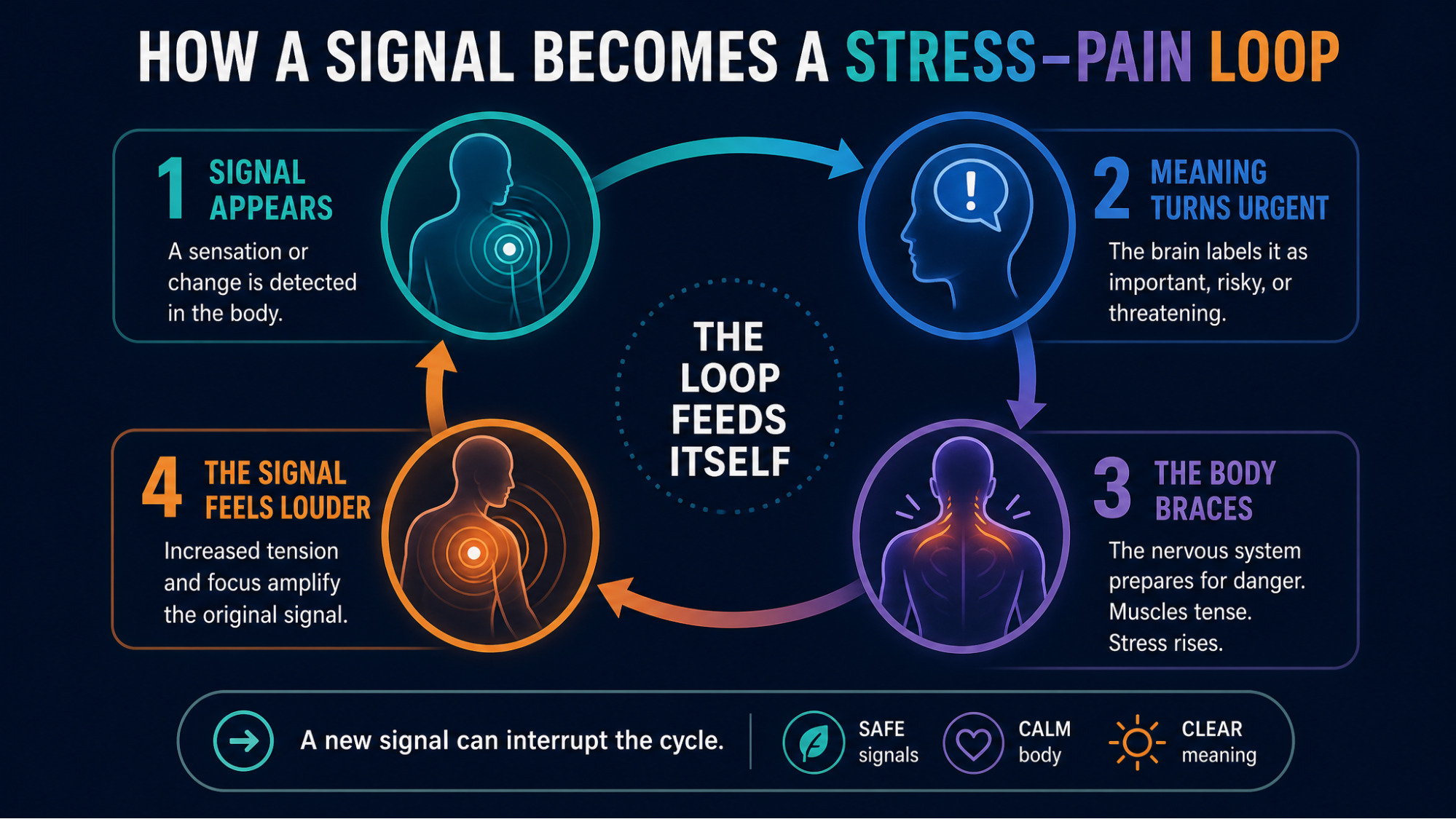
Figure: A sample-style loop graphic showing how a sensation can become a self-reinforcing stress-pain cycle.
Animation: A simple step-by-step loop highlight showing where the cycle can be interrupted.
Your nervous system listens to more than symptoms.
It listens to your stress level.
It listens to your emotional load.
It listens to your self-talk.
It listens to your sleep.
It listens to your breathing.
It listens to your sense of control.
It listens to whether life feels safe or overwhelming.
This matters because pain and stress often feed each other.
A sensation appears.
The mind quickly interprets it:
“What if this gets worse?”
“What if I cannot function?”
“What if something is wrong with me?”
“What if I lose control of my day?”
“What if this never goes away?”
That interpretation sends a signal of danger.
The nervous system becomes more alert.
Muscles tighten.
Breathing changes.
Attention narrows.
The body scans more closely.
The pain signal becomes louder.
Then the louder signal seems to prove that something is wrong.
And the loop continues.
This is not weakness. It is not imagination. It is not “all in your head.”
It is a learned protective pattern.
Frequency as a Practical Metaphor
When we speak about “frequency” in this context, we do not need to make exaggerated claims.
For your niche, the most useful meaning is this:
If your system practices urgency, it becomes easier to feel urgent.
If your system practices bracing, it becomes easier to tighten.
If your system practices fear around symptoms, it becomes easier to amplify symptoms.
If your system practices calm attention, it becomes easier to soften.
If your system practices safety, it becomes easier to recover.
In other words, the body becomes familiar with the state you repeat.
That repeated state becomes your baseline.
And your baseline influences how you think, feel, move, heal, perform, and respond under pressure.
State Comes Before Thought
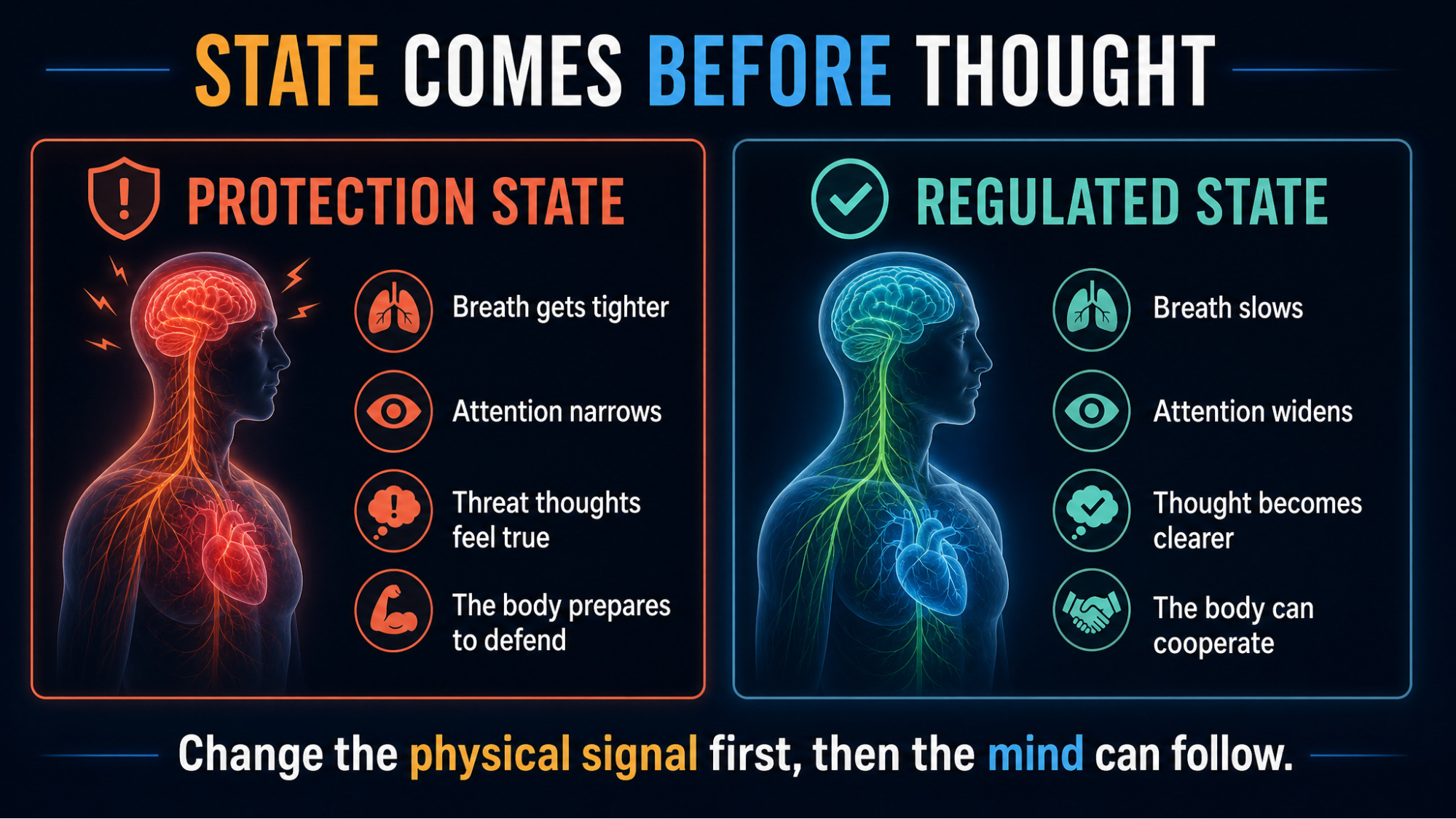
Figure: A side-by-side comparison of protection state versus regulated state.
Many people try to change their life by changing their thoughts first.
They repeat affirmations.
They visualize success.
They try to think positively.
They argue with fear.
They tell themselves to calm down.
Sometimes this helps.
But for pain, stress, and high performance, there is often a deeper starting point:
Your body state shapes your thinking.
When the nervous system is in protection mode, the mind naturally produces protective thoughts.
It thinks in warnings.
It looks for danger.
It predicts failure.
It expects pain.
It remembers past episodes.
It searches for what could go wrong.
So when someone is in a stressed body state and tries to force positive thinking, it often does not land. The words may sound good, but the body does not believe them.
That is why the first shift is often physical.
Slow the breath.
Release the jaw.
Lower the shoulders.
Unclench the hands.
Relax the eyes.
Lengthen the exhale.
Soften the belly.
Slow the pace of speech.
These small changes send a different signal.
Not a magical signal.
They tell the nervous system:
We are not in immediate danger right now.
That one message can begin to change everything.
Pain Often Responds to Safety
Pain is not only a message from the body.
Pain is also shaped by how safe the brain believes the body is.
When the nervous system senses danger, pain can become louder because pain is designed to protect you. It demands attention. It interrupts action. It forces you to notice something.
But when the system begins to sense safety, the pain signal may soften.
This does not mean every pain disappears instantly.
It means the system may stop amplifying the signal unnecessarily.
For many high performers, this is the missing piece.
They are not weak.
They are not lazy.
They are not broken.
They are not failing.
Their body has learned to stay on high alert.
And a high-alert body often creates a louder pain experience.
The High Performer Problem
High Performer Pattern Shifts
This table turns the section on pressure and performance into a practical conversion chart.
| Driven trait under pressure | What it can become | Steadier upgrade |
|---|---|---|
| Responsibility | Tension and hypervigilance | Responsibility with recovery built in |
| Focus | Fixation and symptom monitoring | Focused attention with deliberate widening breaks |
| Discipline | Self-criticism | Consistent practice with supportive language |
| Commitment | Overcontrol | Commitment plus flexibility |
| Achievement drive | Nervous-system overload | Sustainable performance with regulation |
High performers are often trained to override the body.
Push through.
Stay productive.
Keep going.
Do not complain.
Meet the deadline.
Handle the pressure.
Stay strong.
Do not slow down.
This can work for a while.
Until the body begins to interpret constant pressure as danger.
Then the same traits that created success can begin to create symptoms:
Responsibility becomes tension.
Focus becomes fixation.
Drive becomes pressure.
Discipline becomes self-criticism.
Commitment becomes overcontrol.
Achievement becomes nervous system overload.
This is when pain becomes more than pain.
It becomes a signal that the system needs a new way to operate.
You Do Not Create Change by Force
One of the most important shifts is this:
When pain appears, many people immediately go into battle:
“I hate this.”
“Why is this happening again?”
“I cannot deal with this.”
“My body is betraying me.”
“I need this gone now.”
The body hears danger.
The nervous system tightens.
The signal often grows.
A better approach is not passive acceptance. It is active regulation.
You can say:
“This is a signal.”
“My body is trying to protect me.”
“I can listen without panic.”
“I can respond instead of react.”
“I can help my system feel safer now.”
That language changes the internal environment.
And the body responds to internal environment.
Change the Signal, Change the System
Signal Shift Table
A quick reference for translating the five signal shifts into practical action.
| Signal channel | Escalates the system | Calms the system | Useful immediate practice |
|---|---|---|---|
| Breath | Short, tight, chest-led breathing | Slower breath with a longer exhale | Breathe gently through the nose and lengthen the exhale for 30-60 seconds. |
| Attention | Fixation, scanning, and threat-checking | Neutral noticing and wider awareness | Describe the sensation with simple words instead of alarm. |
| Meaning | This means I am damaged or failing | This is a signal asking for support | Reframe the sensation before reacting to it. |
| Identity | I am broken | I am learning regulation | Repeat one cooperation-based identity statement daily. |
| Environment | Urgency, clutter, conflict, and overload | Space, boundaries, rhythm, and recovery | Change one environmental stress cue today. |
If the body responds to signals, then healing begins by changing the signals you send.
This is where transformation becomes practical.
1. Change the breath signal
Breathing is one of the fastest ways to communicate with the nervous system.
A short, tight breath often signals stress.
A slower breath with a longer exhale can signal safety.
Try this:
Inhale gently through the nose.
Exhale slowly, as if you are fogging a mirror.
Let the shoulders drop slightly.
Repeat for 30 to 60 seconds.
Do not force relaxation. Just give the body a different rhythm.
2. Change the attention signal
Pain grows when attention becomes locked onto it with fear.
This does not mean ignoring pain.
It means changing the quality of attention.
Instead of staring at the sensation as a threat, describe it neutrally:
Warm.
Tight.
Heavy.
Moving.
Pulsing.
Sharp.
Dull.
Changing.
Contained.
Spreading.
Softening.
Neutral description reduces emotional amplification.
The brain begins to receive information instead of alarm.
3. Change the meaning signal
Meaning can intensify or soften suffering.
“This pain means I am broken” creates one nervous system response.
“This pain is a signal my system is asking for support” creates another.
The pain may be the same.
But the meaning changes the body’s reaction to it.
This is not pretending. It is reframing.
And reframing is powerful because the nervous system responds not only to sensation, but to interpretation.
4. Change the identity signal
One of the deepest signals is identity.
If someone starts to believe, “I am a person with a broken body,” the nervous system may organize around protection, limitation, and fear.
A more useful identity might be:
“I am learning how to work with my body.”
“I am becoming someone who can regulate my system.”
“I am no longer only reacting to pain.”
“I am training my body and mind to return to safety.”
“I am building pain-free performance one signal at a time.”
Identity creates consistency.
Consistency teaches the nervous system.
5. Change the environment signal
Your environment also speaks to your nervous system.
Noise, pressure, clutter, conflict, screens, isolation, overwork, poor sleep, and constant urgency all send signals.
Supportive environments send different signals:
Clean space.
Clear schedule blocks.
Warm relationships.
Time outdoors.
Nourishing food.
Gentle movement.
Quiet recovery windows.
Boundaries around work.
Your system synchronizes with what surrounds it.
This is why healing is not only internal. It is also environmental.
The Body Changes Faster Through Experience
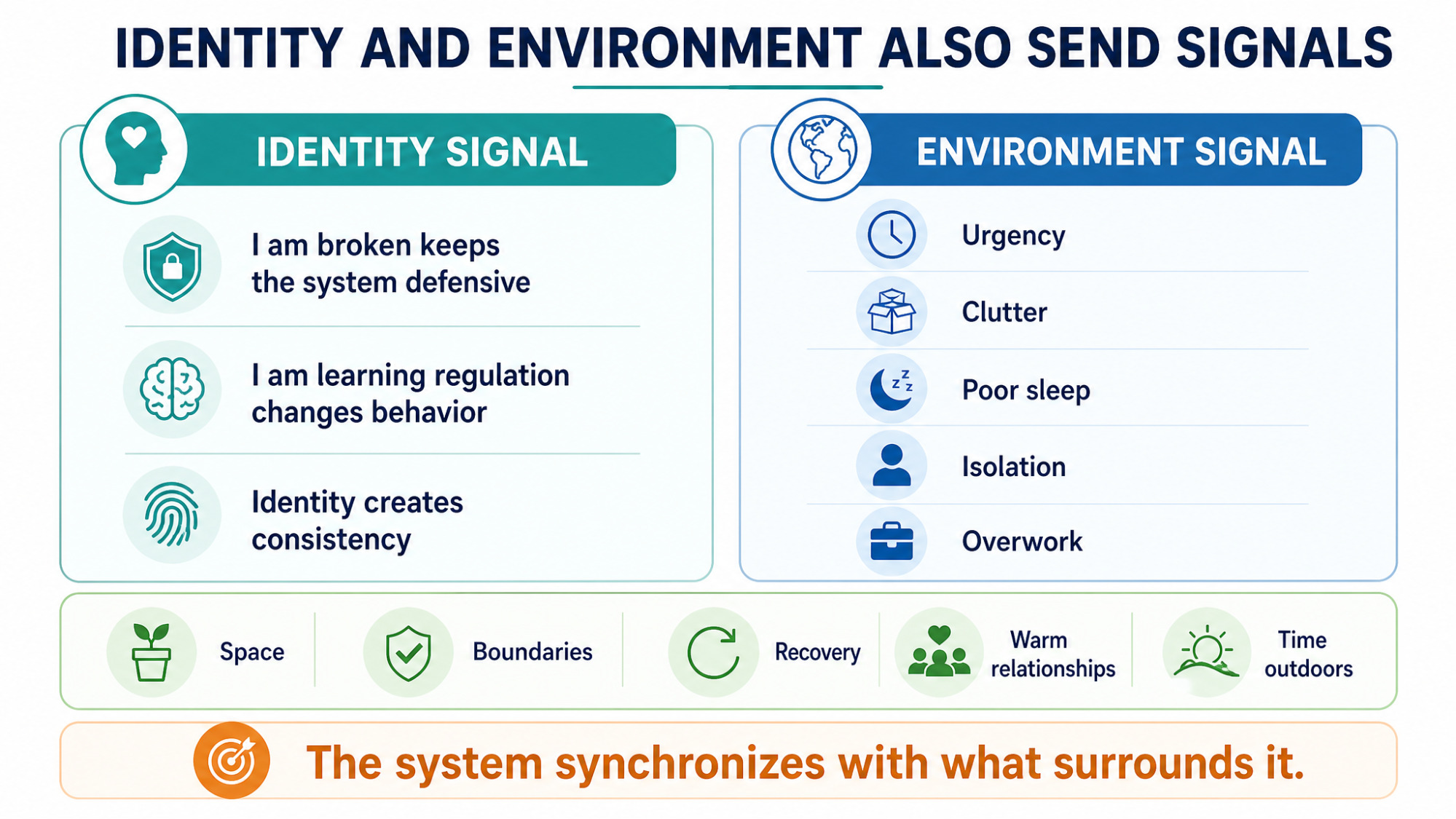
Figure: Identity and environment both shape the baseline signals a body keeps receiving.
The nervous system does not change only because you understand something.
It changes when you experience something repeatedly.
That is why insight is not enough.
You may understand that stress amplifies pain, but still tighten when the signal appears.
You may know that fear increases sensitivity, but still panic when the body feels different.
You may believe in healing, but still brace when life becomes demanding.
This is normal.
The nervous system needs repetition.
Small practices repeated often are usually more effective than one long practice done occasionally.
A one-minute reset used five times per day may teach the body more than one 30-minute practice done once a week.
Because the goal is not only relaxation.
A Simple Daily Signal Reset
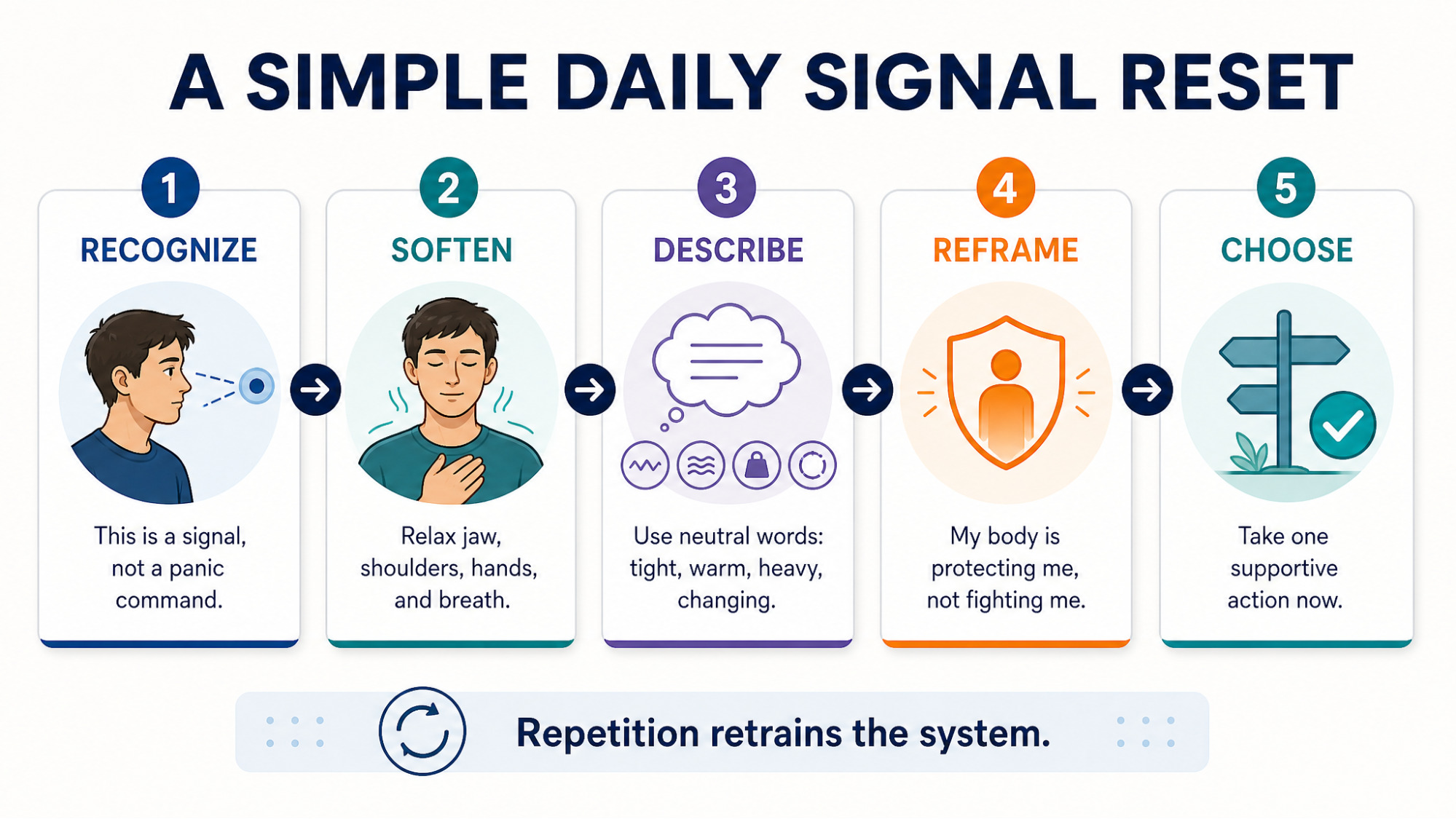
Figure: A five-step daily reset sequence for shifting the signal in real time.
Here is a short practice you can use when pain, stress, or tension appears.
Step 1: Recognize the signal
Say internally:
“This is a signal. My body is asking for attention, not panic.”
Step 2: Soften the body
Relax your jaw.
Drop your shoulders.
Unclench your hands.
Let your exhale become slightly longer.
Step 3: Describe the sensation
Use neutral language:
“It feels tight.”
“It feels warm.”
“It feels pulsing.”
“It feels heavy.”
“It is located here.”
“It is changing.”
Step 4: Reframe the meaning
Say:
“My body is not my enemy. My system is trying to protect me. I can help it feel safer.”
Step 5: Return to choice
Ask:
“What is one small supportive action I can take now?”
Maybe you stretch.
Maybe you drink water.
Maybe you step away from the screen.
Maybe you breathe for one minute.
Maybe you walk slowly.
Maybe you use a nervous system regulation tool.
The key is simple:
Do not collapse into the old loop.
This Is Not Mystical. It Is Pattern Training.
You do not need to believe that your thoughts magically create everything.
You do not need to believe that pain is imaginary.
You do not need to believe that biology is controlled by mindset alone.
The grounded truth is enough:
Your nervous system is adaptive.
Your brain is plastic.
Your body responds to perceived safety and threat.
Attention changes experience.
Breathing changes physiology.
Emotion changes muscle tone.
Meaning changes stress response.
Repetition changes patterns.
Identity changes behavior.
The New Definition of Healing
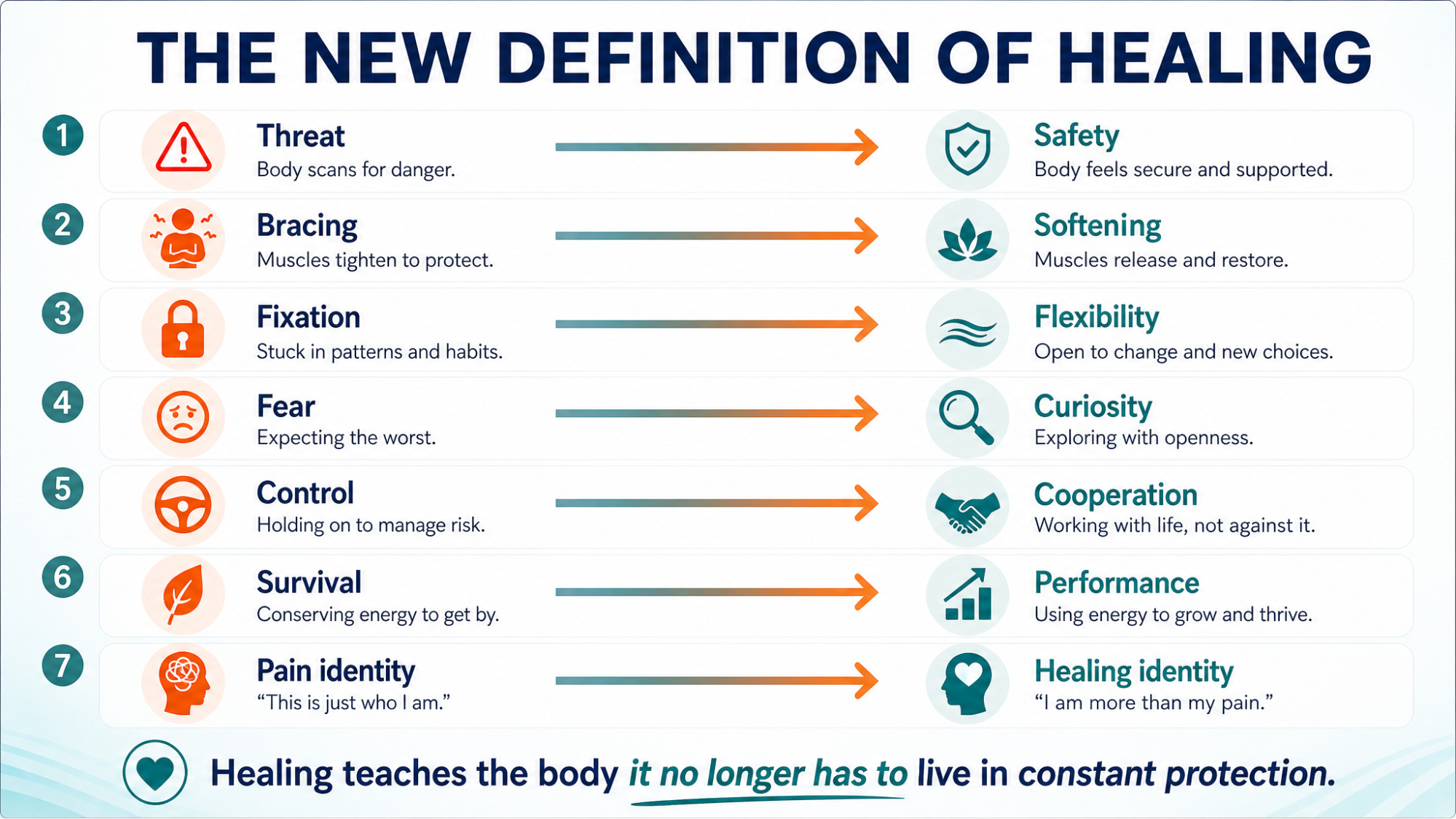
Figure: Healing is presented as a movement from protection toward safety, flexibility, and performance.
Healing is teaching the body that it no longer has to live in constant protection.
It is helping the nervous system move from:
Threat to safety.
Bracing to softening.
Fixation to flexibility.
Fear to curiosity.
Control to cooperation.
Survival to performance.
Pain identity to healing identity.
This is why the work is not just physical.
And it is not just mental.
It is body, mind, emotion, nervous system, subconscious pattern, and identity working together.
Final Thought
It listens to the way you breathe.
It listens to the words you repeat.
It listens to the meaning you give symptoms.
It listens to how safe you feel in your own life.
It listens to whether you fight it or support it.
So the question is not only:
“How do I get rid of this pain?”
A better question is:
“What signal is my system receiving, and what signal can I send now?”
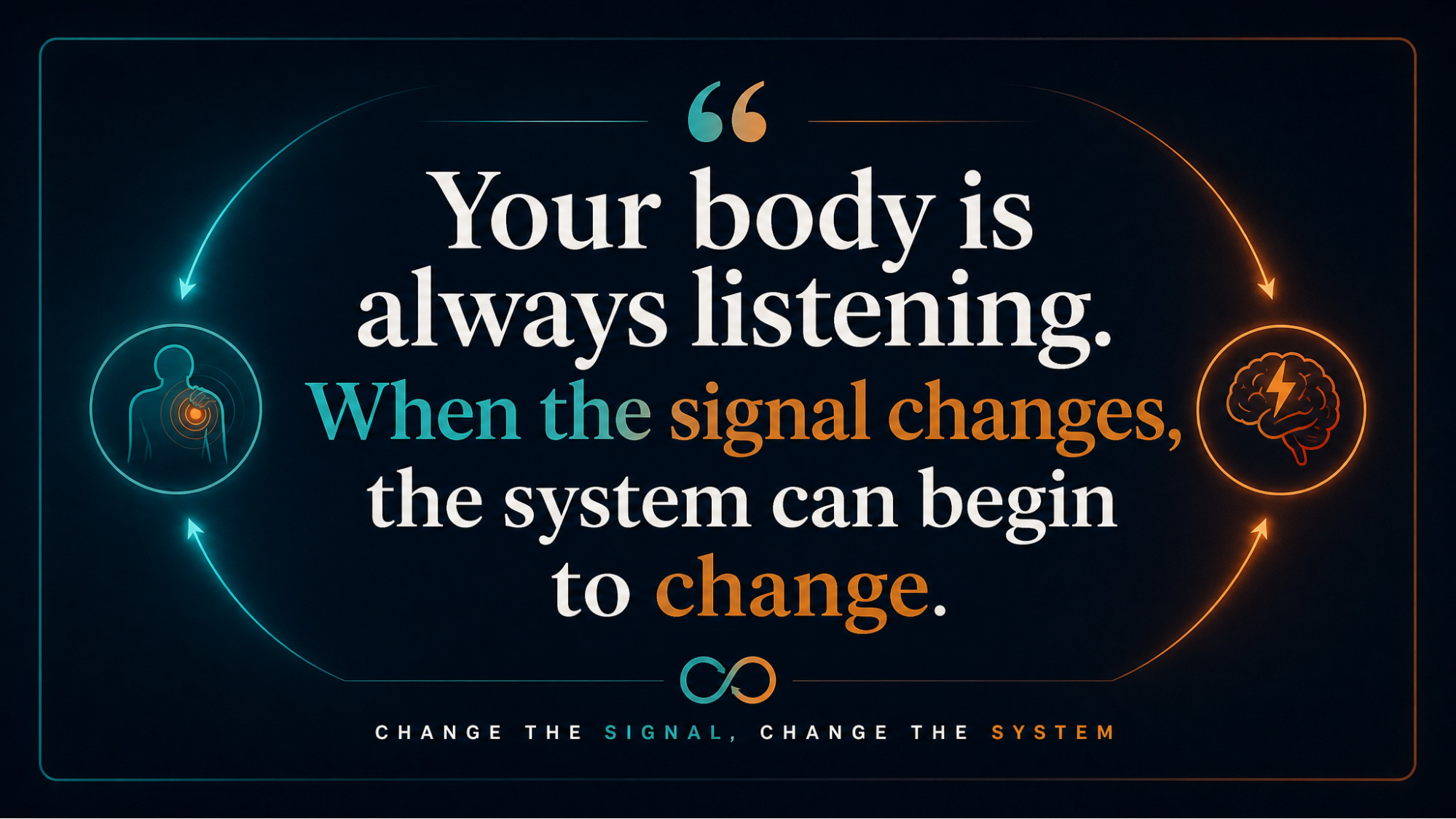
Because when the signal changes, the system can begin to change.
And when the system changes, pain, stress, and performance can begin to reorganize around a new possibility.
If your system has been practicing urgency for a long time, which single signal would most change your day right now: breath, attention, meaning, identity, or environment?
This article is for educational purposes only and is not a substitute for medical advice. If you have persistent, worsening or severe pain, or symptoms that concern you, please speak with a qualified healthcare professional.

Rami Bareket
Rami Bareket is an NLP Master Trainer and hypnotherapist with over 30 years of entrepreneurial experience and 20 years as a combat medic. Through NLP, hypnosis, and integrative transformation work, he helps high performers create fast and lasting change from the inside out.
Read Full Bio