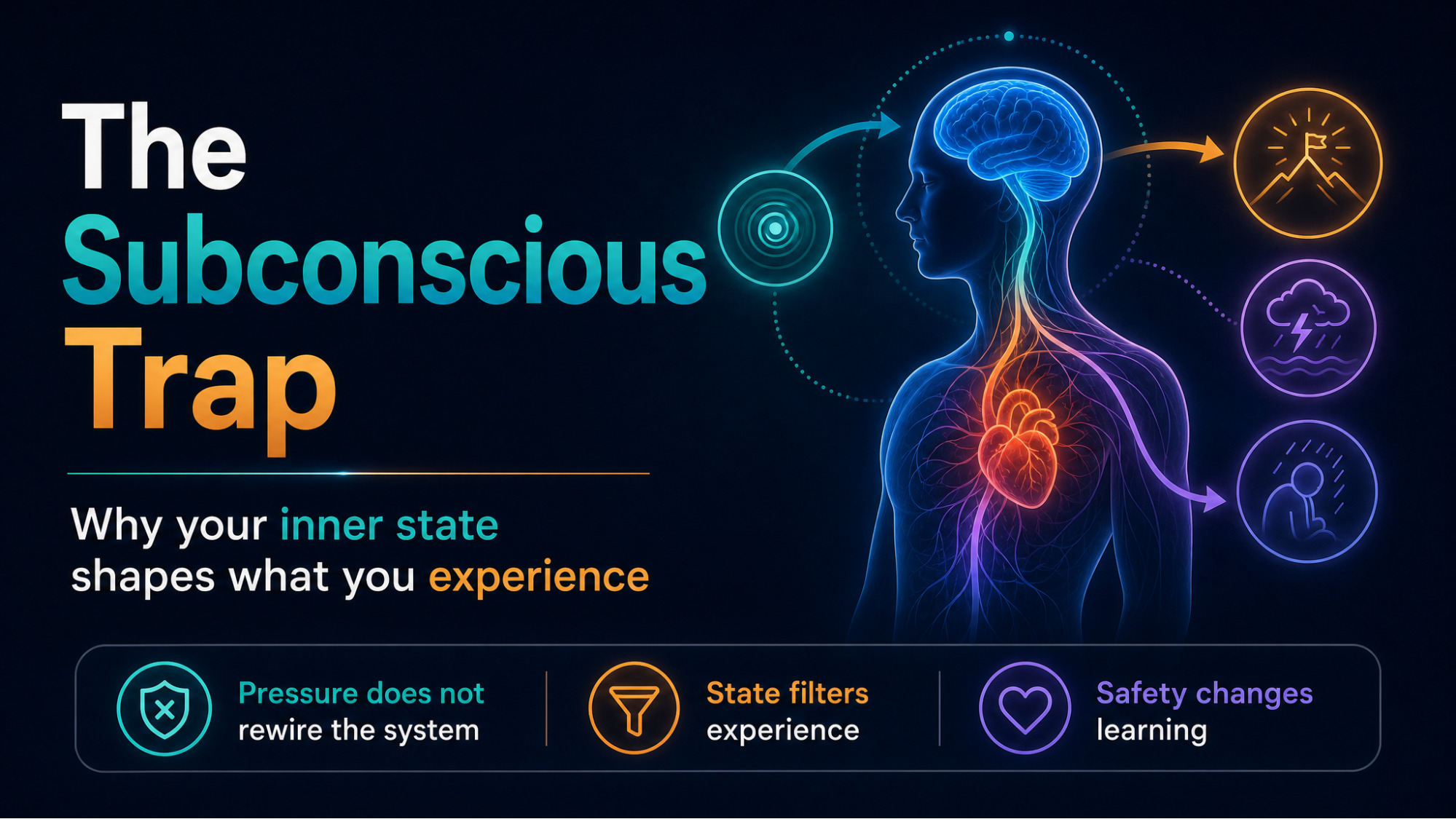
There is a trap many high performers fall into.
Not because they are weak.
Not because they lack discipline.
Not because they do not know enough.
The trap is believing that life changes only when you think harder, push harder, perform harder, and force yourself into a better future.
But the nervous system does not change through pressure alone.
The subconscious mind does not reorganize because you explain something logically.
And the body does not release old patterns just because you decide you are done with them.
It begins in the place where your thoughts, emotions, body, beliefs, and identity meet.
This is why so many people know what they want, but still repeat the same patterns.
They want calm, but their body is trained for pressure.
They want success, but their subconscious is still protecting them from visibility.
They want freedom, but their nervous system still recognizes stress, pain, and struggle as familiar.
This is the real trap.
Not lack of information.
Not lack of motivation.
But an inner system that keeps recreating what feels familiar, even when familiar is painful.
Meet Walter Russell
Walter Russell was an artist, sculptor, writer, musician, and self-taught thinker.
He believed that creativity, science, consciousness, and human potential came from the same deeper source.
Whether someone views his work as mystical, symbolic, philosophical, or visionary, the important point for our purpose is not to treat his ideas as medical science.
The important point is this:
He spoke about reality as something shaped by consciousness, rhythm, light, energy, and perception.
And while we do not need to accept every claim literally, the metaphor is powerful for personal transformation.
Because in healing, performance, pain relief, and subconscious reprogramming, one principle appears again and again:
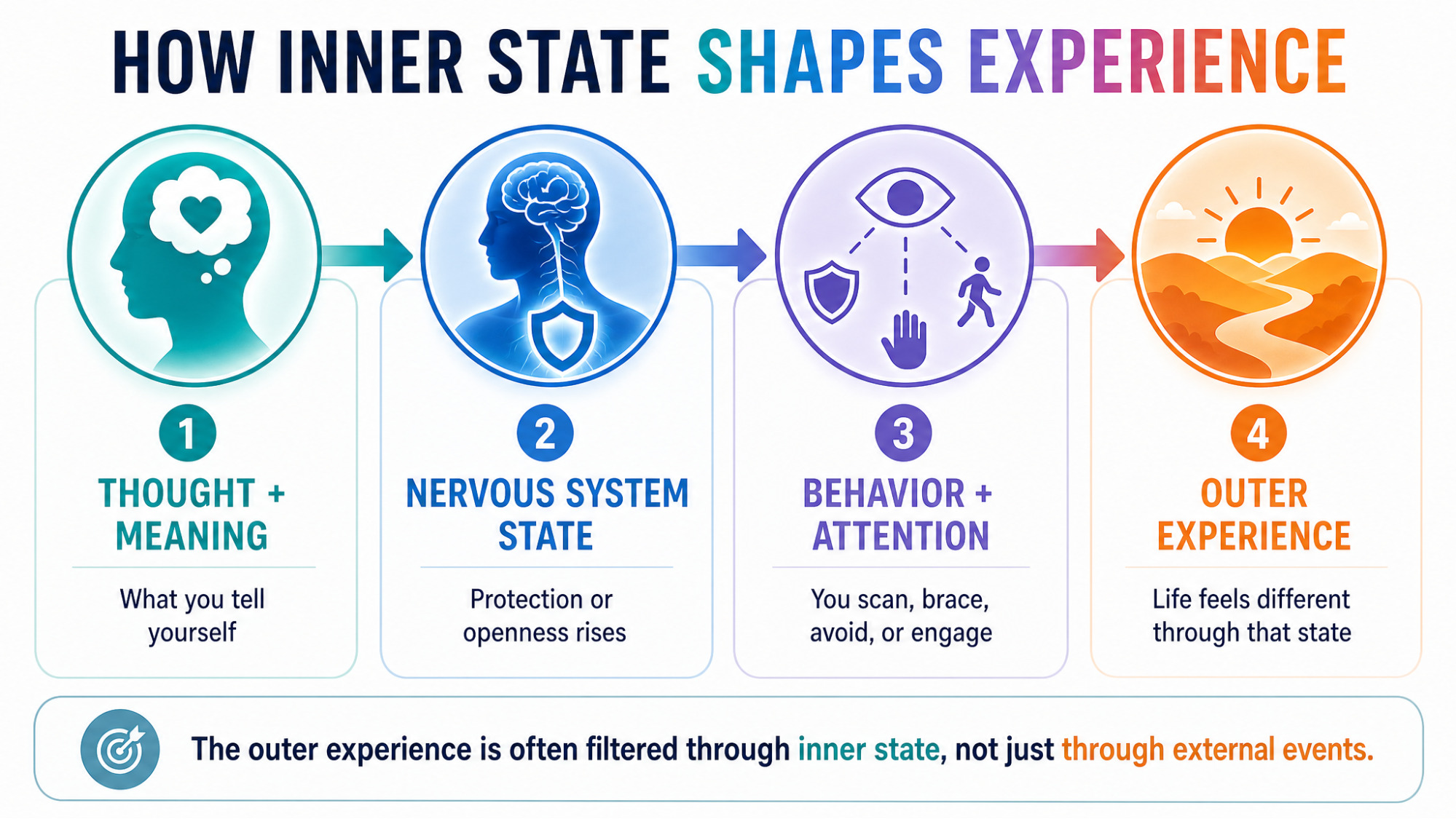
Your inner state shapes how you experience your outer world.
Not magically.
Not instantly.
Not by denying reality.
But through perception, attention, physiology, emotional patterning, and repeated identity signals.
The Deeper Idea: Existence Begins Inside Perception
One of the core ideas in Russell's philosophy was that reality is not only physical.
He suggested that what we call matter, life, health, and experience are shaped by deeper organizing patterns.
In the PainShift Paradigm, we can translate this into something very practical:
Your body does not simply respond to what happens.
Your body responds to what your nervous system believes is happening.
That distinction matters.
Two people can face the same deadline.
One feels focused.
The other feels threatened.
Two people can receive the same feedback.
One hears useful information.
The other hears rejection.
Two people can experience the same physical sensation.
One notices it and moves on.
The other becomes afraid, monitors it, tightens around it, and starts a pain-stress loop.
The external event may be similar.
But the inner interpretation changes everything.
Discovery 1: Existence Is Thought
Russell suggested that matter is not the deepest foundation.
For your niche, the useful translation is this:
Your lived reality is deeply shaped by thought, interpretation, and meaning.
This does not mean pain is imaginary.
But the meaning your mind gives to the signal can change how loudly your nervous system responds.
A tight shoulder can become:
"This is dangerous."
Or:
"My system is asking for regulation."
A racing heart can become:
"Something is wrong with me."
Or:
"My body is mobilizing energy."
A flare-up can become:
"I am back to zero."
Or:
"My nervous system needs support today."
The signal matters.
But the story around the signal matters too.
And sometimes the story creates more suffering than the sensation itself.
Discovery 2: Energy Is Rhythm
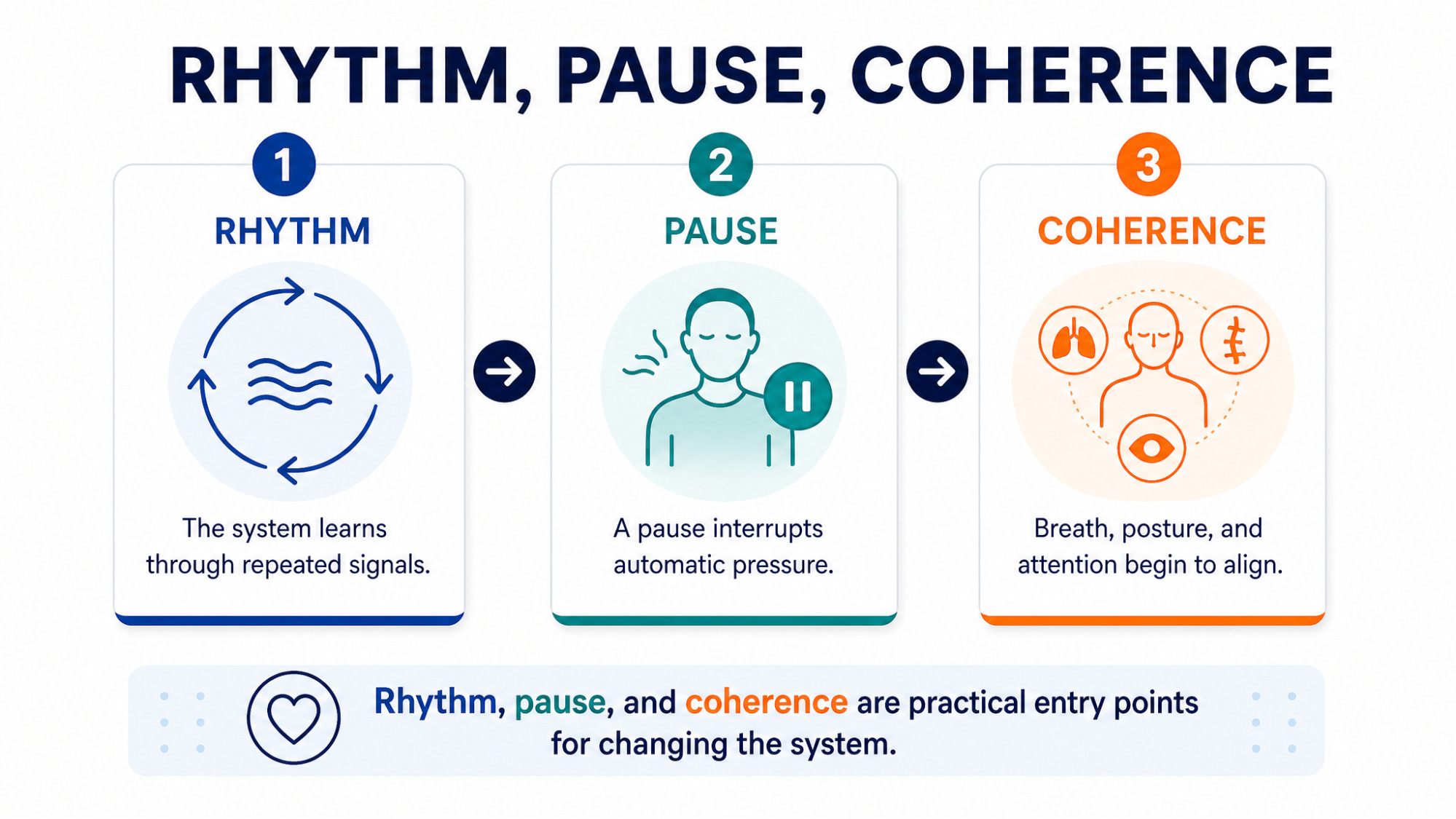
Nothing in the body is static.
Breath has rhythm.
Heart rate has rhythm.
Sleep has rhythm.
Digestion has rhythm.
Hormones have rhythm.
Pain signals have rhythm.
Emotions have rhythm.
Even performance has rhythm.
High performers often forget this.
They try to live like machines.
They push through fatigue.
They ignore early signs.
They override hunger.
They delay rest.
They treat recovery like a reward instead of a requirement.
But the body is not designed to stay in constant output.
It is designed to move between activation and recovery.
Effort and restoration.
Focus and release.
Challenge and safety.
When that rhythm breaks, symptoms often rise.
You may feel more tension.
More pain.
More emotional reactivity.
More brain fog.
More sensitivity.
Not because your body is broken.
Because your system has lost rhythm.
Healing often begins by restoring rhythm.
Not by forcing the body.
By teaching it safety again.
Discovery 4: Light Creates Form
Russell spoke of light forming matter.
In our work, we can use this as a metaphor:
Attention gives form to experience.
What you focus on becomes more defined in your nervous system.
If you keep scanning for pain, the pain map becomes sharper.
If you keep rehearsing danger, the threat response becomes stronger.
If you keep repeating "I cannot handle this," your body begins to organize around helplessness.
But if you bring attention to safety, breath, posture, support, choice, and possibility, the system begins to receive a different message.
This does not mean ignoring pain.
It means changing the relationship to pain.
There is a big difference between awareness and obsession.
Awareness says:
"I notice this signal."
Obsession says:
"What if this never ends?"
Awareness creates space.
Obsession creates pressure.
And pressure often amplifies the signal.
Discovery 5: Electricity Is Life
The body is electrical.
The nervous system communicates through electrical and chemical signals.
Muscles contract through electrical activity.
The heart has electrical rhythm.
The brain operates through neural signaling.
This is why your state matters so much.
When your nervous system is in threat mode, everything changes.
Breathing becomes shallow.
Muscles tighten.
Attention narrows.
Digestion slows.
Pain sensitivity may increase.
Emotions become more reactive.
The mind starts searching for problems.
Your body is trying to protect you.
But protection can become overprotection.
And overprotection can become the loop.
This is why the goal is not to fight the nervous system.
The goal is to retrain it.
To show the body:
"We are safe enough right now."
"We can soften."
"We can respond instead of react."
"We can move from survival back into choice."
Discovery 6: Space Is Not Empty
Russell described space as potential.
In transformation work, this becomes a powerful idea:
The pause is not empty.
The pause is where change becomes possible.
Most people lose the moment of change because they react too quickly.
Trigger.
Reaction.
Tension.
Story.
Emotion.
More tension.
More signal.
More stress.
But when you create a pause, even a small one, the loop begins to loosen.
A pause gives the nervous system new information.
A pause gives the subconscious a new pattern.
A pause says:
“I do not have to repeat the old response automatically.”
This is where PainShift begins.
Discovery 7: Health Is Rhythm
This may be the most important idea for your niche.
Disease, stress, pain, and emotional dysregulation often involve disrupted rhythm.
Not always as the only cause.
But often as part of the pattern.
Sleep rhythm changes.
Breathing rhythm changes.
Muscle rhythm changes.
Stress hormone rhythm changes.
Attention rhythm changes.
Movement rhythm changes.
Emotional rhythm changes.
The person becomes stuck in activation.
Or stuck in collapse.
Or stuck between pushing and crashing.
This is why healing is not only about removing symptoms.
It is about restoring coherence.
Coherence means the system starts working together again.
The breath supports the body.
The body supports the mind.
The mind stops threatening the body.
The emotions become signals instead of storms.
The identity begins to shift from:
“I am trapped in this.”
To:
“I am learning how to influence my system.”
That shift matters.
Because once a person feels they can influence their state, they are no longer powerless inside the experience.
Discovery 8: Time Is a Spiral
Many people think healing should be linear.
Day one: pain.
Day two: less pain.
Day three: even less pain.
Day four: breakthrough.
But real healing rarely moves like that.
Healing often moves in spirals.
You revisit old patterns from a new level.
You meet the same trigger with more awareness.
You feel the old fear, but recover faster.
You notice the old pain, but do not collapse as deeply.
You experience a flare-up, but no longer treat it as failure.
This is important.
Because high performers often judge themselves harshly when progress is not linear.
They think:
"I should be past this."
"I already worked on this."
"Why is this coming back?"
But sometimes the pattern returns so you can meet it differently.
Not as the old identity.
As the new one.
That is how the nervous system learns.
Through repetition.
Through safety.
Through new responses practiced enough times to become familiar.
Discovery 9: Consciousness Creates Reality
This idea can become too mystical if we are not careful.
So let us make it practical.
Your thoughts do not magically control everything.
But your thoughts influence your attention.
Your attention influences your nervous system.
Your nervous system influences your behavior.
Your behavior influences your choices.
Your choices influence your outcomes.
Your outcomes reinforce your identity.
So yes, your inner world does shape your outer experience.
Not because every thought instantly becomes reality.
But because repeated inner patterns become the lens through which you interpret life.
And the lens changes what you notice, avoid, pursue, tolerate, and believe is possible.
A person who constantly thinks, "I am stuck," will unconsciously search for proof of walls.
A person who practices, "I am in process," begins to search for doors.
Same life.
Different filter.
Different state.
Different choices.
Different results.
What This Says About You
This is not really about Walter Russell.
It is not about proving every idea he taught.
It is about what his framework helps us see.
You are not only a thinking mind.
You are a nervous system.
You are a body.
You are a subconscious pattern.
You are an emotional field.
You are an identity in motion.
And when these parts are not aligned, life feels harder than it needs to feel.
You may want success, but your body feels unsafe being seen.
You may want healing, but your subconscious is still loyal to protection.
You may want peace, but your nervous system is addicted to urgency.
You may want freedom, but your identity is still organized around survival.
This is why change requires more than positive thinking.
It requires state change.
It requires emotional safety.
It requires repetition.
It requires body-based regulation.
It requires identity-level reprogramming.
The Subconscious Key
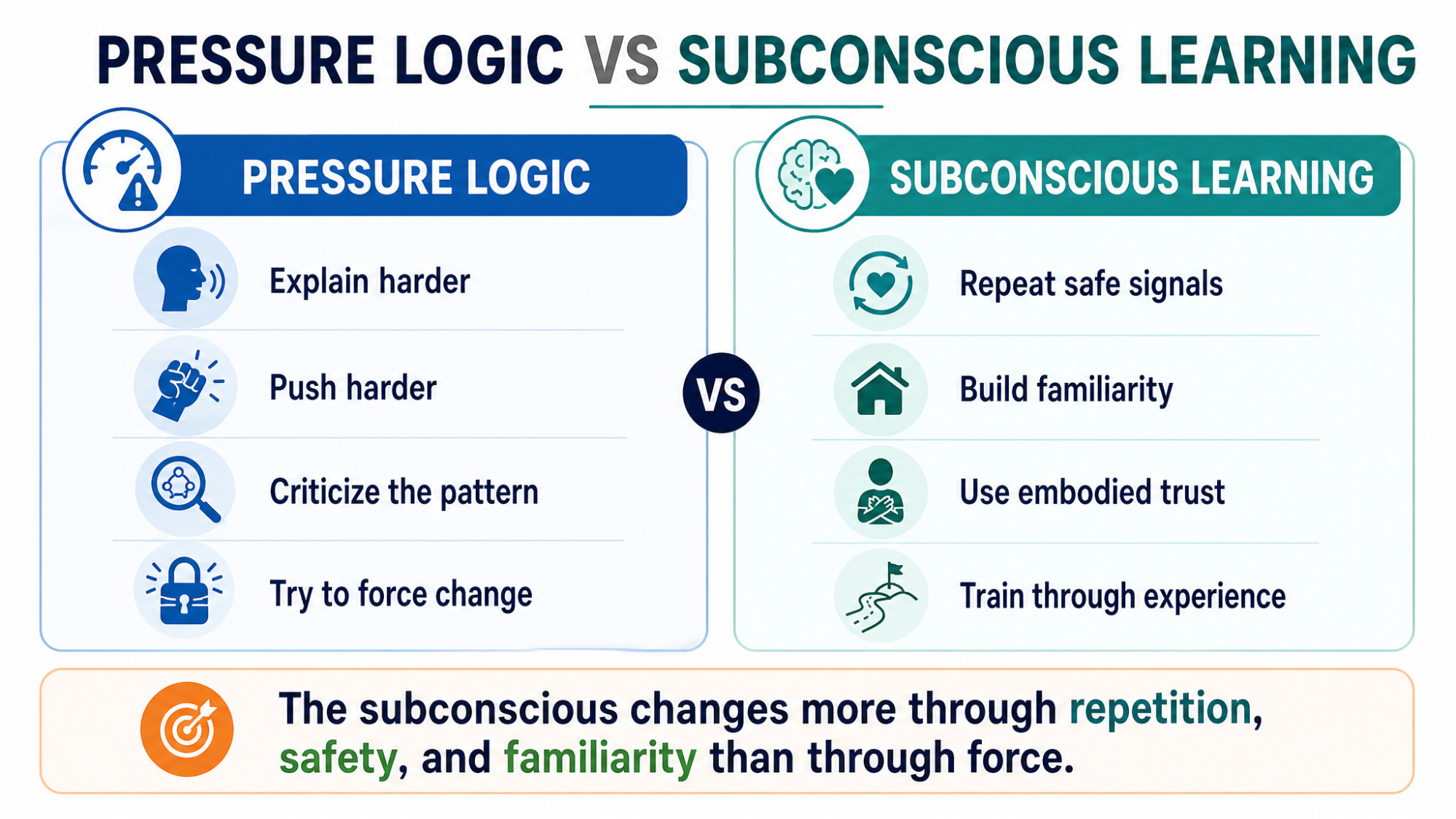
The subconscious mind does not respond well to pressure.
It does not change because you criticize yourself.
It does not open because you shame yourself.
It does not release a pattern simply because you logically understand it.
The subconscious responds to:
Repetition.
Emotional safety.
Identity signals.
Familiarity.
Embodied experience.
This is why a person can say, "I know this is irrational," and still feel it in the body.
Because the subconscious does not ask:
“Is this logical?”
It asks:
"Is this familiar?"
"Is this safe?"
"Does this protect me?"
"Who do I believe I am in this situation?"
That is why real transformation happens when a new response becomes familiar enough for the body to trust it.
Why Pain and Stress Become Familiar
For many high performers, stress becomes the default state.
Urgency feels normal.
Tension feels normal.
Overthinking feels normal.
Pressure feels normal.
Even pain can become connected to identity:
"I am the person who pushes through."
"I cannot slow down."
"My body always gets in the way."
"I have to perform no matter how I feel."
Over time, the nervous system learns that this is the baseline.
So when peace appears, it may feel unfamiliar.
When rest appears, it may feel uncomfortable.
When ease appears, the mind may search for a problem.
This is not because peace is wrong.
It is because the system has not yet learned to recognize peace as safe.
That is the work.
To make regulation familiar.
To make calm productive.
To make ease trustworthy.
To make recovery part of performance.
Imagination Is Not Fantasy
Imagination becomes powerful when it is embodied.
Not just seeing a goal.
Feeling the state.
Not just visualizing success.
Practicing the nervous system of the person who can receive success.
Not just saying affirmations.
Speaking to yourself in a way your body believes.
This is where many people miss it.
They imagine the outcome, but their body remains in threat.
They visualize success, but their posture says fear.
They repeat affirmations, but their tone says doubt.
The subconscious listens to the whole message.
Words.
Breath.
Muscle tone.
Emotion.
Posture.
Identity.
That is why coherence matters.
When your words say one thing and your body says another, the subconscious believes the body.
A Simple PainShift Practice
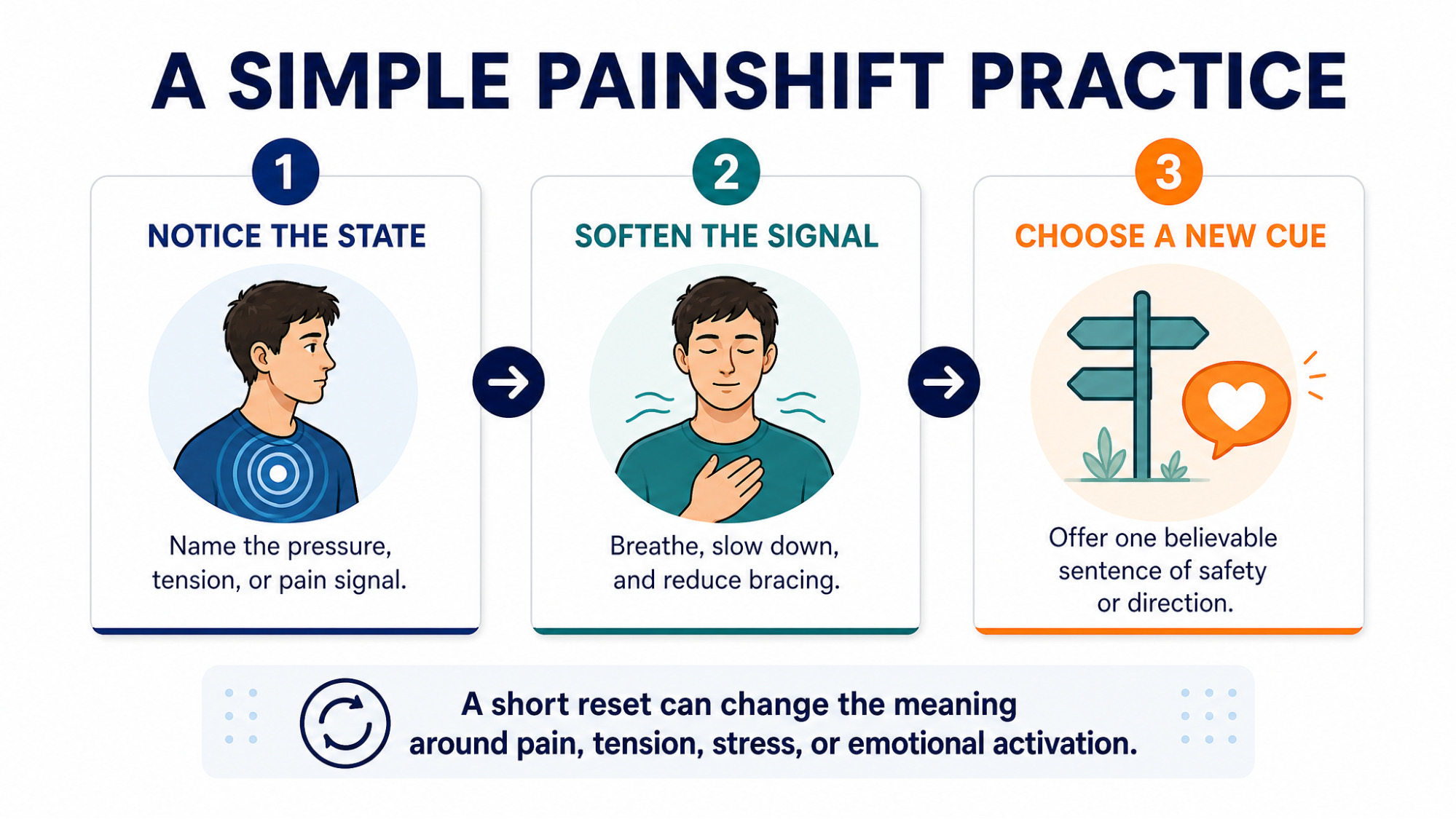
Here is a practical way to use this.
When you notice pain, tension, stress, or emotional activation, pause.
Do not rush to fight it.
Do not immediately interpret it as a problem.
Place one hand somewhere grounding, such as your chest, belly, or thigh.
Exhale slowly.
Let your shoulders drop slightly.
Then say:
“This is a signal, not a sentence.”
Pause again.
Then ask:
“What does my system need right now?”
Maybe it needs breath.
Maybe it needs movement.
Maybe it needs hydration.
Maybe it needs support.
Maybe it needs boundaries.
Maybe it needs rest.
Maybe it needs a new meaning.
Then choose one small action.
Not a perfect action.
A regulating action.
That is how the old loop begins to change.
The Real Transformation
The goal is not to become someone who never feels stress.
The goal is to become someone who can return.
Return to breath.
Return to choice.
Return to clarity.
Return to presence.
Return to the body without fear.
Return to performance without pressure.
Return to healing without forcing.
The old model says:
“Control everything.”
The new model says:
“Regulate the system.”
The old model says:
“Push harder.”
The new model says:
“Create coherence.”
The old model says:
“Fix yourself.”
The new model says:
“Retrain what your system has learned.”
That is a very different kind of healing.
Final Thought
Your imagination is not just a picture.
It is a state.
Your beliefs are not just ideas.
They are signals.
Your body is not just carrying symptoms.
It is carrying patterns.
Your reality is not only what happens to you.
It is also what your nervous system has learned to expect, protect, repeat, and perceive.
So the question is not only:
“What do I want?”
The deeper question is:
“What has become normal inside me?”
Because once calm becomes normal, the body responds differently.
Once safety becomes normal, the mind opens differently.
Once possibility becomes normal, choices expand.
Once a new identity becomes normal, the outer world begins to meet a different version of you.
Not by escaping the body.
By teaching the body that the future can be safer than the past.
What has become normal inside you that may be shaping your experience more than you realize: urgency, overthinking, tension, fear of visibility, or the belief that peace is unsafe?
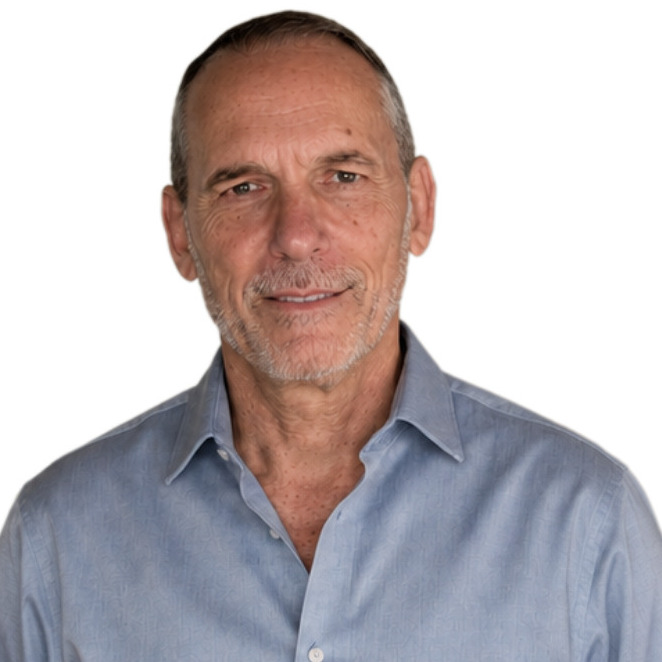
Rami Bareket
Rami Bareket is an NLP Master Trainer and hypnotherapist with over 30 years of entrepreneurial experience and 20 years as a combat medic. Through NLP, hypnosis, and integrative transformation work, he helps high performers create fast and lasting change from the inside out.
Read Full Bio