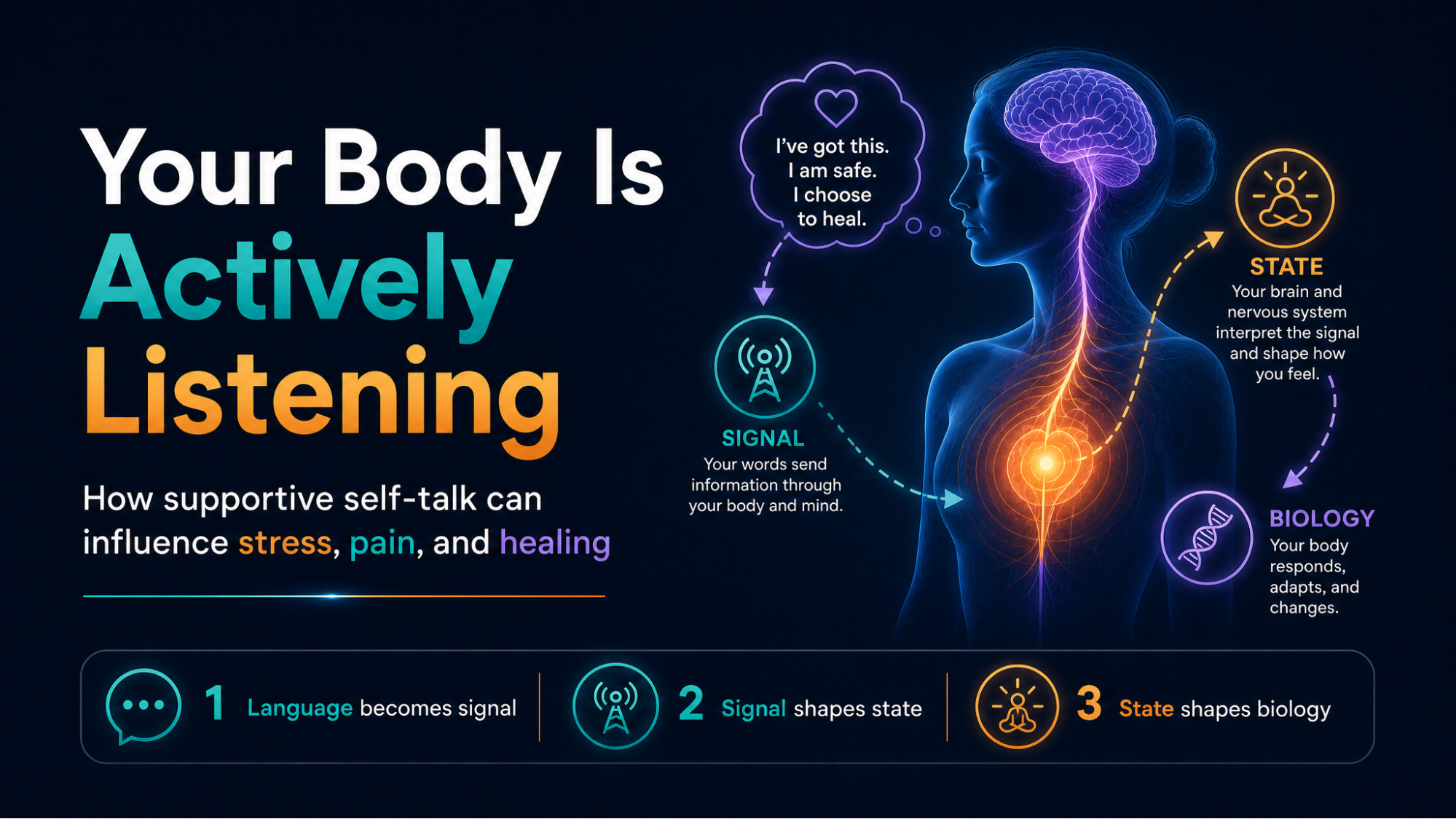
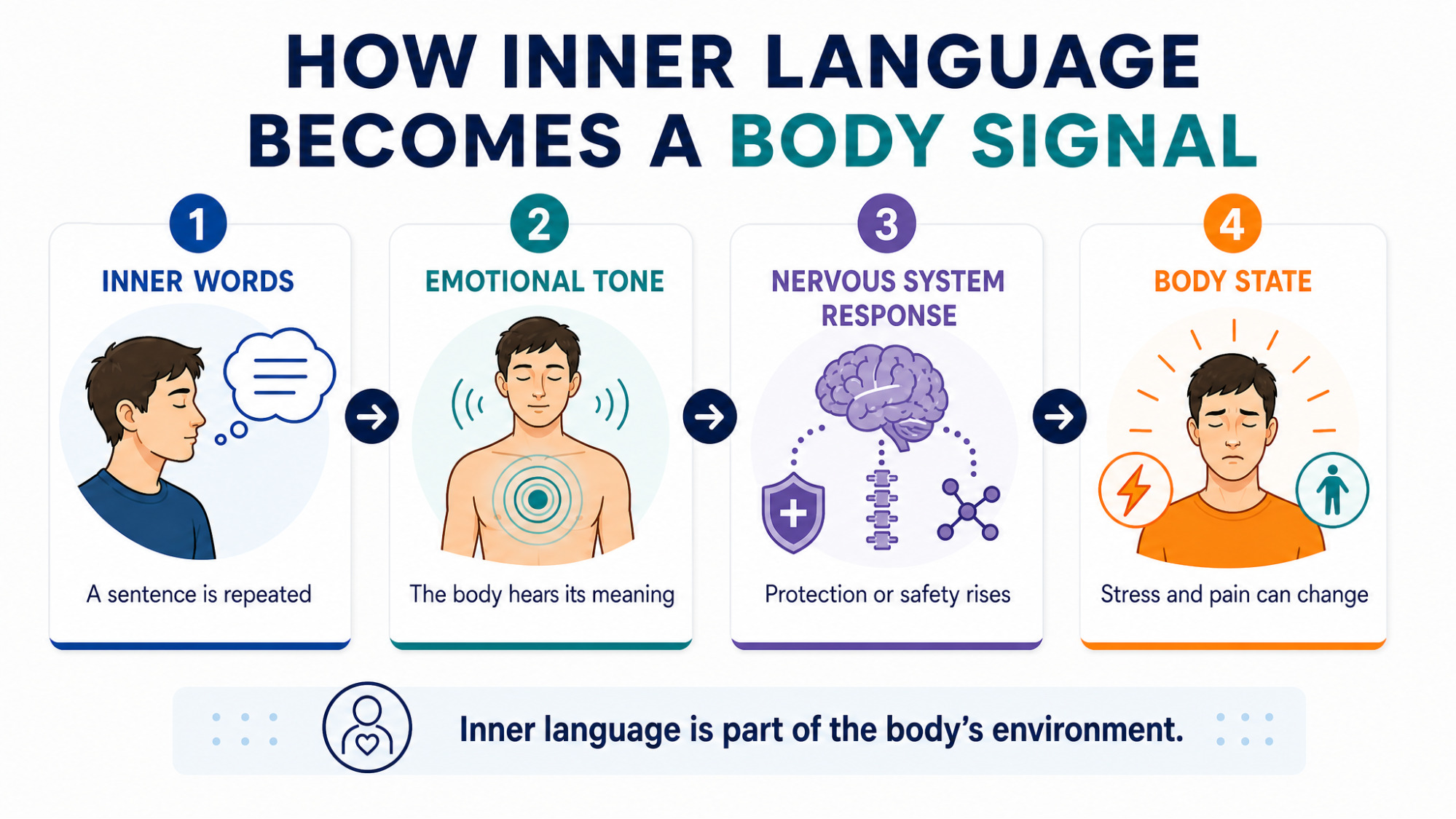
Figure: Inner language can act as a nervous-system signal, shaping meaning, state, and repeated body responses.
What if the way you speak to your body is not only emotional?
What if it is biological?
This is not a metaphor. The internal language you use, the words, tone, and meaning you direct at yourself, influences your nervous system state, your stress response, and how your body processes physical sensation.
Your body is not a passive recipient of what you decide to do. It is actively listening. To your thoughts. To your tone. To the meaning you assign to what you feel.
And it responds accordingly.
The Body Does Not Know the Difference Between a Threat and a Thought
The nervous system is designed to respond to threat. When it detects danger, real or perceived, it shifts into protection mode. Breathing changes. Muscle tone rises. The stress hormones are released.
But here is what many people do not realize: the nervous system responds to the internal environment in the same way it responds to the external one.
A thought that generates fear activates the same protective response as a physical threat. A belief that your body is failing you sends the same signal of danger to the nervous system as if something genuinely threatening were happening.
The body listens.
And it responds to what it hears.
What Your Inner Voice Is Saying Right Now
Most people have a continuous internal conversation happening throughout the day. Most of it goes unnoticed.
For many people dealing with stress, pain, or persistent patterns of physical tension, that inner voice sounds something like:
"Why is this happening again?"
"I cannot take any more of this."
"My body always does this."
"Something is wrong with me."
"I am falling apart."
"I will never feel better."
Every one of those statements sends a signal to the nervous system. Not just a thought signal. A biological signal. Stress hormones. Muscle tension. Narrowed attention. Reduced capacity to regulate.
The inner voice is not separate from the body. It is communicating with the body, continuously, whether you are aware of it or not.
Supportive Self-Talk Is Not Positive Thinking
This is not about telling yourself everything is fine when it is not. Forced positivity does not work and often makes things worse, because the subconscious can detect the disconnection between what is being said and what is actually felt.
Supportive self-talk means something different. It means speaking to the nervous system in a way that is honest, grounded, and genuinely calming.
"This is difficult right now. I can be with this."
"My body is responding. That is not the same as my body failing."
"I do not need to fix everything immediately. I can take one breath."
"I have moved through difficult things before."
These statements are not denials. They are accurate reframes. And the subconscious responds to accurate information.
The Biology of Being Spoken to With Kindness
Research in psychoneuroimmunology has consistently found that the way we relate to ourselves, our internal emotional tone, affects the body's stress responses, immune function, and capacity for regulation.
Self-criticism activates threat. The body responds as if it is under attack. Muscle tone rises. Stress hormones are released. The system moves toward protection.
Self-compassion activates safety. The body receives a signal that the internal environment is supportive. The nervous system can begin to downregulate. Regulation becomes possible.
This is not a small difference. It is the difference between spending your days with your internal environment amplifying stress and pain, or spending your days with your internal environment supporting recovery and regulation.
A Practice for Changing How You Speak to Your Body
For the next seven days, begin to notice your inner voice when pain, tension, or stress appears.
When you notice the voice saying something critical, urgent, or threatening, do not argue with it. Just notice it. Name it: there is the critical voice again.
Then offer the body a different signal. Something honest, grounded, and calm.
"Something is activated right now."
"I do not need to fight this."
"My system is doing what it learned to do. It can learn something new."
"One breath at a time."
Do this consistently. Not once, not in a crisis, but as a regular practice when the body is already in a regulated state, so the nervous system begins to build a new association.
Over time, the internal environment begins to change. The body receives a different signal. And a different signal can produce a different response.
The Deeper Message
Your body is actively listening to everything you tell it. Not metaphorically. Biologically.
The way you speak to yourself in moments of stress, pain, and uncertainty is one of the most powerful inputs your nervous system receives. And it is one of the inputs you can most directly change.
Begin there. With the voice. With the tone. With the meaning you offer to your own experience. Because the body is listening. And it will respond to what it hears.
Note: The ideas in this article are for educational purposes only. They are not a substitute for medical, psychological, or psychiatric care. Always consult a qualified healthcare professional for any health or mental health concerns.
What is one sentence you say to yourself under stress that your body may be hearing as danger, and what is one calmer, more accurate sentence you could practice instead?

Rami Bareket
Rami Bareket is an NLP Master Trainer and hypnotherapist with over 30 years of entrepreneurial experience and 20 years as a combat medic. Through NLP, hypnosis, and integrative transformation work, he helps high performers create fast and lasting change from the inside out.
Read Full Bio