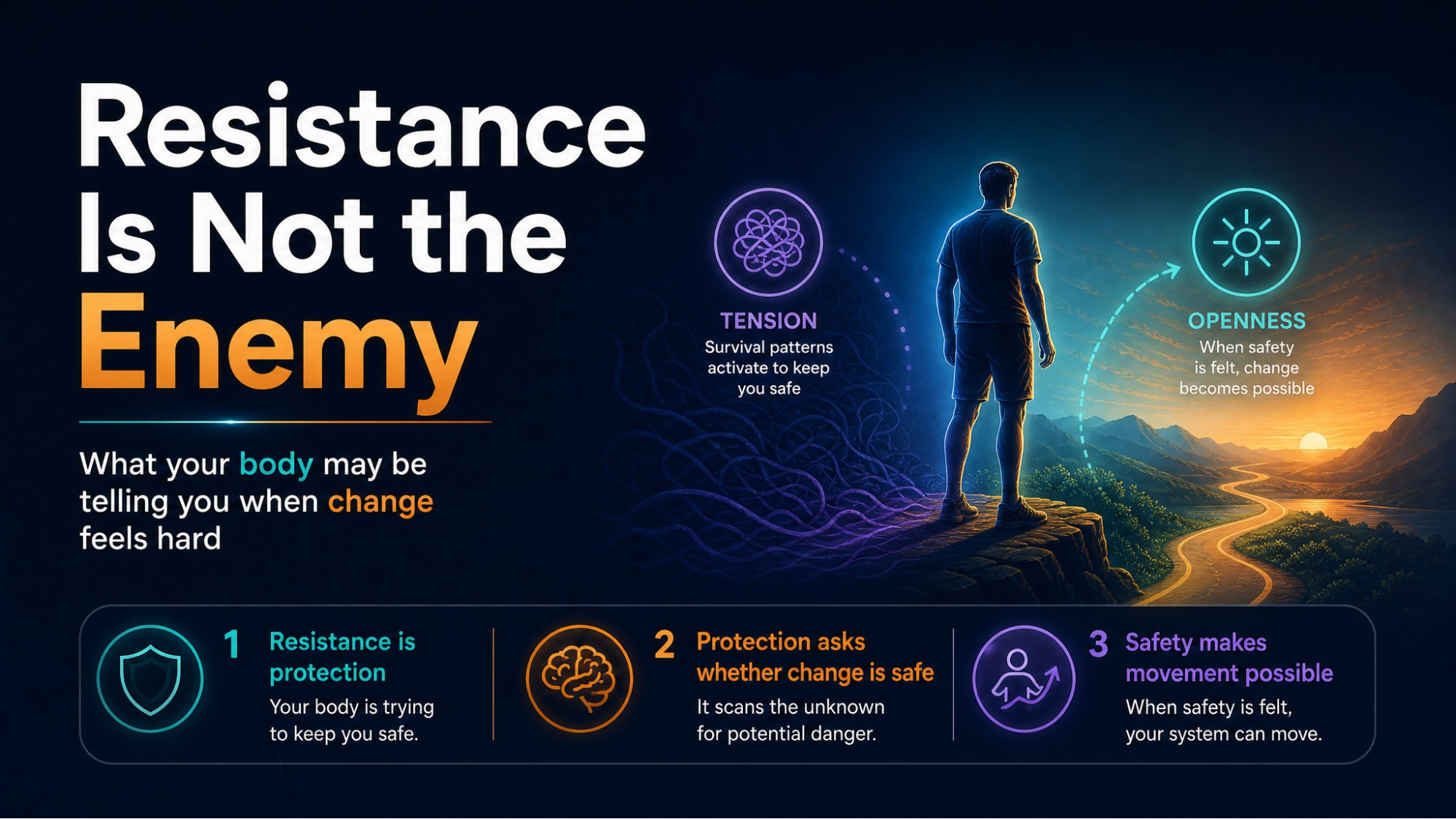
Quick read. This blog explores resistance as protection, shows how pressure can intensify the loop, and offers practical ways to add safety without losing direction.
Most people think resistance means something is wrong.
They begin to move toward change, healing, growth, emotional freedom, pain relief, a healthier body, a calmer nervous system, or a more meaningful life, and suddenly something inside pushes back.
They feel tension.
They feel fear.
They feel doubt.
They feel heaviness.
They feel the old pattern pulling them back.
And because they feel resistance, they assume they are failing.
They think, “Maybe I am not ready.”
They think, “Maybe this is not for me.”
They think, “Maybe I am broken.”
They think, “Maybe I should just stay where I am.”
But resistance is not always a sign that you are going in the wrong direction.
Many times, resistance appears because you are getting close to the very place where change becomes possible.
In the PainShift Paradigm™, this is important because chronic pain, chronic stress, physical tension, emotional shutdown, fatigue, and nervous system dysregulation are not only physical experiences. They are often connected to how the nervous system has learned to protect you.
Your body does not only respond to what is happening now.
It responds to what it has learned from the past.
It responds to familiar patterns.
It responds to old meanings.
It responds to emotional memories.
It responds to perceived threat.
And sometimes, when you begin to move toward freedom, the old system inside you becomes uncomfortable.
Not because freedom is dangerous.
But because freedom is unfamiliar.
The Ego Loves the Familiar, Even When the Familiar Hurts
The ego is not evil.
It is not trying to destroy your life.
It is not trying to keep you in pain because it wants you to suffer.
The ego is protective.
It prefers what it knows.
It prefers the familiar.
It prefers the predictable.
Even when the familiar is painful, the ego often chooses it because it knows how to survive there.
This is why someone can stay in chronic stress for years, even when they consciously want peace.
This is why someone can keep repeating the same emotional reaction, even when they know it hurts their relationships.
This is why someone can continue holding physical tension in the jaw, neck, shoulders, chest, stomach, or back, even when they deeply want relief.
The system is not choosing pain because pain is good.
It is choosing what feels known.
To the nervous system, familiar often feels safer than new.
This is one of the reasons change can feel threatening at first.
Not because the new pattern is bad.
But because the old pattern has become linked with survival.
Resistance Often Appears at the Edge of Growth
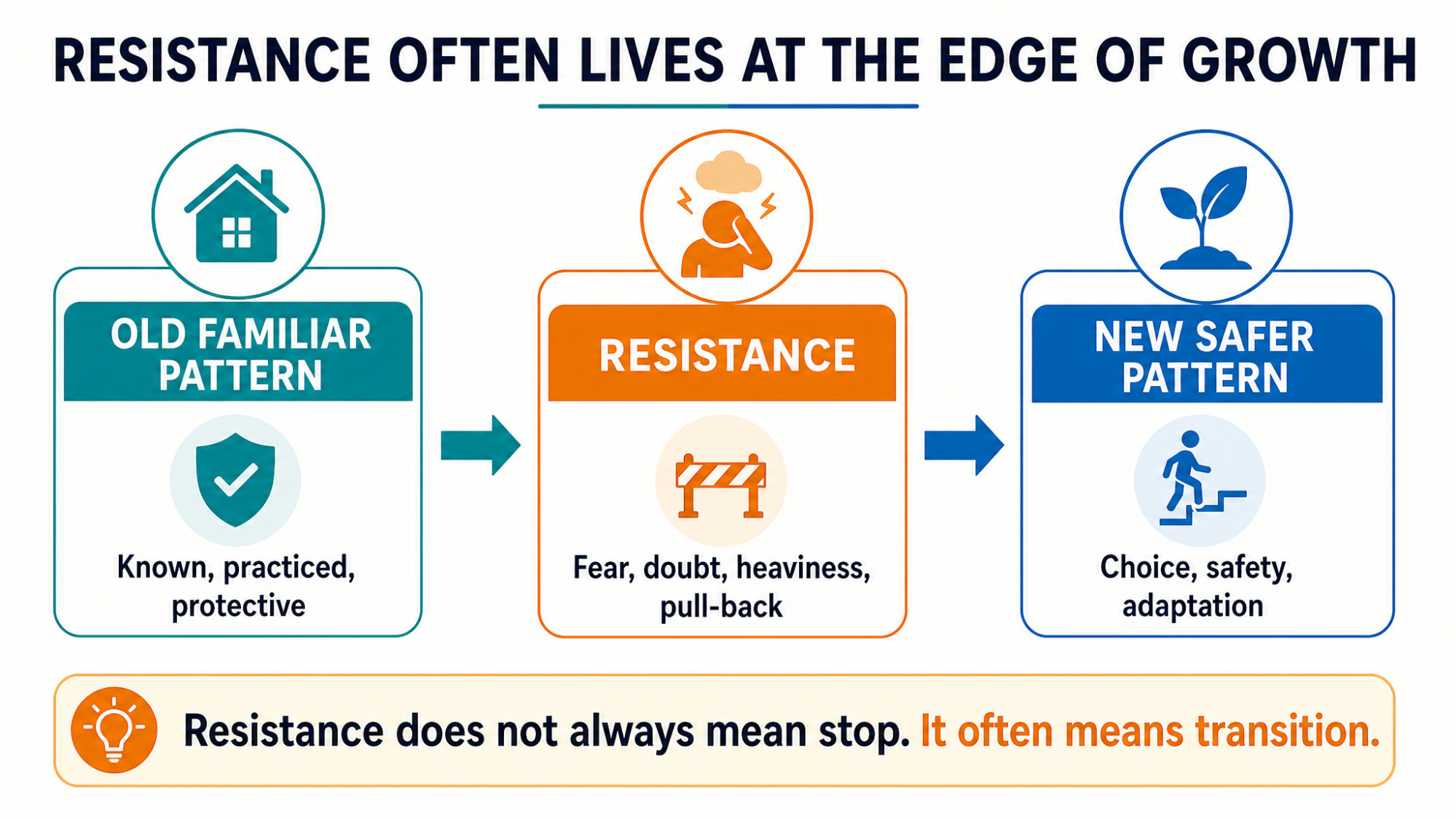
Figure: Resistance can signal that an old protection map is meeting an unfamiliar but potentially healthier path.
Resistance does not usually show up when nothing is changing.
It shows up when something inside you is being challenged.
A new belief.
A new identity.
A new boundary.
A new emotional response.
A new relationship with your body.
A new way of listening to pain.
A new way of calming your nervous system.
A new way of speaking to yourself.
When you begin to step out of an old pattern, the system may react.
It may say:
“Go back.”
“This is too much.”
“This will not work.”
“You have tried before.”
“You are not safe.”
“You cannot trust this.”
“You do not know who you will become.”
This is not always truth.
It is the old nervous system map trying to keep you inside the world it already knows.
The problem is that many people misread this signal.
They think resistance means stop.
But in many cases, resistance means pause, listen, regulate, and proceed differently.
Your Body Does Not Need Force. It Needs Safety.
Many high performers are trained to push through.
Push through fatigue.
Push through stress.
Push through pain.
Push through anxiety.
Push through emotional discomfort.
Push through tension.
Push through the warning signs.
For a while, this can look like strength.
You keep working.
You keep producing.
You keep showing up.
You keep achieving.
When you keep pushing without listening, your body may begin to protect you in stronger ways.
Pain can increase.
Tension can become chronic.
Sleep can suffer.
Digestion can shift.
Energy can drop.
Focus can become harder.
Emotional reactivity can increase.
The system may begin to say, “If you will not slow down voluntarily, I will create symptoms strong enough to get your attention.”
This does not mean pain is imaginary.
It does not mean symptoms are “all in your head.”
It means the body and brain are deeply connected.
Your nervous system is constantly interpreting safety, threat, pressure, emotional meaning, and internal demand.
When it decides that something is unsafe, it can amplify protection.
Resistance Is Often a Protective Signal
In the PainShift framework, resistance is not treated as an enemy to defeat.
It is treated as a signal to decode.
The question is not only:
“How do I get rid of this resistance?”
The better question is:
“What is this resistance trying to protect?”
That question changes everything.
Instead of fighting yourself, you become curious.
Instead of forcing your body, you begin listening.
Instead of seeing pain or stress as proof that something is wrong with you, you begin asking what your system has learned to associate with danger.
For example:
A person may want to rest, but rest feels unsafe because their nervous system learned that productivity equals worth.
A person may want to relax, but relaxation feels threatening because stillness allows emotions to surface.
A person may want to set a boundary, but the body tightens because boundaries used to create conflict.
A person may want to heal, but healing feels unfamiliar because pain has become part of their identity.
A person may want to feel joy, but joy feels vulnerable because disappointment followed it many times before.
The resistance is not random.
It is organized around protection.
Pain Can Become Part of the Old Identity
One of the most difficult parts of chronic pain is that it can slowly become part of how a person sees themselves.
Not by choice.
Not because they want it.
But because after months or years of pain, the brain begins to organize life around it.
You begin asking:
“Can I do this, or will it hurt?”
“Can I go there, or will I flare?”
“Can I trust my body today?”
“What if this makes it worse?”
“What if I never get better?”
Over time, the nervous system can begin to identify with limitation.
The body becomes something to manage.
Movement becomes something to fear.
Rest becomes something filled with frustration.
Hope becomes something dangerous because disappointment has happened too many times.
This is why healing is not only about reducing symptoms.
It is also about changing the relationship between you and your body.
Your body cannot become your enemy if you want to heal.
You cannot fight your nervous system into safety.
You cannot shame your body into regulation.
You cannot attack your pain and expect the system to feel protected.
The Shift From Fighting to Listening
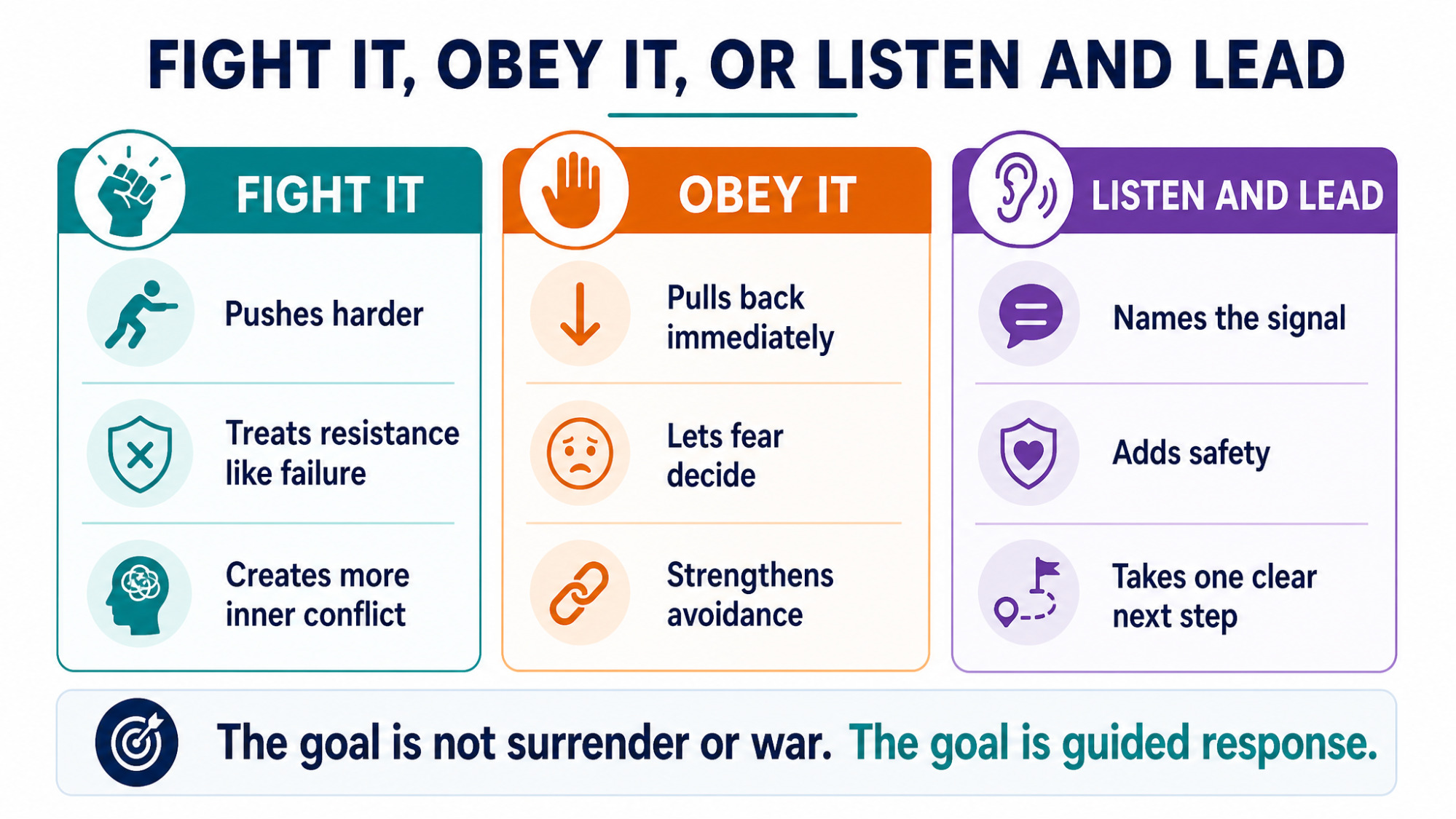
Figure: A third option is to listen to resistance without surrendering direction.
When resistance appears, most people try one of two things.
They either fight it or obey it.
Fighting sounds like:
“I should not feel this.”
“This is stupid.”
“I need to get over it.”
“I am weak.”
“I have to push harder.”
Obeying sounds like:
“This means I cannot change.”
“This means I should stop.”
“This means I am not ready.”
“This means I am stuck.”
Both responses keep the old pattern alive.
The third option is different.
You can listen without surrendering your direction.
You can say:
“Something in me is afraid.”
“Something in me is protecting.”
“Something in me does not yet feel safe.”
“Let me slow down and understand.”
You are no longer reacting automatically.
You are beginning to relate consciously.
That is where change begins.
Resistance Is a Doorway, Not a Wall
The moment you notice resistance, you have already stepped into awareness.
You are no longer completely inside the pattern.
You are observing it.
That matters.
The old pattern depends on unconscious repetition.
It depends on automatic reaction.
It depends on the body moving before the mind understands.
But when you pause and notice, something different happens.
You are no longer saying to the body, “We must react.”
You are saying, “We can listen.”
That pause is powerful.
Not dramatic.
Not loud.
But powerful.
Because the nervous system begins to learn that discomfort does not always mean danger.
A sensation does not always mean threat.
A trigger does not always require the old response.
A painful memory does not have to control the present moment.
A protective reaction does not have to become your identity.
How Resistance Keeps Pain and Stress Loops Alive
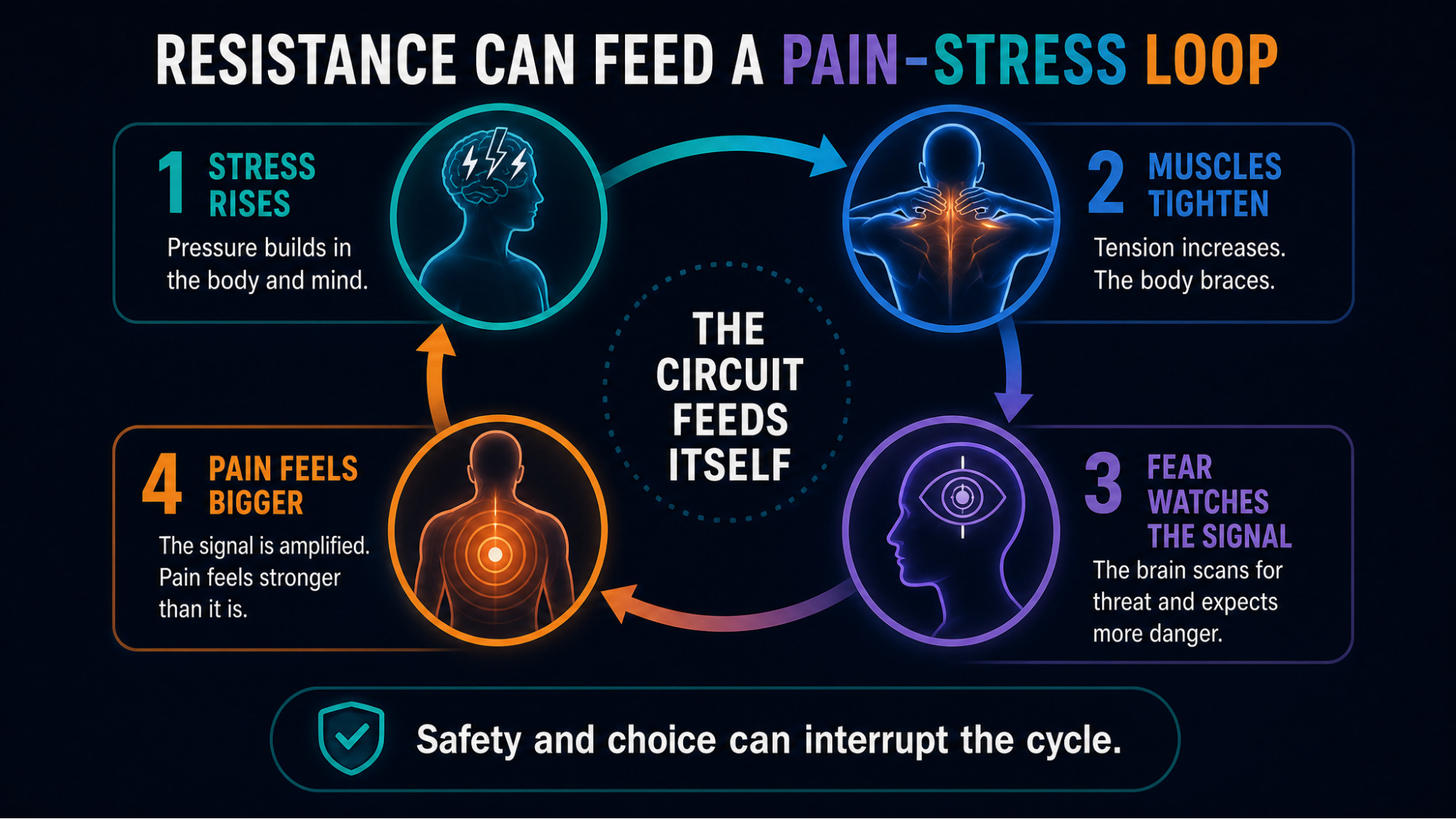
Figure: Resistance can add a second layer of suffering by linking sensation with panic, shame, or self-criticism.
Chronic pain and chronic stress often feed each other.
Stress increases muscle tension.
Muscle tension increases discomfort.
Discomfort increases fear.
Fear increases vigilance.
Vigilance increases nervous system sensitivity.
Sensitivity increases pain.
Pain increases stress.
Resistance can keep this loop alive because it often adds a second layer of suffering.
There is the original sensation, and then there is the fight against the sensation.
There is the pain, and then there is fear of the pain.
There is the fatigue, and then there is shame about the fatigue.
There is the emotional reaction, and then there is judgment about the reaction.
The nervous system does not only respond to the sensation.
It responds to the meaning you attach to the sensation.
Pain with panic becomes a stronger threat signal.
Tension with self criticism becomes a deeper stress pattern.
Fatigue with shame becomes heavier.
A flare with fear becomes more loaded.
This is why the way you respond to your body matters.
Not because words magically fix symptoms.
But because your internal response can either increase threat or increase safety.
The Body Listens to Meaning
Your body is constantly listening to meaning.
If your inner world says, “I am trapped,” the body may prepare for threat.
If your inner world says, “I am broken,” the body may collapse into hopelessness.
If your inner world says, “This will never change,” the nervous system may reinforce helplessness.
But if your inner world says, “I am noticing a protective pattern,” something softens.
If it says, “My body is trying to protect me,” the relationship changes.
If it says, “I can move slowly,” the system receives a different signal.
If it says, “I am safe enough in this moment,” the nervous system may begin to downshift.
This is not positive thinking.
Positive thinking often tries to cover pain with a nicer sentence.
This is different.
This is accurate, grounded, body based communication.
You are not pretending.
You are not denying.
You are not forcing yourself to feel good.
You are giving the nervous system a new interpretation that reduces threat.
A PainShift View of Resistance
In the PainShift Paradigm™, resistance is not a character flaw.
It is not proof that you are lazy.
It is not proof that you lack discipline.
It is not proof that healing is impossible.
Resistance is often a signal that an old protection strategy is being asked to update.
The body may be asking:
“Is this safe?”
“Can I trust this?”
“What happens if I let go?”
“What happens if I stop bracing?”
“What happens if I am no longer the person who lives in constant pain?”
“What happens if I release the identity that was built around survival?”
These are not small questions.
For someone who has lived in chronic pain, chronic stress, or emotional pressure for years, change can feel like stepping into unknown territory.
Even relief can feel unfamiliar.
Even peace can feel strange.
Even safety can feel suspicious.
That is why healing must be paced.
The Real Work Is Not to Destroy Resistance
The goal is not to destroy resistance.
The goal is to understand it so the body no longer needs to use it in the same way.
When resistance appears, try this simple process:
Pause.
Place one hand on the area of your body where you feel the most tension.
Breathe slowly.
Ask, “What is this trying to protect?”
Then say internally:
“I see the protection.”
“I do not need to fight it.”
“I can move slowly.”
“I can choose one safe next step.”
This begins to change the relationship.
Instead of pushing against the wall, you begin looking for the door.
Instead of treating resistance as failure, you treat it as information.
Instead of trying to overpower your system, you begin educating it.
This is how the nervous system learns.
Why High Achievers Struggle With This
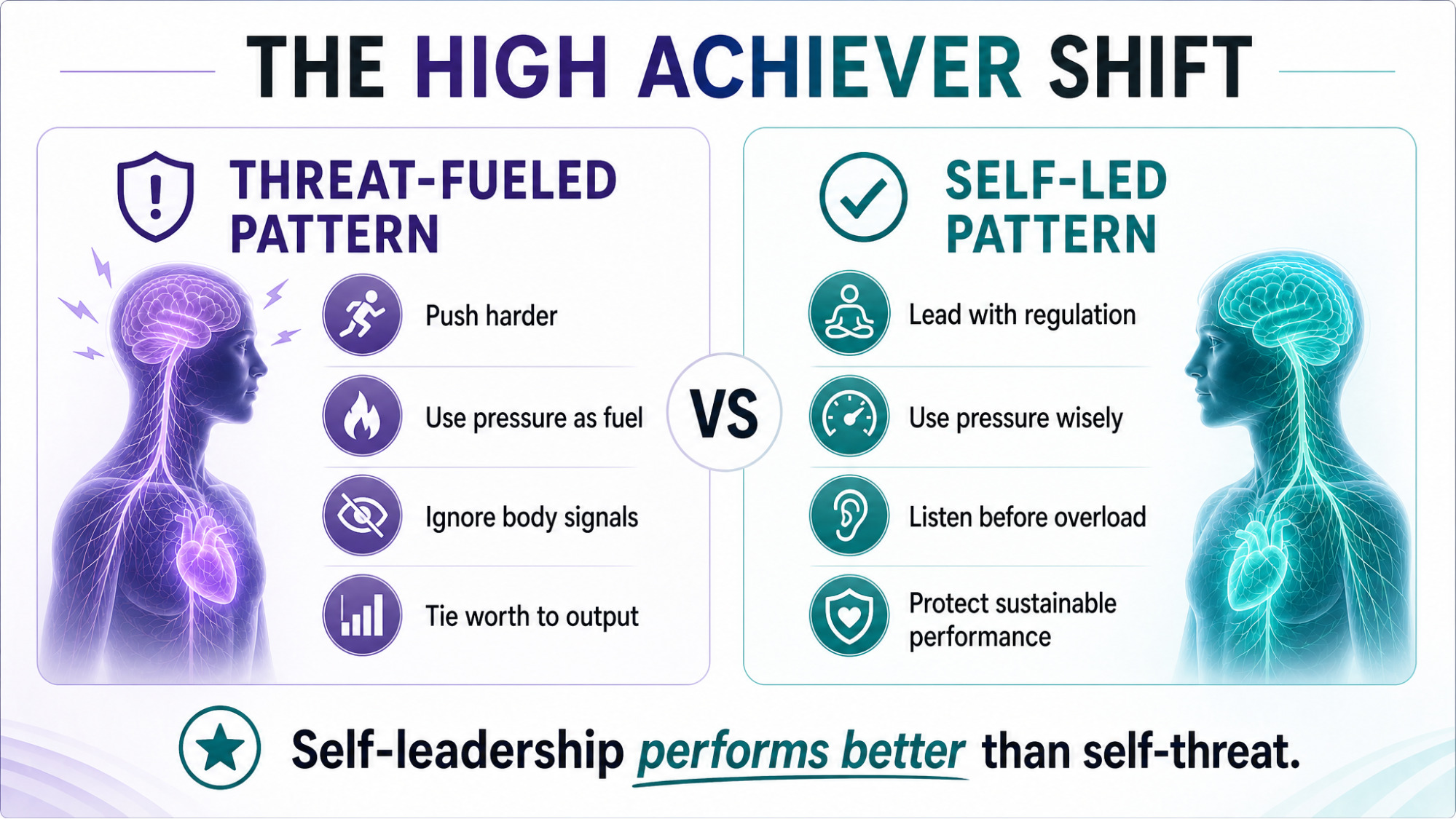
Figure: High performers can trade pressure and threat for attunement, precision, and self-leadership.
High achievers often have a unique challenge.
They are used to winning through effort.
They are used to solving problems.
They are used to finding strategies.
They are used to performing under pressure.
That works in business, leadership, productivity, and achievement.
But the body does not always respond well to being managed like a project.
The nervous system does not heal through pressure alone.
It responds to safety, rhythm, repetition, emotional honesty, and embodied experience.
For high performers, this can feel uncomfortable because it requires a different kind of intelligence.
The body is not asking you to give up your ambition.
It is asking you to stop using threat as your fuel.
The Moment Resistance Appears, You Are Close to Something Important
Resistance often appears near the doorway of change.
It appears when the old identity senses that it may not be in charge forever.
It appears when the nervous system is being invited into a new pattern.
It appears when the body begins to realize that the old strategy may no longer be necessary.
This is why resistance can feel uncomfortable and meaningful at the same time.
A part of you wants the new.
A part of you clings to the old.
The question is not, “How do I get rid of this feeling immediately?”
The question is, “Can I stay present without letting this feeling make the decision for me?”
That is where freedom begins.
Not when resistance disappears.
But when resistance no longer controls your choices.
Your Body Is Not Against You
Your body is not trying to ruin your life.
Your symptoms are not proof that you are weak.
Your resistance is not proof that you are incapable.
Your nervous system is trying to protect you based on what it has learned.
Some of those protections may be outdated.
Some may be too intense.
Some may be keeping you stuck.
But they were built for a reason.
Healing begins when you stop treating your body as the problem and start helping it learn a new signal.
Safety.
Choice.
Movement.
Breath.
Permission.
Self trust.
Presence.
A new relationship with sensation.
A new relationship with pain.
A new relationship with yourself.
A Simple Practice for When Resistance Shows Up
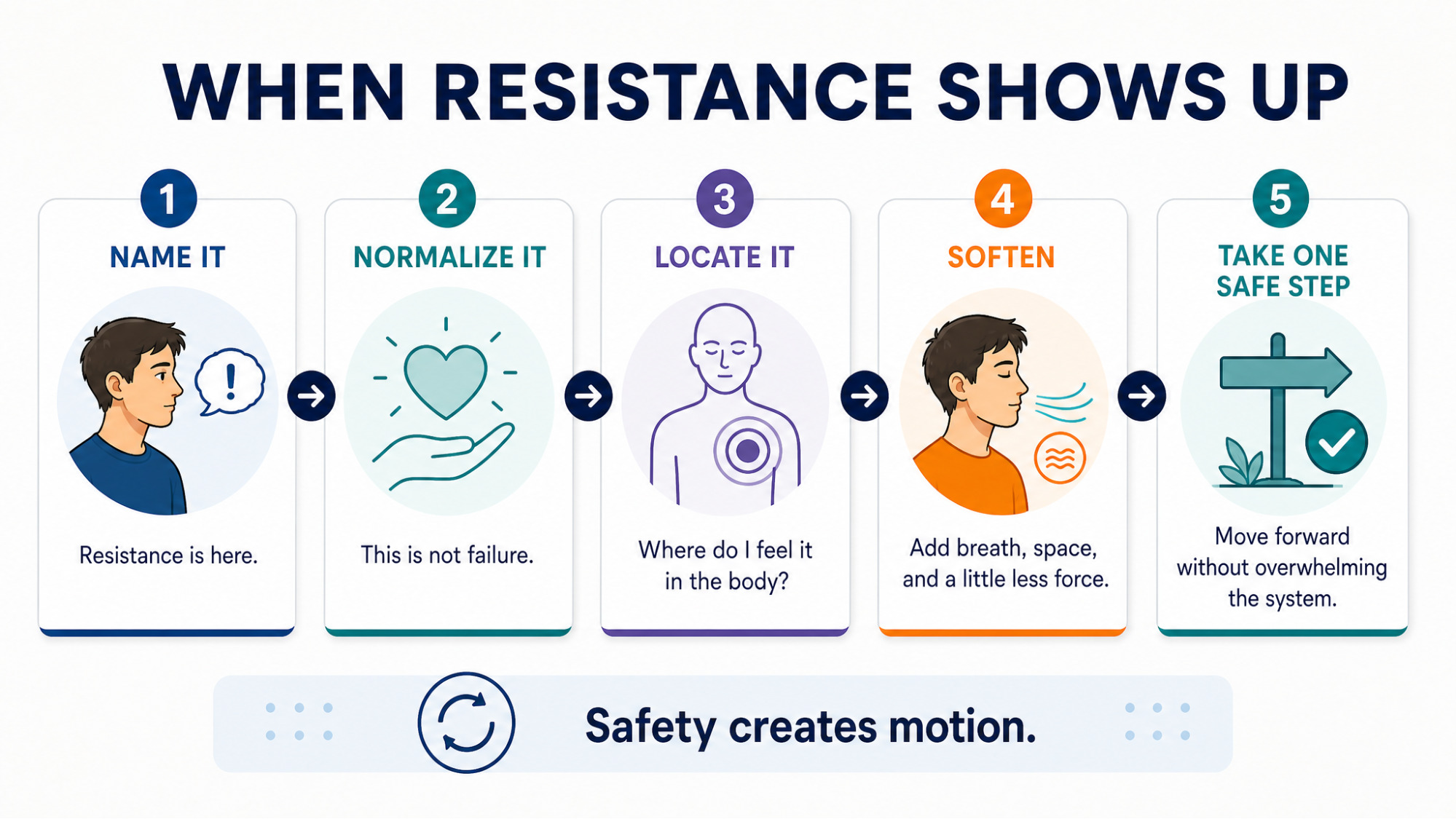
Figure: The practical sequence moves from naming and normalizing resistance to choosing one safe next action.
The next time you feel resistance, do not rush to overcome it.
Try this instead.
First, name it.
“This is resistance.”
Then normalize it.
“This is my system trying to protect me.”
Then locate it.
“Where do I feel this in my body?”
Then soften around it.
“I do not have to fight this.”
Then choose one small action.
“What is the next safe step?”
That step may be tiny.
One breath.
One stretch.
One honest sentence.
One boundary.
One moment of rest.
One choice not to return to the old story.
Small steps matter because the nervous system learns through repetition.
You do not need to force a massive breakthrough.
You need to create enough safety for the next layer to open.
The New Message
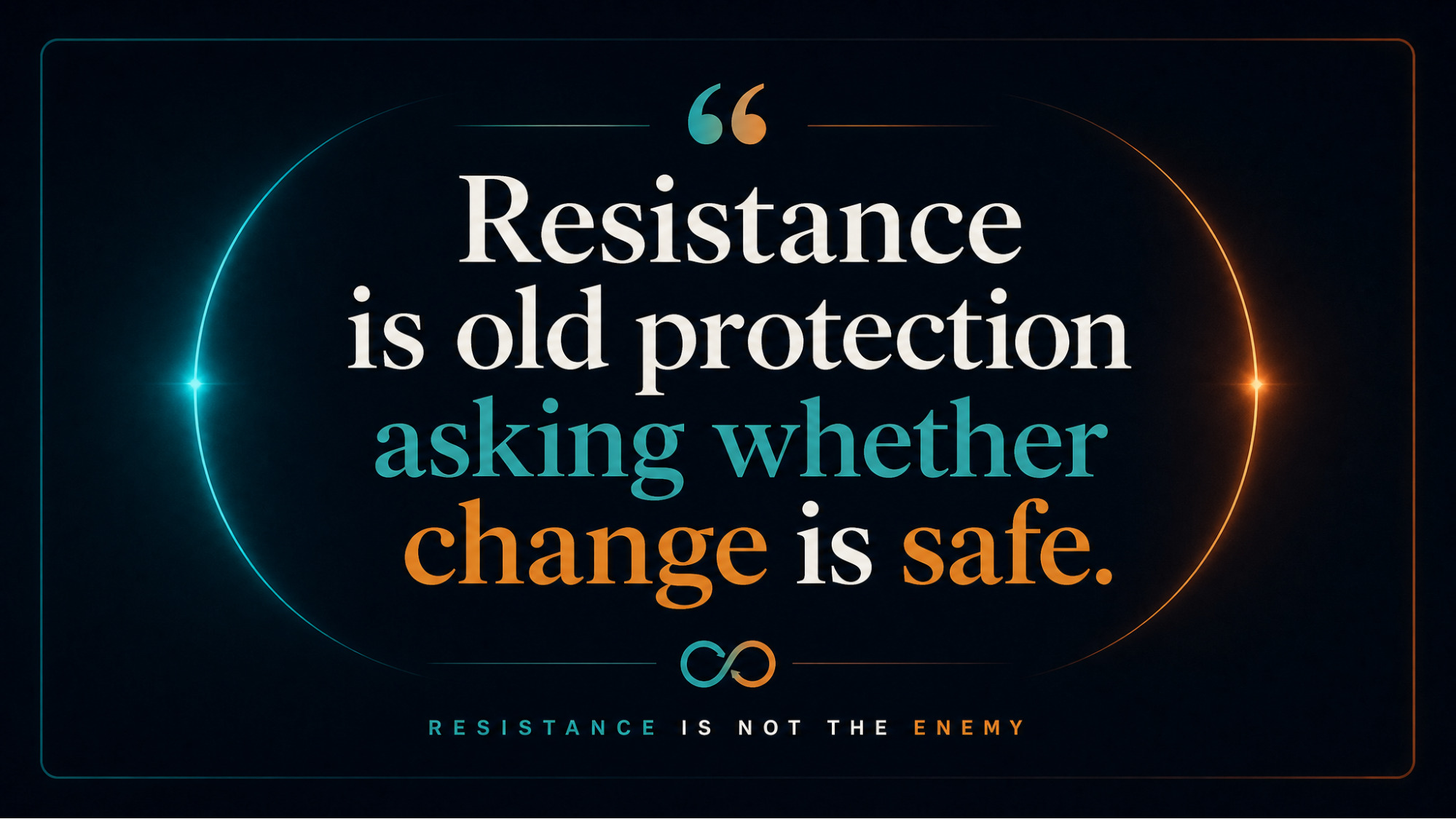
Resistance is not the end of your healing.
It may be the beginning of a deeper conversation with your body.
The part of you that resists is often the part that has been protecting you for years.
Because healing is not about defeating the body.
It is about helping the body understand that the old protection is no longer the only option.
Your pain may have been speaking the language of survival.
Your stress may have been speaking the language of protection.
Your resistance may have been speaking the language of fear.
But your body can learn a new language.
The language of safety.
The language of trust.
The language of choice.
The language of relief.
The language of becoming.
And the moment you stop fighting resistance and start listening to what it protects, the doorway to real transformation begins to open.
When resistance shows up in your own life, what if it is not a command to stop—but a prompt to slow down, decode the protection, and choose a safer next step?

Rami Bareket
Rami Bareket is an NLP Master Trainer and hypnotherapist with over 30 years of entrepreneurial experience and 20 years as a combat medic. Through NLP, hypnosis, and integrative transformation work, he helps high performers create fast and lasting change from the inside out.
Read Full Bio