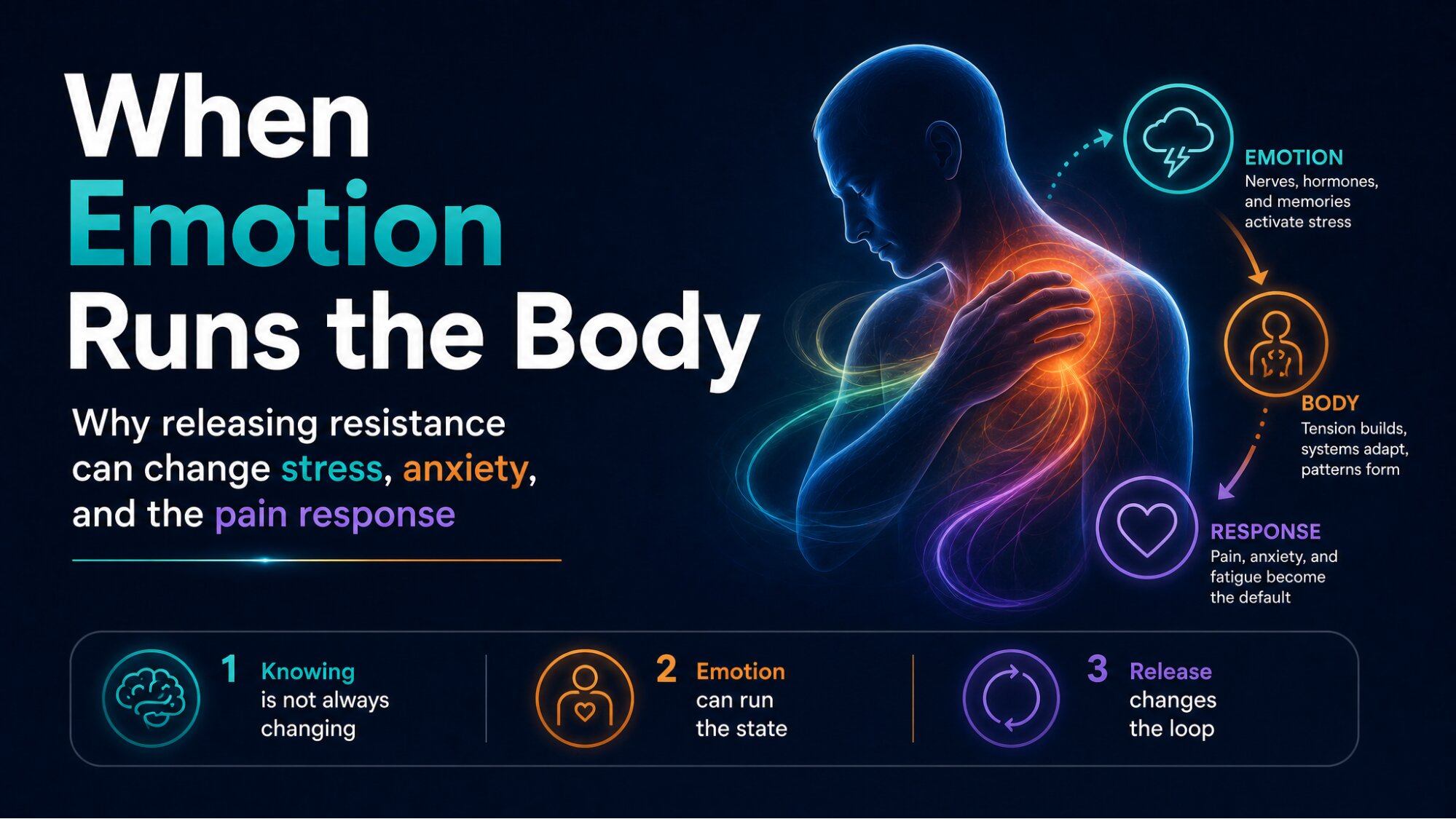
“I know what I should do… but I still feel stuck.”
That sentence says a lot.
You know you should calm down.
You know you should breathe.
You know you should stop overthinking.
You know stress makes everything worse.
You know the body tightens when pressure rises.
But knowing does not always change the state.
The chest is still tight.
The jaw is still locked.
The stomach is still holding.
The shoulders are still braced.
The pain signal still gets louder.
The nervous system still reacts.
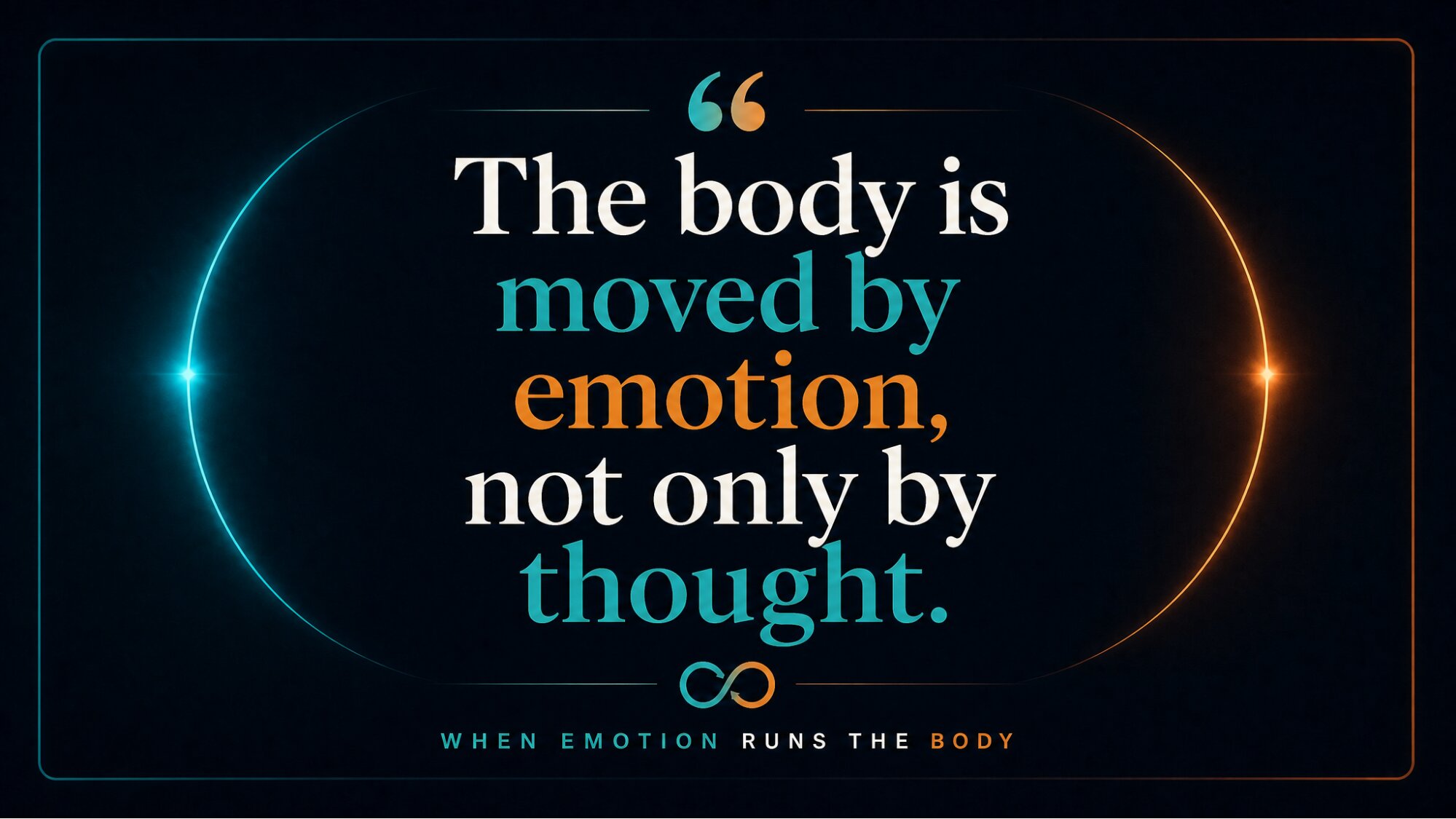
That is because the body is not moved only by thoughts.
Very often, the body is moved by emotion.
The emotion underneath the thought.
The emotion underneath the reaction.
The emotion underneath the stress.
The emotion underneath the pain loop.
The emotion you may not even realize you are carrying.
This is where many high performers get trapped.
They try to think their way out of what the body is feeling.
But the body does not always respond to logic.
It responds to state.
And emotion is one of the strongest state signals we have.
Emotions Run More Than We Realize
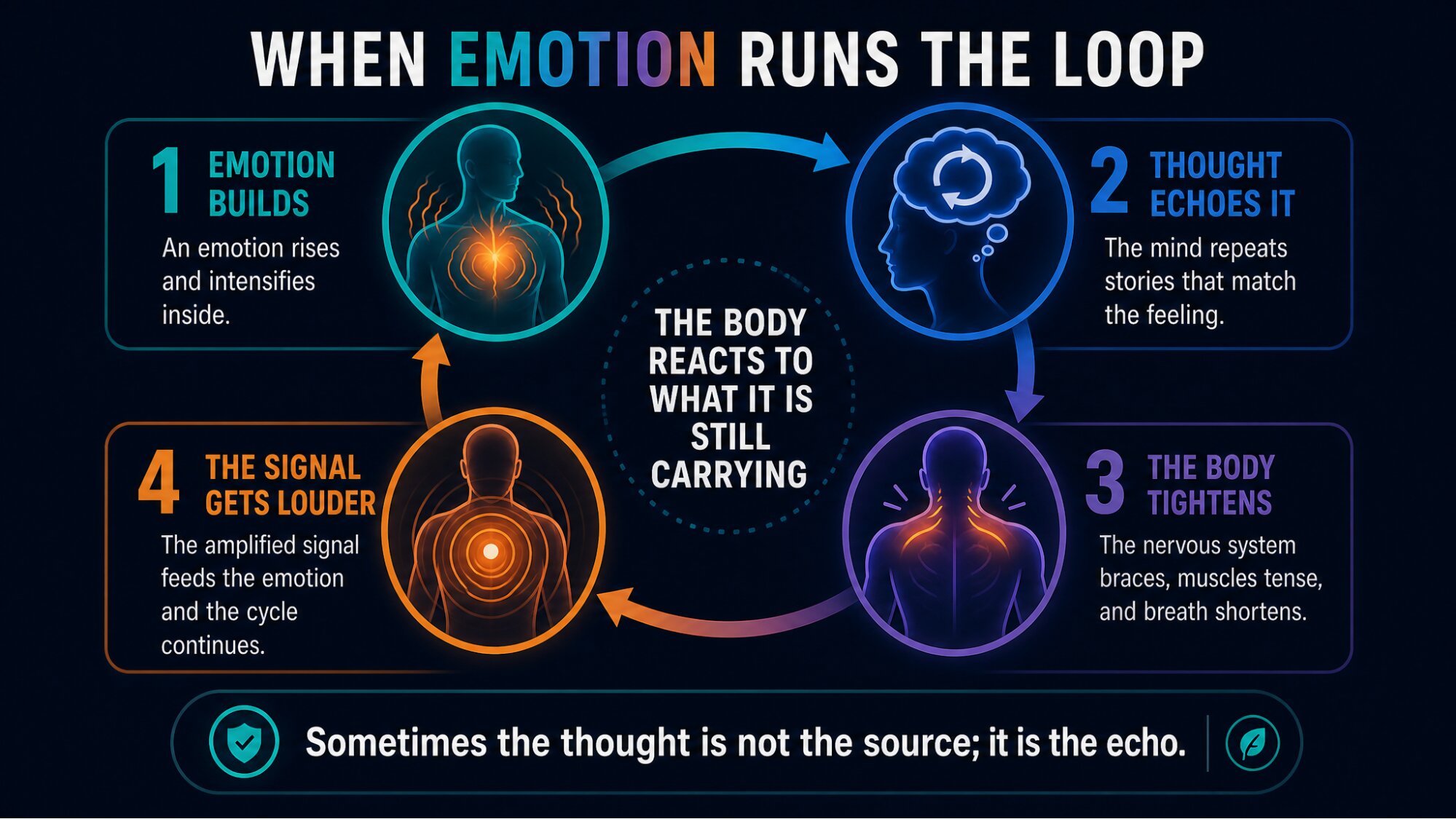
Many people believe their thoughts are in charge.
They think:
“If I can just think better, I will feel better.”
“If I can just understand this, I will change.”
“If I can just make the right plan, my body will follow.”
Sometimes that helps.
But often, the real driver is deeper.
A person may think clearly and still feel afraid.
They may understand the situation and still feel frozen.
They may have a good plan and still feel resistance.
They may know they are safe and still feel the body reacting.
Why?
Because emotion can move faster than conscious thought.
Fear can tighten the body before you finish the sentence.
Shame can collapse posture before you know what happened.
Anger can raise pressure before you decide what to say.
Grief can drain energy before you understand why.
The nervous system listens to emotion.
And when emotion is intense, unresolved, or suppressed, it can shape how the body responds.
The High Performer's Hidden Pattern
High performers are often trained to keep going.
To stay composed.
To function under pressure.
To solve problems.
To perform even when the body is asking for attention.
That can be a strength.
But it can also become a trap.
Because emotions do not disappear just because you override them.
They may go underground.
The face stays calm.
But the body tightens.
The voice stays professional.
But the stomach contracts.
The schedule keeps moving.
But the nervous system keeps carrying.
“I am fine.”
“Something is still unresolved.”
Over time, suppressed emotion can become tension.
Tension can become bracing.
Bracing can become pain.
Pain can create more fear.
Fear can create more tension.
And the loop continues.
One Emotion Can Create Thousands of Thoughts
A strong emotion does not stay quiet.
It creates thoughts.
Fear creates prediction.
“What if this gets worse?”
“What if I cannot handle this?”
“What if I fail?”
Anger creates judgment.
“This should not be happening.”
“They should know better.”
“My body should not be doing this.”
Shame creates identity.
“What is wrong with me?”
“I should be stronger.”
“I am not enough.”
Helplessness creates collapse.
“There is nothing I can do.”
“This will never change.”
“I am stuck.”
This is why working only with thoughts may not be enough.
Sometimes the thoughts are not the source.
They are the echo.
The emotion underneath is producing them.
So if you only correct the thought but never release the emotion, the body may keep generating the same pattern.
Stress Is Not Only the Event
A deadline is not always stressful by itself.
A meeting is not always stressful by itself.
A conversation is not always stressful by itself.
A body sensation is not always stressful by itself.
Stress often comes from the response.
The meaning.
The emotion.
The prediction.
The sense of threat.
One person sees a deadline and feels focused.
Another sees a deadline and feels panic.
One person feels neck tension and thinks, "I need to move."
Another feels neck tension and thinks, "This is going to ruin my day."
The event matters.
But the nervous system response matters too.
And the nervous system response is often shaped by emotion.
Resistance Traps the Emotion
Most people deal with uncomfortable emotions in one of three ways.
They push them away.
They distract from them.
They fight them.
That makes sense.
No one wants to feel fear.
No one wants to feel shame.
No one wants to feel grief.
No one wants to sit with helplessness.
But resistance has a cost.
When you push emotion away, the body may have to hold it.
When you fight emotion, the nervous system may stay activated.
When you run from emotion, the pattern may keep chasing you.
Resistance can turn emotion into pressure.
And pressure often becomes physical.
Tight shoulders.
Shallow breathing.
Chest pressure.
Stomach tension.
Jaw clenching.
Fatigue.
Pain sensitivity.
The Body Does Not Need You to Collapse
Releasing emotion does not mean falling apart.
It does not mean drowning in the feeling.
It does not mean losing control.
It means learning to stop resisting what is already present.
There is a big difference between:
being consumed by emotion
and
allowing emotion to move through the body
The skill is not to intensify the emotion.
The skill is to stop fighting it.
To notice it.
To name it.
To give it space.
To let the body complete what it has been holding.
The Release Method
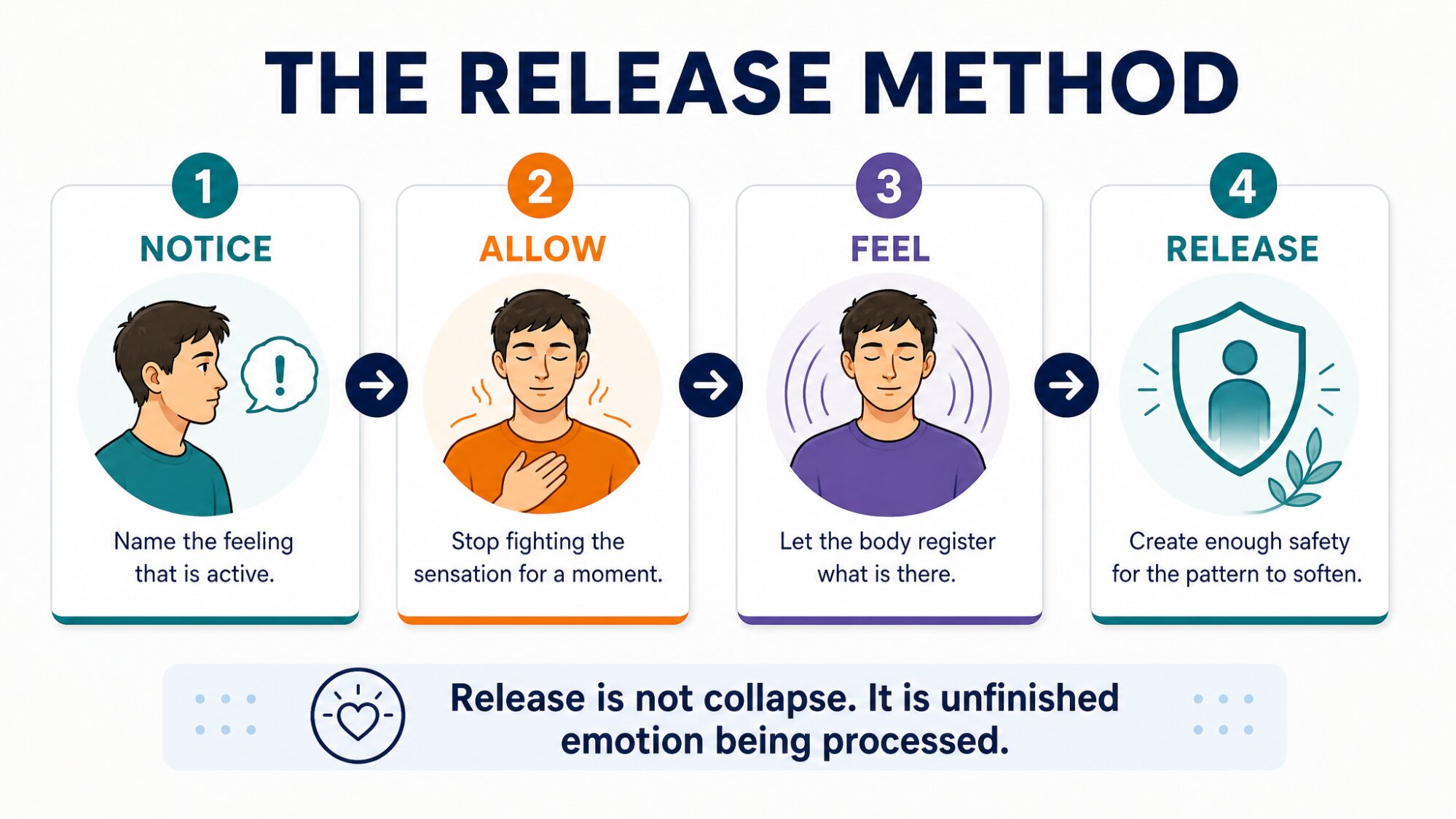
Figure: Releasing emotion does not mean collapsing; it means stopping resistance long enough for the body to soften.
Here is a simple version of the release method, adapted for stress, pain, and nervous system regulation.
1. Identify the feeling
Pause and ask:
“What am I actually feeling?”
Not:
“What is the problem?”
Not:
“What should I do?”
Not:
“Why am I like this?”
Ask:
“What is the feeling?”
Fear.
Pressure.
Sadness.
Anger.
Helplessness.
Shame.
Disappointment.
Grief.
Frustration.
Naming the feeling matters because it brings awareness to the pattern.
You cannot release what you are not willing to recognize.
2. Sit with it. Do not fight it.
Once you identify the feeling, let it be present for a moment.
Not forever.
Not dramatically.
Just honestly.
You might say:
“Fear is here.”
“Pressure is here.”
“Sadness is here.”
“Anger is here.”
Then notice where it lives in the body.
Chest.
Throat.
Stomach.
Jaw.
Shoulders.
Back.
Hands.
Do not try to fix it immediately.
Do not judge it.
Just notice.
3. Stop resisting
This is the turning point.
Instead of saying:
“I should not feel this.”
Say:
“This is what my system is feeling right now.”
Instead of:
“I need this gone.”
Say:
“I can allow this feeling to move.”
Instead of:
“This is too much.”
Say:
“I can be with this one breath at a time.”
4. Let it dissolve by itself
Emotions often change when they are no longer being held down or fought.
The feeling may soften.
It may move.
It may change shape.
It may become warmth.
It may become sadness.
It may become a breath.
It may become a release in the shoulders.
It may become a quiet sense of relief.
The goal is not to force the emotion out.
The goal is to stop feeding it with resistance.
Sometimes the body knows how to complete what the mind has been trying to control.
What This Has to Do With Pain
Pain and emotion are deeply connected.
Pain can create emotion.
Emotion can amplify pain.
Fear can tighten the body.
Stress can increase sensitivity.
Anger can keep the system activated.
Shame can make the body collapse.
Helplessness can reduce agency.
Pressure can keep the nervous system in protection mode.
So when someone says:
“My pain gets worse when I am stressed,”
that is not random.
The body is responding to the whole state.
Not only the physical signal.
But the emotional environment around the signal.
That is why releasing emotion can matter.
Not as a replacement for medical care.
Not as a promise that every pain disappears.
But as a way to reduce the emotional load that keeps the nervous system amplified.
The Difference Between Correcting Thoughts and Releasing Emotion
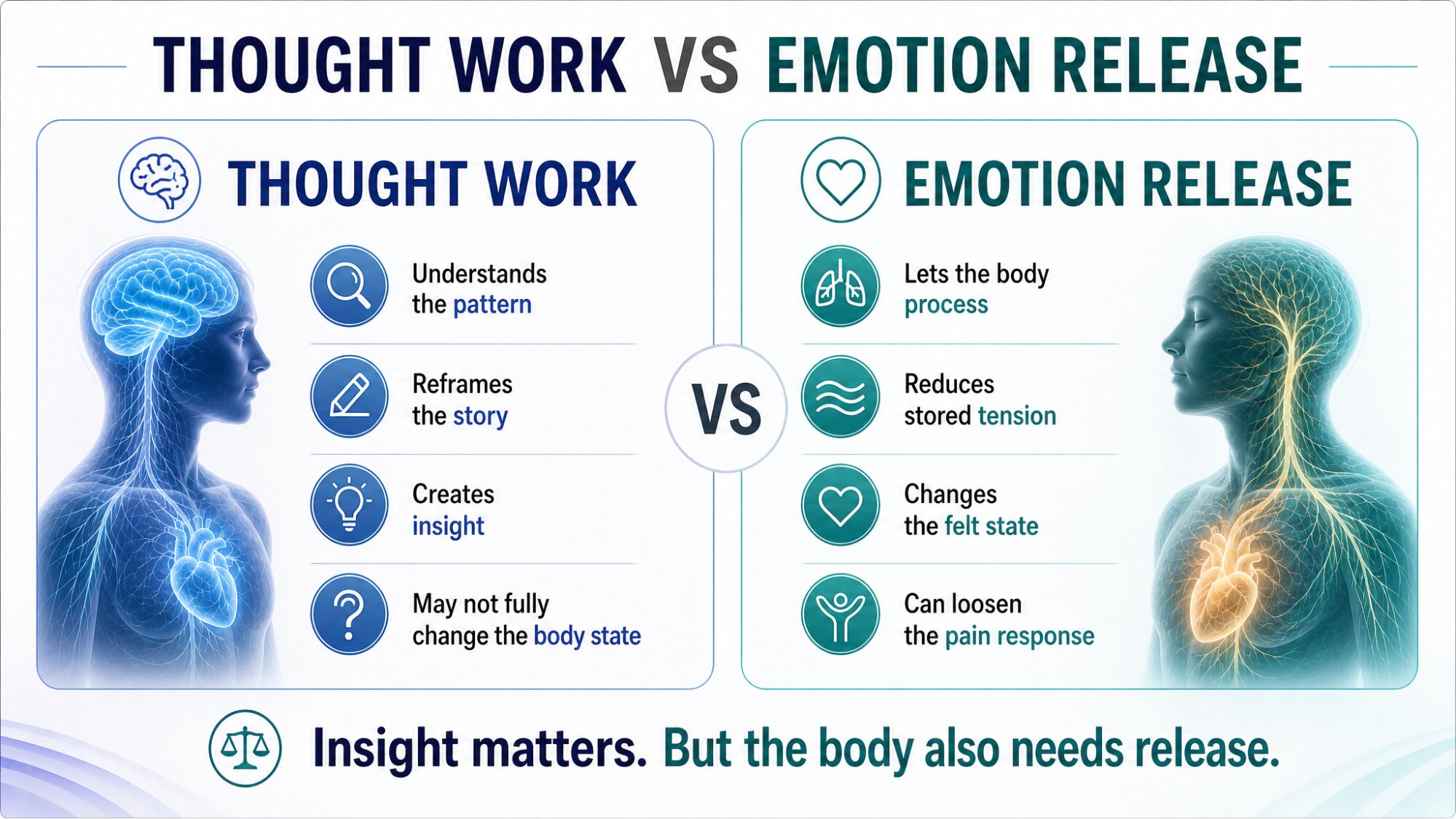
Figure: The mind may need a new thought, but the body may need the emotion to move.
There is value in changing thoughts.
A thought like:
“This will ruin my life”
can be reframed.
A thought like:
“My body is broken”
can be questioned.
A thought like:
“I cannot handle this”
can be softened.
But sometimes, the thought is being powered by emotion.
If fear is underneath the thought, another thought may not be enough.
If grief is underneath the thought, logic may not reach it.
If shame is underneath the thought, a reframe may feel fake.
That is why emotional release matters.
The mind may need a new thought.
But the body may need the emotion to move.
A High Performer Example
Imagine a business owner who feels chest tightness before an important call.
The conscious thought is:
“I need to perform.”
But underneath that thought is fear.
“What if I fail?”
“What if I disappoint them?”
“What if I am not prepared enough?”
The body responds.
The chest tightens.
The breath shortens.
The shoulders brace.
The mind starts racing.
If the person only tries to think positively, the body may not believe it.
But if they pause and name the emotion:
“Fear is here.”
Then sit with it:
“I can feel it in my chest.”
Then stop resisting:
“I do not need to fight this fear.”
Then let the feeling soften:
“I can breathe and allow this to move.”
Something changes.
The body is no longer fighting the emotion.
The nervous system begins to receive safety.
The chest may soften.
The mind may clear.
The person may still care about the call.
But they are no longer being run by fear.
Love, Safety, and Connection
The original slides speak about love as a higher organizing force.
For this work, we can understand love in a grounded way:
Love is connection.
Love is safety.
Love is compassion.
Love is the opposite of internal attack.
When the nervous system feels connected, supported, and safe, the body often responds differently.
The breath changes.
Muscle tone changes.
Attention changes.
Pain may feel less threatening.
This is why compassion matters so much.
“You should be over this.”
“This is hard, and I can support myself through it.”
And safety is one of the most important conditions for regulation.
Why Success Does Not Always Feel Like Relief
Many high performers assume that when they finally succeed, they will relax.
But sometimes success brings a crash.
Why?
Because the nervous system has been running on pressure for too long.
The goal is reached.
The body finally has a moment to feel.
And everything that was pushed down begins to rise.
Fatigue.
Pain.
Sadness.
Fear.
Emptiness.
Grief.
This does not mean success caused the breakdown.
It may mean success removed the distraction.
The body finally had permission to reveal what it had been carrying.
That is why emotional release is not optional for true high performance.
Without release, achievement can become another form of suppression.
Freedom Begins When You Stop Running
Most people wait for a big change.
The right opportunity.
The right diagnosis.
The right plan.
The right answer.
The right breakthrough.
But sometimes real change begins with a much smaller moment.
The moment you notice what you are feeling.
The moment you stop running from it.
The moment you stay.
The moment you let the body tell the truth.
The moment you stop resisting the emotion long enough for it to move.
That is where freedom begins.
Not because life outside instantly changes.
But because something inside relaxes.
And when something inside relaxes, the nervous system gets a different signal.
A Simple Practice for Stress and Pain
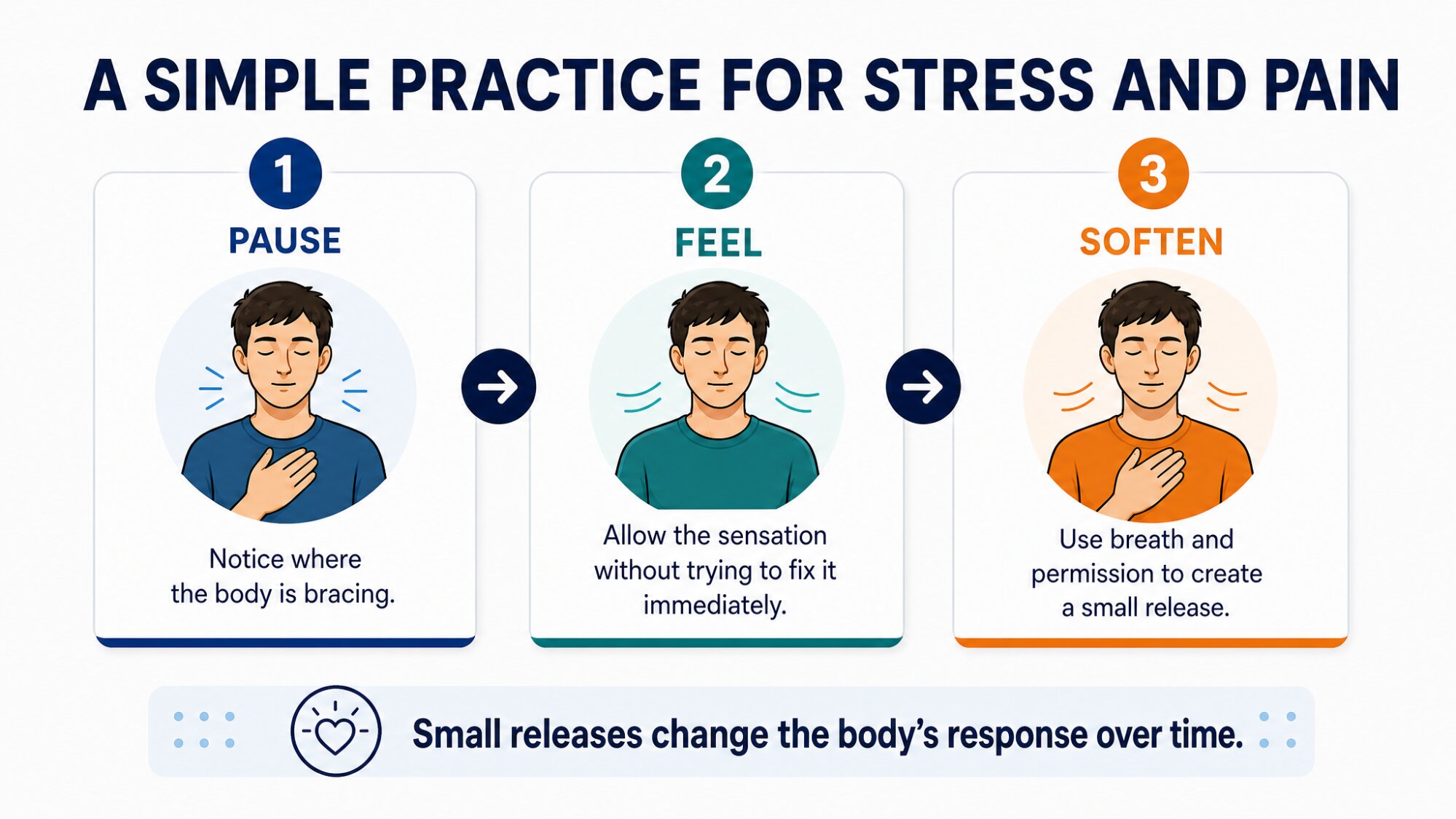
Figure: A short reset for moments when anxiety, stress, tension, or pain starts to rise.
The next time you feel stress, anxiety, tension, or pain rising, try this.
Ask:
“What feeling is underneath this?”
Name it.
Then ask:
“Where do I feel it in my body?”
Notice the location.
Then say:
“I can allow this feeling to be here without fighting it.”
Take a slow breath.
Let the body soften around the feeling.
Ask:
“What happens if I stop resisting this for just ten seconds?”
Then wait.
Do not force.
Do not analyze.
Do not make it dramatic.
Let the emotion move at the pace your system allows.
If it feels overwhelming, open your eyes, look around the room, feel your feet, and return to safety.
Release should feel regulating, not flooding.
The Deeper Message
Emotions shape the body because emotions shape state.
State shapes perception.
Perception shapes behavior.
Behavior shapes results.
And repeated results shape identity.
So if you want to change the stress-pain loop, do not only ask:
“What am I thinking?”
Ask:
“What am I feeling beneath the thought?”
And then:
“Am I resisting this feeling, or allowing it to move?”
That question can change the loop.
Your Practice Invitation
The next time your body tightens, do not immediately push through.
There may be an emotion underneath the tension.
A fear underneath the pressure.
A sadness underneath the fatigue.
An anger underneath the pain.
A helplessness underneath the stress.
You do not need to fight it.
You do not need to become it.
You do not need to let it control you.
You can identify it.
Sit with it.
Stop resisting.
Let it dissolve in its own time.
Because sometimes the body does not need another strategy.
And when emotion is released, the nervous system can finally stop carrying what the mind has been trying to outrun.
When your body tightens under pressure, what feeling might be underneath it — fear, shame, anger, sadness, helplessness, or something else — and what changes when you stop resisting it for one honest breath?
When your body tightens under pressure, what feeling might be underneath it — fear, shame, anger, sadness, helplessness, or something else — and what changes when you stop resisting it for one honest breath?

Rami Bareket
Rami Bareket is an NLP Master Trainer and hypnotherapist with over 30 years of entrepreneurial experience and 20 years as a combat medic. Through NLP, hypnosis, and integrative transformation work, he helps high performers create fast and lasting change from the inside out.
Read Full Bio