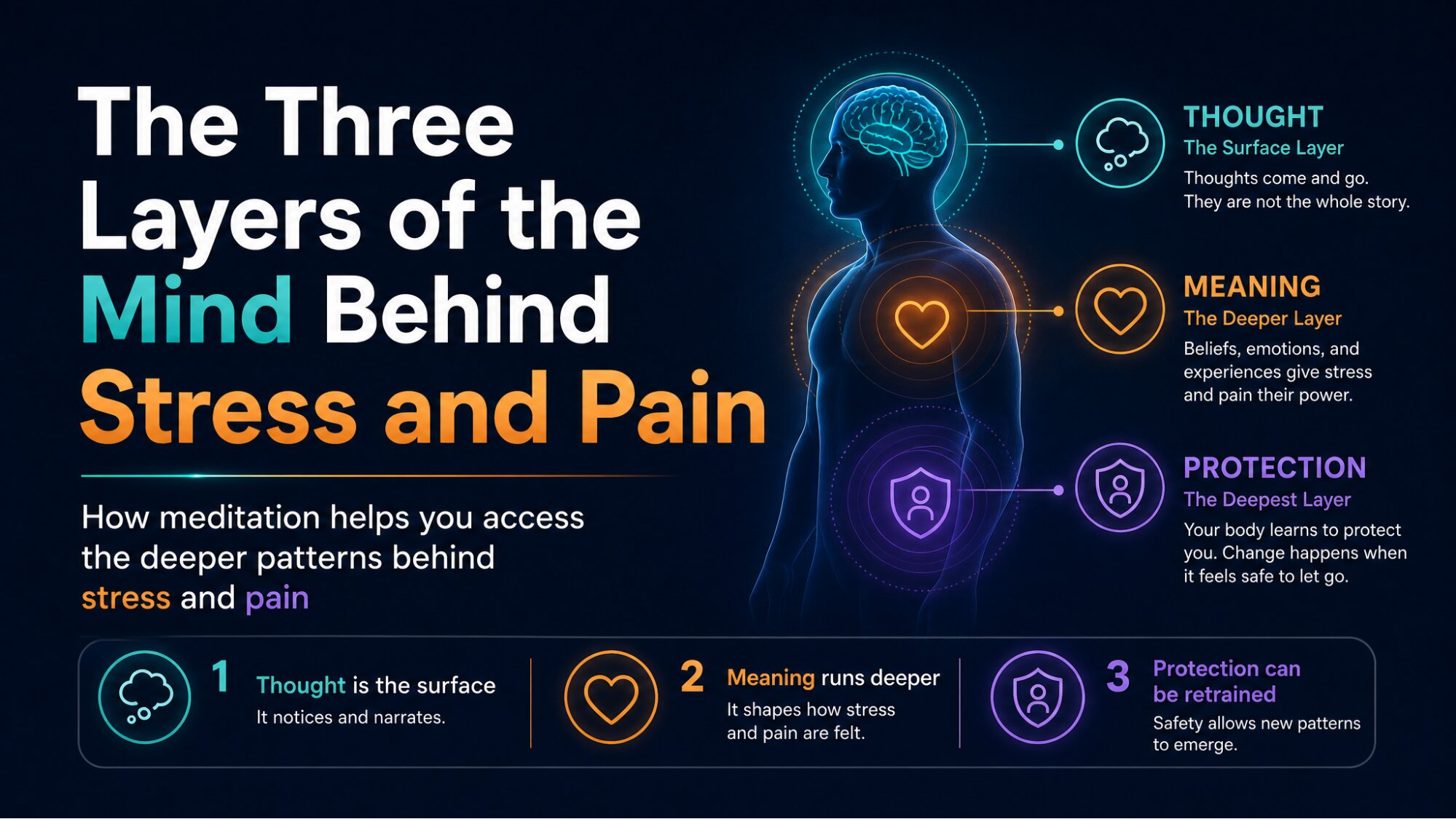
The three-layer model shows how pain is noticed, given meaning, and protected around at different depths of the system.
“I know I should calm down… but my body won't listen.”
That sentence captures something many high performers experience.
The conscious mind understands.
It knows the pain may be stress-related.
It knows tension often increases under pressure.
It knows fear can amplify the signal.
It knows pushing through does not always help.
But the body still reacts.
The shoulders still tighten.
The breath still becomes shallow.
The jaw still locks.
The pain signal still gets louder.
The nervous system still behaves as if something is wrong.
And that is where the deeper work begins.
Because stress and pain patterns do not live only in the conscious mind.
They live across layers.
The conscious mind.
The subconscious mind.
The deep subconscious mind.
And meditation can become a bridge into those layers.
Not just to relax.
But to notice, understand, and retrain the deeper patterns that keep the Stress-Pain Loop alive.
Pain Is Not Only a Conscious Experience
Most people try to solve pain at the level they can think about.
They analyze. They research. They plan. They try to reason with themselves.
They say:
“I know I am probably okay.”
“I know I should not worry.”
“I know stress makes this worse.”
“I know I need to relax.”
But knowing is not always enough.
Because the conscious mind is only one layer of the system.
It can think. It can analyze. It can decide. It can understand.
But many stress-pain patterns are not created by conscious decision.
You do not consciously decide to brace your shoulders.
You do not consciously decide to hold your breath.
You do not consciously decide to scan your body for symptoms.
You do not consciously decide to fear a sensation before you even understand it.
Those patterns often come from deeper layers.
The subconscious mind.
And beneath that, the deep subconscious mind.
The Conscious Mind: The Layer That Notices and Explains
The conscious mind is the part of you that thinks, analyzes, plans, judges, compares, and decides.
It is the part that says:
“What is this sensation?”
“Why is this happening?”
“What should I do?”
“How bad is this?”
“What if this gets worse?”
It is the part of the mind that tries to solve the problem.
For a high performer, the conscious mind is often highly developed.
It is strategic. Fast. Capable. Analytical. Good at solving complex problems.
But pain is not always solved by more analysis.
Sometimes analysis becomes part of the loop.
The mind starts tracking the sensation.
Then measuring it.
Then predicting it.
Then researching it.
Then wondering what it means.
Then imagining the worst case.
And before long, the conscious mind is no longer helping the nervous system regulate. It is increasing the alarm.
This is how conscious thought can become mental amplification.
The signal appears.
The mind explains it as danger.
Emotion rises.
The body tightens.
The signal feels louder.
The conscious mind then says:
“See? It is getting worse.”
And the loop continues.
The Subconscious Mind: The Layer That Gives Meaning
The subconscious mind is the layer where automatic meanings, emotional associations, beliefs, habits, inner images, and learned responses live.
This is where a body signal becomes personal.
A sensation appears.
The conscious mind may say:
“My neck is tight.”
But the subconscious may say:
“This always happens before something important.”
“This means I am not safe.”
“This means I cannot trust my body.”
“This means I am losing control.”
“This means I am not as strong as I used to be.”
That subconscious meaning can activate the nervous system quickly. Often before you have time to reason with it.
This is why a person can consciously know one thing but physically react as if something else is true.
The conscious mind says: "I am okay."
The subconscious mind says: "This signal means danger."
And the body follows the deeper message.
Subconscious Patterns That Amplify Pain
Pain amplification often runs through subconscious associations. For example:
Pain means danger.
Stress means brace.
Movement means risk.
Rest means guilt.
Fatigue means weakness.
A flare means failure.
A symptom means loss of control.
A body signal means something is wrong.
These patterns may not be spoken out loud. They may not even appear as clear thoughts. But the nervous system reacts to them.
The body tightens. Breathing changes. Attention narrows. The emotional system activates. And the pain signal becomes louder.
This is why PainShift does not only work with symptoms.
It works with the meanings attached to symptoms.
Because when the meaning changes, the nervous system receives a different message.
The Deep Subconscious Mind: The Layer That Protects Automatically
The deep subconscious mind is the deepest layer in this model.
It includes automatic body-level responses and deeply learned protective patterns. This is where the nervous system runs many processes outside conscious awareness.
Breathing rhythm. Muscle guarding. Postural tension. Startle responses. Stress activation. Pain prediction. Body scanning. Emotional protection. Deep identity patterns. Implicit memories.
The deep subconscious mind is not trying to hurt you.
It is trying to protect you.
But sometimes protection becomes outdated.
The body may still brace for a danger that is no longer present.
The nervous system may still amplify signals based on old experiences.
The system may still behave as if pain means threat, even when the current moment is safe enough.
This is where the Stress-Pain Loop can become deeply automatic.
The conscious mind thinks: "I want to relax."
The subconscious mind believes: "This sensation means danger."
The deep subconscious mind responds: "Protect."
Then the body tightens. The breath shortens. The muscles guard. The pain signal becomes louder. And the conscious mind says: "I cannot control this."
That is why deeper access matters.
Meditation as a Bridge Between the Layers
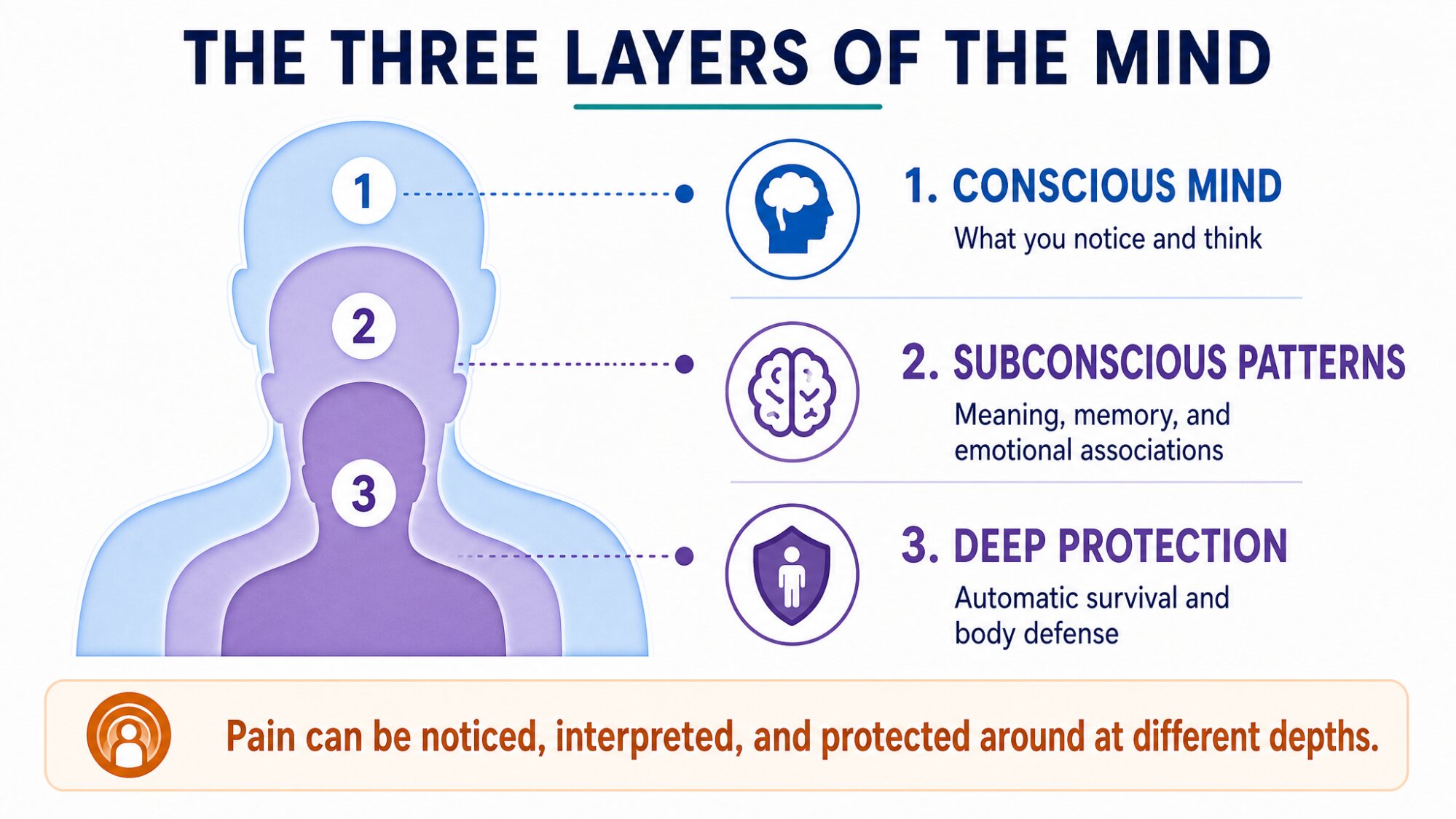
Figure: Meditation becomes useful when it helps you notice which layer is active instead of trying to control everything with thought alone.
Meditation is often described as relaxation. But in PainShift, meditation can be much more than that.
Meditation is a bridge.
It quiets the surface noise of the conscious mind.
It helps you notice the subconscious story.
It helps you feel the body-level response.
It helps the deep subconscious mind receive signals of safety.
When meditation deepens, you may begin noticing things that were hidden beneath the surface.
Not just: "I feel pain."
But:
“I feel fear around this pain.”
“I notice my body bracing.”
“I notice the thought that this will ruin my day.”
“I notice the belief that I cannot trust my body.”
“I notice that I feel guilty when I rest.”
“I notice that my system is trying to protect me.”
This is powerful. Because what you can notice, you can begin to work with.
The Movement From Surface to Depth
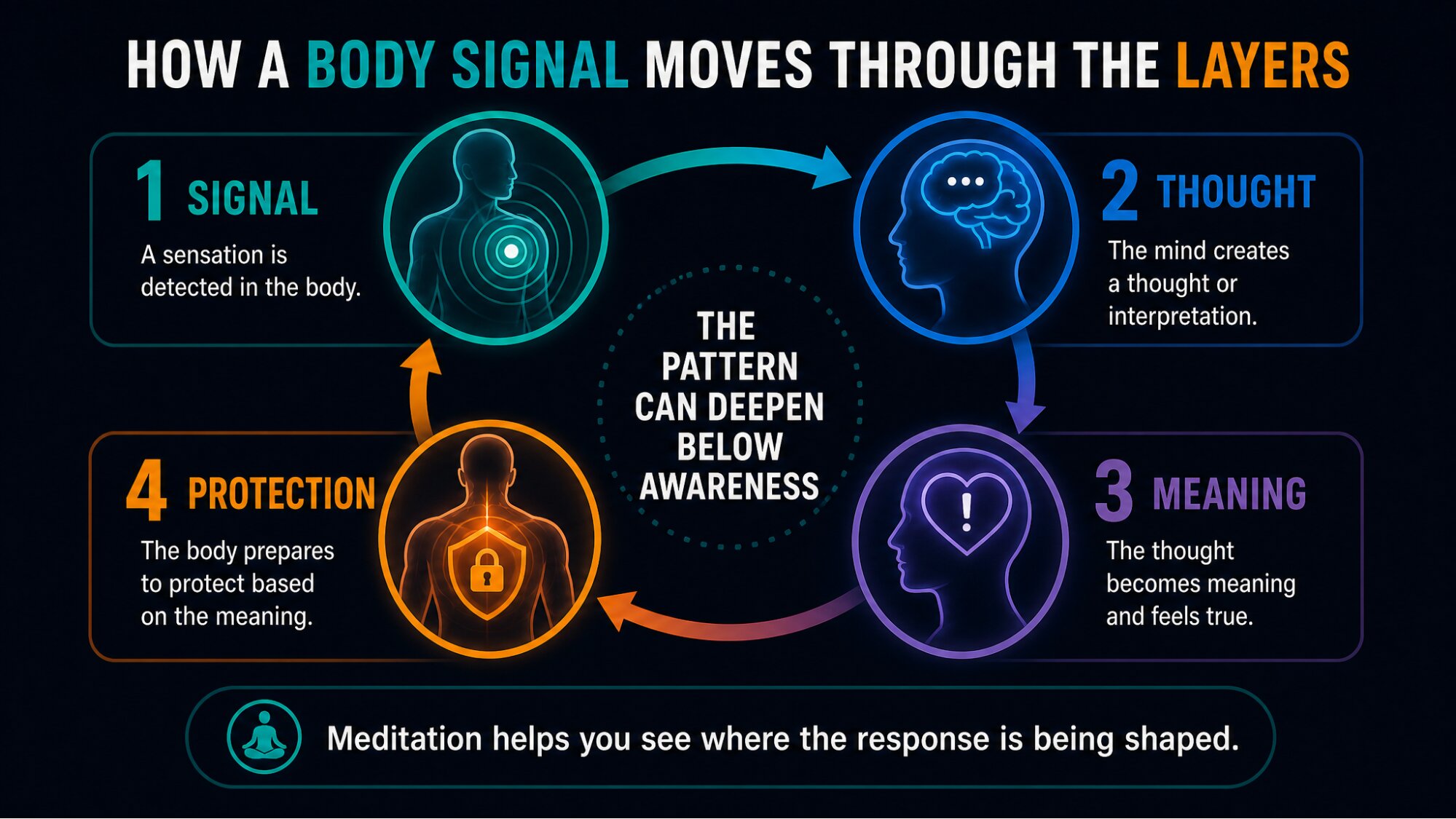
Figure: One signal can move from thought to meaning to automatic protection, which is why layered awareness matters.
In the beginning, meditation may only reveal conscious thoughts.
You sit quietly and the mind says:
“This hurts.”
“I am distracted.”
“I do not have time for this.”
“This is not working.”
That is the conscious layer.
If you stay with it gently, you may notice the subconscious layer.
“This pain scares me.”
“I hate feeling limited.”
“I feel angry at my body.”
“I am afraid this means I am falling behind.”
“I believe I should be stronger than this.”
Then, as awareness deepens, you may notice the deep subconscious layer.
The body is holding. The shoulders are guarding. The breath is restricted. The stomach is clenched. The jaw is locked. The nervous system is preparing for threat.
Now you are seeing the pattern more clearly.
Not just pain.
Pain plus story.
Pain plus emotion.
Pain plus protection.
Pain plus identity.
Pain plus nervous system activation.
That is the moment when change becomes possible.
Why High Performers Need This Layered Approach
High performers often live strongly in the conscious mind.
They think. Plan. Analyze. Lead. Decide. Perform. Solve.
This is a strength.
But when pain enters the picture, the same strength can become overused.
The mind tries to solve the pain like a business problem.
More analysis. More control. More research. More pressure. More tracking. More effort.
But the nervous system may not need more pressure.
It may need safety. It may need permission. It may need a new association. It may need a different identity. It may need the deep subconscious mind to stop interpreting the body as unsafe.
This is why meditation, hypnosis, somatic awareness, and subconscious repatterning can become so valuable. They reach the layers that logic alone cannot fully access.
The Three-Layer PainShift Map
Here is a simple way to understand it.
The conscious mind notices the pain. It says: "What is this?" "How bad is it?" "What should I do?" "What if this gets worse?" This layer needs awareness and thought interruption.
The subconscious mind gives the pain meaning. It says: "This is dangerous." "My body is unreliable." "I cannot handle this." "This always ruins my day." This layer needs reframing, emotional processing, hypnosis, and visualization.
The deep subconscious mind protects around the pain. It responds with: muscle guarding, shallow breathing, body scanning, stress activation, avoidance, tension, pain amplification. This layer needs safety signals, somatic regulation, repetition, and new embodied experiences.
When all three layers are running the same threat pattern, pain becomes louder.
When all three layers begin learning safety, the loop can begin to soften.
A High Performer Example
Imagine a founder preparing for an important investor call.
A familiar pain appears in the lower back.
At the conscious level, the thought is: "My back hurts." Then: "What if I cannot sit through the call?"
At the subconscious level, the meaning is: "My body lets me down when it matters." "I cannot trust myself under pressure."
At the deep subconscious level, the body protects. The back muscles tighten. The breath shortens. The nervous system becomes alert. Attention narrows around the sensation.
Now the pain feels stronger.
The founder may believe: "The pain is getting worse."
But in reality, the whole system is amplifying.
Conscious worry. Subconscious meaning. Deep subconscious protection.
Now imagine using meditation as a bridge.
The founder pauses. Closes the eyes for a moment. Feels the feet. Lengthens the exhale.
Notices the thought: "What if this gets worse?"
Then notices the deeper meaning: "I am afraid I cannot trust my body."
Then notices the body response: "My lower back is guarding."
Now the intervention changes.
Instead of pushing through with fear, the founder sends a new message: "This is a signal. My system is activated. I can support it."
The breath slows. The jaw softens. The back receives less threat.
The body begins to learn: "This signal does not have to mean danger."
That is how a deeper pattern begins to shift.
Meditation Is Not About Emptying the Mind
Many people think meditation means having no thoughts. That expectation creates pressure. And pressure is not helpful for the nervous system.
In PainShift, meditation is not about forcing the mind to be blank. It is about creating enough stillness to see what is happening inside.
You are not trying to control everything.
You are learning to observe.
You observe the thought. You observe the story. You observe the emotion. You observe the body response. You observe the identity pattern. You observe the nervous system state.
And then, from that awareness, you begin sending different signals.
How Meditation Helps PainShift
Meditation can support the PainShift process in several ways.
It helps you notice early signals before they escalate.
It helps separate sensation from story.
It helps calm the nervous system.
It helps reveal subconscious meanings attached to pain.
It helps soften emotional reactivity.
It helps reconnect with the body in a safer way.
It helps rehearse a new identity.
It helps train the deep subconscious mind through repetition.
This is why meditation is not just a relaxation tool. It can become a repatterning tool.
A Simple PainShift Meditation Practice
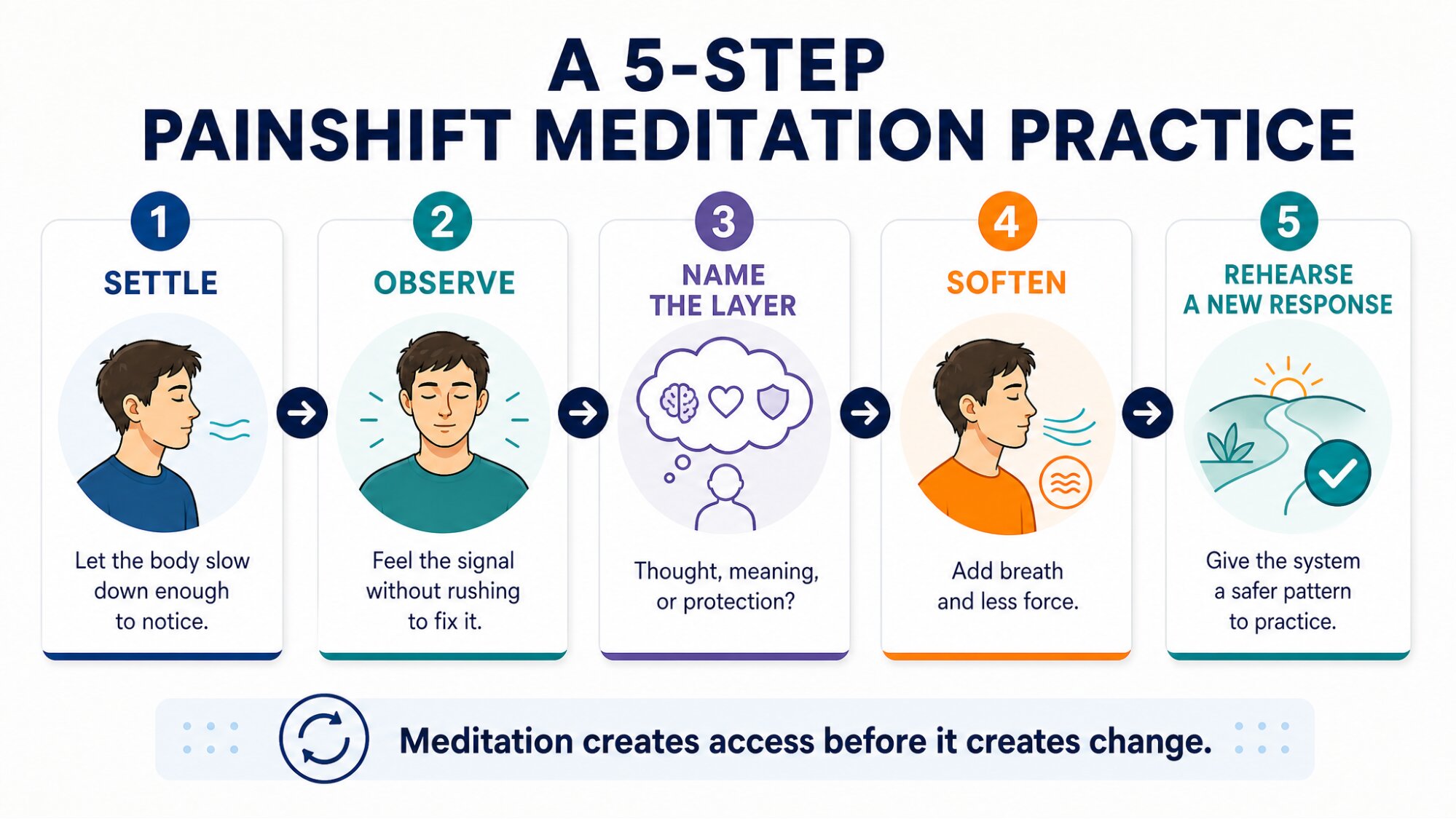
Figure: The practice moves from thought awareness to meaning awareness to body regulation and a new response.
Here is a simple practice based on the three-layer model.
Step 1: Notice the conscious thought
Close your eyes or soften your gaze.
Ask: "What is my mind saying right now?"
Do not argue with it. Just notice.
Maybe it says: "This hurts." "I cannot focus." "I need this to stop." "What if this gets worse?"
Step 2: Notice the subconscious meaning
Ask gently: "What does this signal seem to mean to me?"
Maybe the answer is: "It means I am not safe." "It means I cannot trust my body." "It means I am falling behind." "It means I am losing control."
Step 3: Notice the deep subconscious protection
Ask: "How is my body protecting right now?"
Notice: jaw tension, shoulder bracing, chest tightness, stomach holding, back guarding, shallow breathing, body scanning.
Step 4: Send a safety signal
Lengthen the exhale. Relax the jaw. Drop the shoulders. Feel your feet.
Let your body receive the message: "I am safe enough in this moment."
Step 5: Install a new response
Say internally: "This is a signal, not my identity." "My body is trying to protect me." "I can support my nervous system." "I am learning a new pattern."
Then sit for a few breaths and allow the system to absorb it. Not as a forced affirmation. As a new experience.
The Role of Hypnosis and Visualization
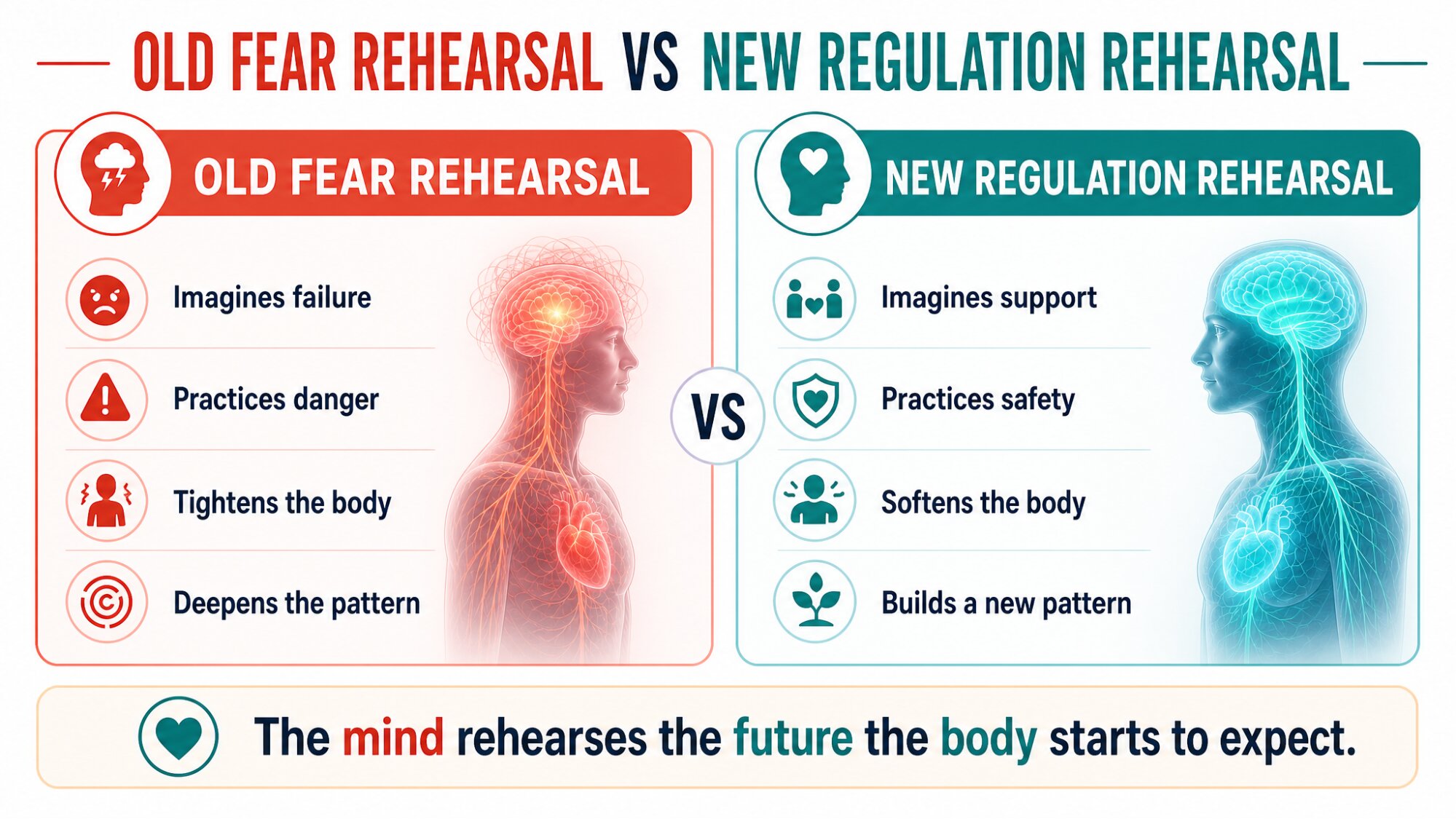
Visualization works by giving the nervous system a different prediction to practice before pressure arrives.
Meditation opens the doorway. Hypnosis and visualization can deepen the change.
Why? Because the subconscious mind responds strongly to imagery, emotion, repetition, and inner rehearsal.
If the nervous system has rehearsed fear for years, it may expect danger.
If it has rehearsed pain identity for years, it may expect limitation.
If it has rehearsed bracing for years, it may expect threat.
Visualization gives the brain a new rehearsal. The person imagines: responding calmly, breathing through a signal, moving with confidence, trusting the body, performing with steadiness, recovering faster, living from a regulated identity.
Over time, this can help the system build a new prediction.
Not: "Pain means danger."
But: "A signal can appear, and I can regulate."
That is a powerful shift.
The Deeper Transformation
At first, the work may seem like calming down. But the deeper transformation is not only calm. It is integration.
The conscious mind learns a new understanding.
The subconscious mind learns a new meaning.
The deep subconscious mind learns a new protection pattern.
Instead of: "I feel pain, this is dangerous, protect harder." The system begins learning: "I notice a signal, this can be worked with, support and regulate."
That is the shift. And when that shift repeats, it can become a new operating pattern.
The PainShift Perspective
PainShift is not just about giving the conscious mind information. It is about retraining the whole system.
The conscious mind needs education.
The subconscious mind needs new meaning.
The deep subconscious mind needs safety and repetition.
That is why a whole-system approach matters.
Because if the conscious mind understands but the subconscious still fears, the loop continues. If the subconscious begins changing but the body still guards, the loop continues. If the body relaxes temporarily but the identity remains "I am broken," the loop can return.
All three layers need to learn a new pattern.
Your Practice Invitation
The next time pain or tension appears, pause.
Do not only ask: "How do I stop this?"
Ask: "What layer is active right now?"
Is the conscious mind worrying? Is the subconscious mind giving the signal a threatening meaning? Is the deep subconscious mind protecting through bracing, guarding, or scanning?
Then ask: "What would help this layer feel safe enough to shift?"
A thought may need reframing.
An emotion may need compassion.
A body pattern may need breath.
An identity may need a new self-message.
A nervous system may need repetition.
That is the work.
Not fighting the mind.
Not fighting the body.
But teaching the whole system a new way to respond.
The Core Message
The conscious mind notices the pain.
The subconscious mind gives it meaning.
The deep subconscious mind protects around it.
Meditation helps you access all three. And when you can access all three, you can begin to change the pattern.
The mind can learn.
The body can learn.
The nervous system can learn.
And when the deeper layers begin receiving a new message, something important becomes possible:
That is where PainShift begins.
The next time tension or pain appears, which layer speaks first for you: the thinking mind, the meaning-making layer, or the body's protection response? What changes when you address the layer that is actually active?

Rami Bareket
Rami Bareket is an NLP Master Trainer and hypnotherapist with over 30 years of entrepreneurial experience and 20 years as a combat medic. Through NLP, hypnosis, and integrative transformation work, he helps high performers create fast and lasting change from the inside out.
Read Full Bio