“Think of your biggest performance challenge.”
These words echo through coaching sessions and high-performance training programs worldwide. Most of the time, we approach pain and stress like consultants examining a failed project. After the damage is done, we analyze what went wrong, develop better strategies, and create detailed action plans for next time. It's prescriptive. It's retrospective. It's logical.
But your body and your business don't wait for you to be ready.
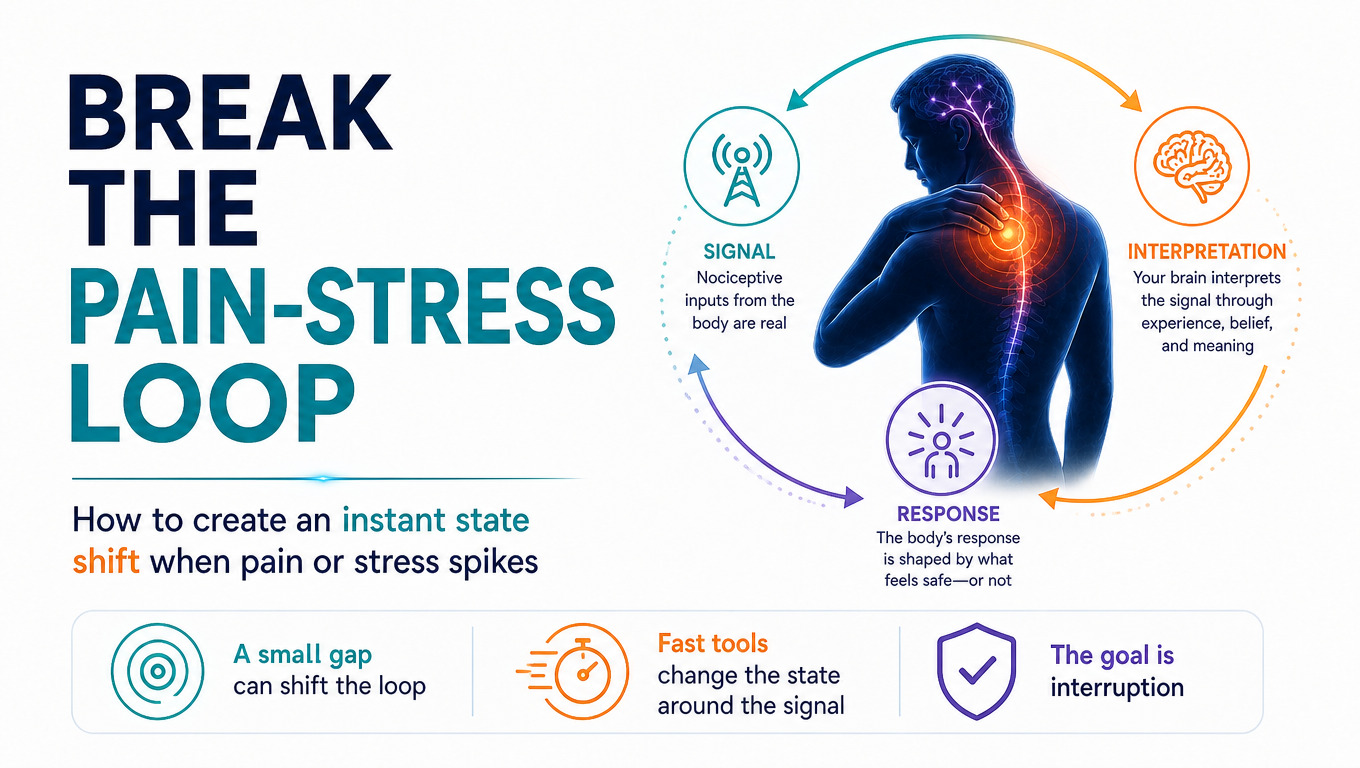
What happens when pain flares during a crucial client meeting? When stress floods your system before an unexpected crisis? When your chronic tension intensifies right before you need to perform at your peak? Is it truly possible to shift from the suffocating grip of the pain-stress loop to a place of power and peak performance in the very moment you need it most — without preparation, without medication, without someone else rescuing you?
The answer will transform how you show up as an entrepreneur and leader every single day.
The Moment Everything Changed
Let me take you back to a high-stakes morning that taught me everything I know about instant transformation.
I was supposed to be meeting with a potential client in Boston, someone who could transform my business trajectory. Instead, I found myself standing in a rental car office in New York at 6 AM, my carefully confirmed reservation suddenly meaningless. "The cars haven't been returned yet," the agent said with practiced indifference. "You'll have to wait."
Two hours evaporated while I stood there, watching my timeline crumble. The tension in my neck and shoulders, my chronic weak spot, began to build.
When I finally got behind the wheel, the universe wasn't finished testing me. Morning rush hour swallowed me whole. The highway had transformed into a construction nightmare, freshly laid asphalt shimmering in the brutal heat, abandoned cars littering the shoulder, their engines defeated by the relentless sun. Every mile took an eternity. The pain in my neck intensified with each passing minute of tension.
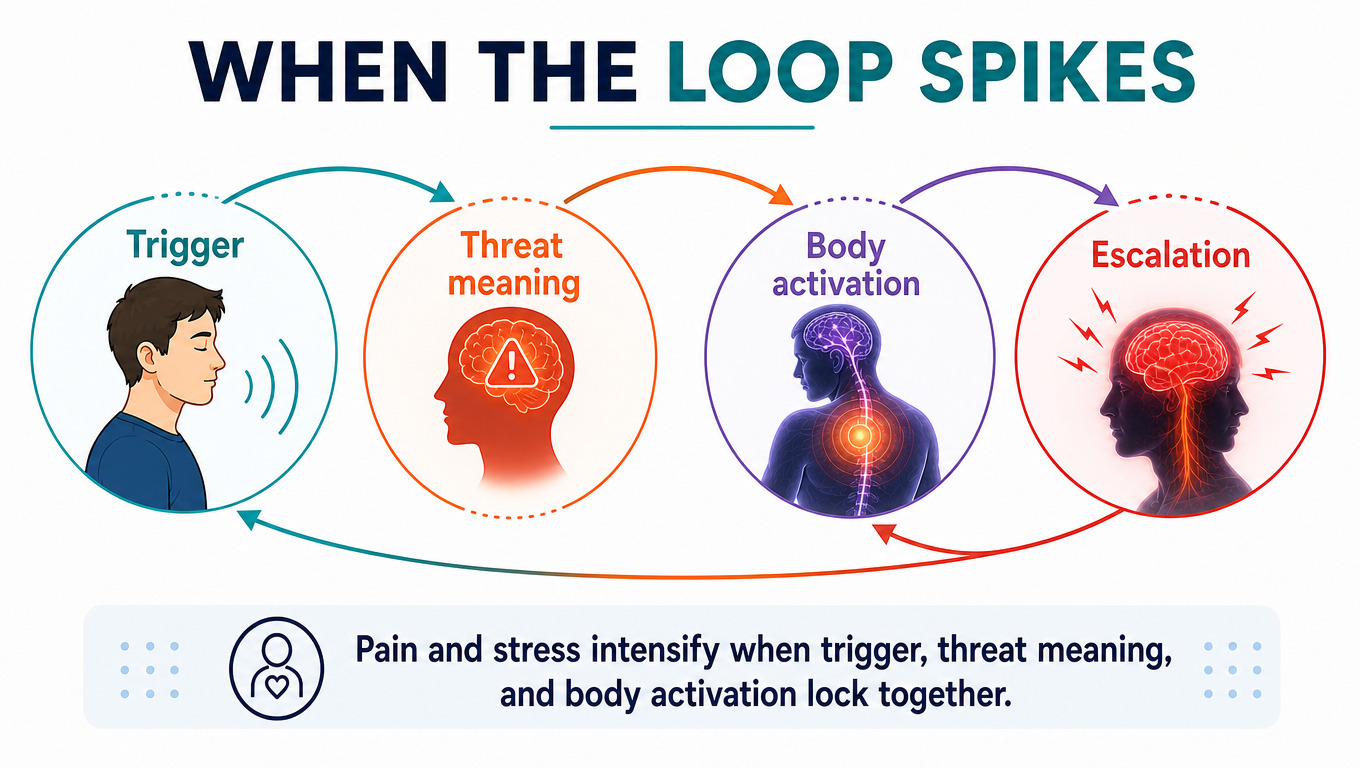
By the time I arrived in Boston, I'd missed the meeting. My potential client had moved on to another consultant. And I was drowning in a toxic cocktail of frustration, physical pain, and professional disappointment. The pain-stress loop was in full effect: stress amplifying pain, pain amplifying stress.
A colleague I was staying with noticed immediately. "You look terrible. What happened?"
I unloaded the entire saga: the incompetent rental company, the nightmarish traffic, the missed opportunity, the pain radiating through my shoulders.
Then he said something that shattered my reality: "But you're not in traffic now. You're here. And you still have a business to run tomorrow."
In that instant, everything changed. One heartbeat, I was trapped in a prison of my own making, replaying every frustrating moment, my body locked in pain. The next heartbeat, the tension released, my breathing deepened, and I could think strategically about the opportunities still in front of me.
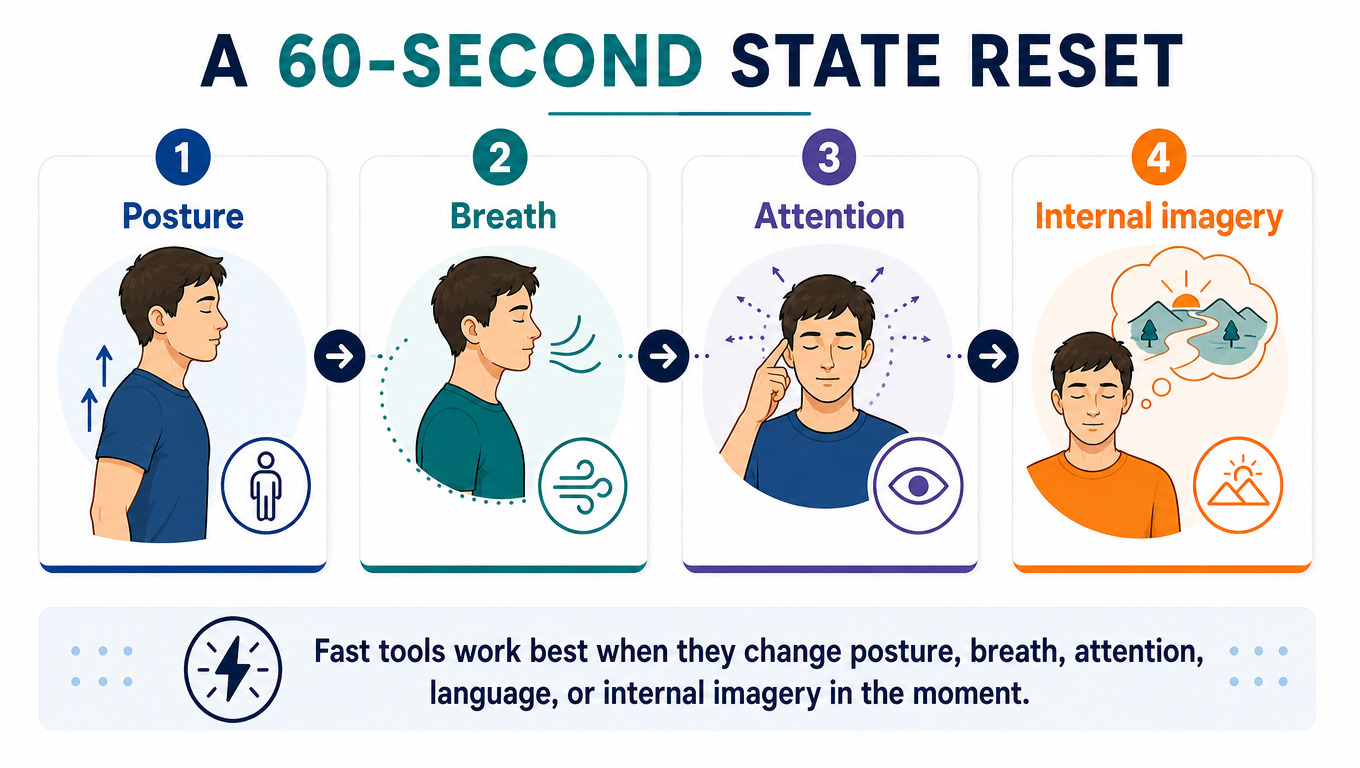
It was an instant state change — faster than thought, more powerful than any pain management technique I'd learned in all my NLP training. And it revealed a crucial question: Why was I waiting for someone else to give me this gift of freedom?
If a colleague could accidentally trigger this transformation with a simple perspective, why couldn't I learn to do it for myself whenever I needed it?
That question became my obsession. And what I discovered changed how I help high-performers break free from the pain-stress loop.
The Radical Truth: Your State Is Your Choice
Dr. William Glasser presents a revolutionary idea in his groundbreaking work Choice Theory that most executives reject the first time they hear it: your physical and emotional state is a choice.
Think about my reaction at that colleague's house. Dr. Glasser would cut through my justifications like a surgeon's scalpel: The reason I was stuck in pain and frustration wasn't because I'd spent hours in traffic. It was because, standing in that house surrounded by possibilities, I was actively choosing to generate a state of pain and stress.
Your mind might be rebelling right now. "That's ridiculous! I don't choose to have chronic pain!" "I don't choose to feel stressed before important meetings!" "I don't choose to be overwhelmed by my responsibilities!"
And you're right — it doesn't feel like a choice. That's what makes this insight so powerful and so difficult for high-achievers to accept.
But here's the truth that will unlock your peak performance: whether or not pain and stress are actually choices in some ultimate sense doesn't matter. What matters is that treating them as choices gives you power you never knew you had.
An Experiment for High-Performers
I want you to try something right now. Don't just read this — actually do it.
Think of a pain or stress you're experiencing right now. Maybe it's tension in your neck. Maybe it's anxiety about an upcoming deadline. Maybe it's that familiar ache that intensifies under pressure.
Now, notice the profound difference when you describe this state three different ways:
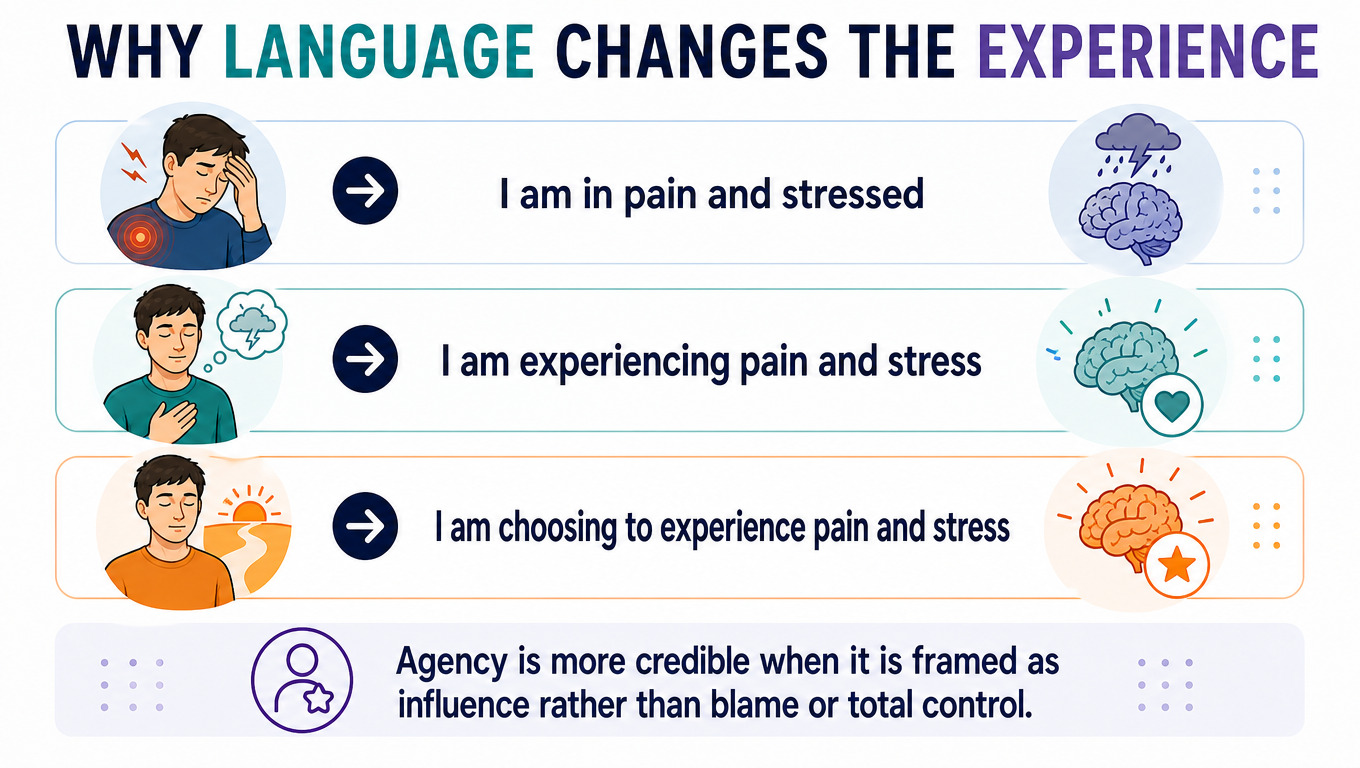
1. "I am in pain and stressed." Notice how this feels. You and the pain-stress are the same thing. There's no space between you and it. You're trapped, identified with the state itself.
2. "I am experiencing pain and stress." Slightly different, isn't it? There's a microscopic gap now — you are experiencing this state, but you're not identical to it.
3. "I am choosing to experience pain and stress." This one probably made you resist. But sit with it. What changes when you frame it this way? Suddenly, there's not just space — there's power. There's agency. There's the recognition that you could choose differently.
Which framing gives you the greatest freedom to perform? Which gives you the most power to change?
When I coach CEOs and entrepreneurs, one of the biggest breakthroughs comes from recognizing they can choose their state. A tech entrepreneur I worked with had spent years believing his chronic back pain and stress responses were inevitable — just the cost of building a company. The revelation that he'd been unconsciously choosing his pain-stress state was simultaneously devastating and liberating.
He asked me, "Why didn't you just tell me this in our first session?"
I smiled and asked him, "Would you have believed me?"
We live in a culture with a conflicted relationship with pain and stress. Some entrepreneurs suppress and hide what they're experiencing, treating it like weakness to be buried. Others wear their stress and pain like badges of honor, proof of how hard they're working. Some analyze endlessly. Others push through with pure willpower.
I'm not suggesting we ignore pain or pretend stress doesn't exist. These states contain valuable information. They're signals that deserve attention.
But here's what astonishes me every day: how often high-performers blindly accept whatever state shows up, as if they have no other options available.
Imagine running a company but accepting whatever strategy randomly emerges without evaluation. Imagine building a team but never choosing who to bring on. Imagine developing products but using whatever features someone else decides.
That's exactly what most professionals do with their pain-stress state. They accept whatever their nervous system generates without ever asking: "Is there a better choice available right now?"
The Astonishing Nature of the Pain-Stress Loop
Here's another experiment that will demonstrate something remarkable about the pain-stress loop you think is so solid.
Right now, think of an important task you've been avoiding. Maybe it's a difficult conversation with a business partner. Maybe it's reviewing financials that might be disappointing. Maybe it's finally addressing that operational issue. Something you can do, something you should do, but something you keep putting off.
When you think about doing this task right now, what do you experience? Does pain intensify? Does stress spike? Does your body tense up?
Now ask yourself one simple question:
Is there any reason I can't postpone deciding how I'll feel about this task until after I've completed it?
Notice what happens. Really pay attention.
If you're like the hundreds of entrepreneurs and professionals I've coached, something extraordinary just occurred. If there's genuinely no reason you need to be in the pain-stress loop before doing the task, that state often spontaneously evaporates. And suddenly you find yourself actually doing the thing you'd been avoiding, wondering why it seemed so difficult moments before.
The state that felt so real, so justified, so permanent — it was ephemeral all along. A pattern your nervous system was running, nothing more.
This is the gateway to pain-free performance. And the two techniques I'm about to share will give you the keys.
The Cloud Technique: Break the Loop in 30 Seconds
Imagine having the ability to shift from pain and stress to confidence and clarity — not over weeks of physical therapy, not through months of stress management, but in less time than it takes to make an espresso.
The Cloud Technique makes this possible. I've watched it transform client performance in moments, and I use it myself multiple times every week.
From Client Crisis to Peak Performance in 60 Seconds
Rachel was a VP at a fast-growing SaaS company facing a problem that threatened her career trajectory. She desperately wanted the C-suite, but quarterly board presentations triggered crippling shoulder and neck pain combined with anxiety so severe she could barely think clearly.
When I asked her in our coaching session to simply imagine walking into the boardroom, her body's response was immediate and intense. Her shoulders lifted toward her ears, her breathing became shallow, and tension visibly rippled across her upper back.
I could have spent months on pain management protocols, stress reduction techniques, and cognitive behavioral strategies. But I knew something Rachel didn't: she didn't need to manage her pain-stress state. She needed to discover that she could choose a different one.
"Rachel," I said, "I want you to understand something. That pain and anxiety you're feeling right now? You're generating it yourself, in this moment. Which means you can generate something else."
Her eyes showed skepticism mixed with desperate hope.
"Stand up," I instructed. "Close your eyes and imagine you're about to walk into that boardroom."
The transformation was instant. Her shoulders locked up, color drained from her face, and her breathing stopped — literally held captive by the pain-stress loop.
"Good," I said. "Now I want you to imagine that pain and stress as a cloud surrounding your body. What color is it?"
She paused, feeling into the experience. "Dark gray," she said.
"How big is it?"
"It's pressing down on my shoulders. Heavy."
"How is it moving?"
"It's not. It's just... crushing."
"Perfect. Now take a physical step to your left, and as you do, leave that cloud of pain and stress exactly where you were standing. Step out of it completely."
She moved, and I watched her shoulders drop slightly.
"Turn around and look at that cloud. See it there without you in it. We have to work quickly now, Rachel, because here's something important: without you inside it actively creating and regenerating that state, the cloud dissipates fast. It's already starting to dissolve."
She stared at the empty space.
"Given what you want — the C-suite position, the ability to influence strategy, becoming the leader you know you can be — is that pain-stress state serving you well?"
"Absolutely not!" The words burst out.
"Even though it's already dispersing, let's finish it. Take a deep breath and blow it out. Blow out that cloud like you're blowing out a candle."
She did. And something shifted in her entire presence.
"Now, walk over to a completely different spot. This is where we're going to create something new. I want you to imagine a different state — one that would actually serve you in that boardroom. What would enable peak performance?"
"Calm authority," she said without hesitation.
"Beautiful. See that calm authority as just a framework, waiting there. It hasn't activated yet because you're not in it. But the moment you step into it, it will turn on. Step in now."
She stepped forward, and I watched the transformation.
Her breathing became deep and natural. Her shoulders relaxed, but her spine remained upright, grounded, and powerful. When I asked her to imagine being in the boardroom now, she smiled and said, "I can see myself presenting the metrics clearly. I can field their tough questions. The pain is gone."
She was stunned. "How is this possible? It's been less than a minute!"
But we weren't finished. I wanted her to experience the full menu of state choices available to her as a leader.
Over the next five minutes, we practiced three more states: strategic clarity (where she could see patterns in the data instantly), energized confidence (where she felt excited rather than threatened by tough questions), and what she called "commanding presence" (where she felt larger than any single metric or critique).
Each state opened entirely different performance possibilities. With strategic clarity, she could pivot discussions toward opportunities. With energized confidence, she could use challenges to demonstrate her strategic thinking. With commanding presence, she could hold the entire conversation lightly, knowing she was bigger than any single board meeting.
Most importantly, Rachel learned she could evaluate different state choices and switch between them as the situation demanded.
Six months later, she got the C-suite position. Her pain during high-stakes presentations had dropped by 90%, and her performance reviews specifically noted her "exceptional composure under pressure."
When to Use the Cloud Technique
Use this technique whenever you notice yourself in the pain-stress loop, when your current state isn't enabling peak performance.
Pain flaring before a crucial client call? Use the Cloud Technique.
Stress spiking before a difficult conversation? Use the Cloud Technique.
Tension building during back-to-back meetings? Use the Cloud Technique.
And here's something crucial: trust yourself. Occasionally, you won't be able to shift your state easily. When that happens, respect it. Sometimes your body is telling you something important. Sometimes a change wouldn't be ecological. Honor that wisdom.
The Cloud Technique: Step-by-Step
Step 1: Identify and Externalize
Imagine the pain and stress you're feeling as a cloud surrounding your body. Don't analyze it, just notice it. What color is it? How large? Is it moving or static? Dense or wispy? Pressing in or hovering?
Step 2: Step Out and Observe
Physically move your body — take a step to the left, right, forward, anywhere. As you move, leave the cloud exactly where you were standing. Turn around and look at it from this new position. Ask yourself: "Given what I need to accomplish right now, is this state serving me well?"
Step 3: Choose Consciously
If the answer is yes — if that state is actually serving your performance — step back into it and own it fully. If the answer is no, recognize that the cloud is already dissipating without you there to continuously generate it. Take a breath and blow it out like extinguishing a candle.
Step 4: Create Your New State
Move to an entirely different location. Ask yourself: "What state would enable peak performance in this situation?" Calm authority? Strategic clarity? Energized confidence? Focused determination? Imagine that state as just a framework waiting to be activated.
Step 5: Step Into Your Choice
Walk into that new state framework and feel it activate. Notice how your body responds. Your breathing. Your posture. Your sense of what's possible. Ask yourself: "Does this serve my performance better?" If yes, you're ready to execute powerfully. If not, try another state.
The Tunnel Technique: Transforming Deep-Rooted Patterns
Some pain-stress patterns aren't just momentary. Some have roots that go deep, planted years or even decades ago. These are the states that show up in situations where they no longer make sense — the chronic pain that started after one failure but persists through every challenge, the performance anxiety that's disproportionate to actual risk.
The Cloud Technique works beautifully for current-moment shifts. But for those old, deeply embedded patterns — the ones that feel "stuck" — you need something more powerful.
You need the Tunnel Technique.
Breaking Free from Old Patterns
I was coaching a founder, I'll call Marcus, on persistent pain and anxiety before investor pitches. The pattern was so severe it was affecting his ability to raise capital.
As we explored the pattern in our sessions, we discovered it was connected to childhood experiences of harsh criticism from a demanding father who was never satisfied with his accomplishments.
"Marcus," I said, "I want you to notice where in your body you feel that fear and pain when you think about pitching."
He closed his eyes, dropping into the sensation. "It's like a band around my chest," he said. "Tight. Makes it hard to breathe."
"Good. I want you to reach in and take hold of that feeling. Pull it out of yourself and put it in front of you."
He made the motions.
"Now expand it. Make it bigger. Make it the size and shape of a doorway."
He nodded.
"Here's what's about to happen. That doorway leads to a tunnel. On the other side is a different state — I can't tell you what it is. But here's the rule: once you enter that tunnel, you must keep walking forward no matter what. Can you commit to that?"
"Yes."
"Then step into the doorway. Close it behind you. Feel the fear surrounding you completely as you walk forward through the tunnel. Keep moving. Find the exit."
I watched his face as he moved through the experience. It took perhaps thirty seconds before his expression changed completely.
"I'm out," he said, and his voice had transformed. It was stronger, sharper.
"What do you feel now?"
"Anger. I'm furious at my father. Nothing I did was ever good enough. I'm angry that I'm still carrying his voice into these pitch meetings."
This was progress; anger is more empowering than fear for a founder. But we weren't done.
"Make the anger into a doorway and walk through it too."
He did. And when he emerged on the other side of that second tunnel, his entire presence had shifted.
"What is it now?"
"Freedom," he said, wonder in his voice. "And self-acceptance. I can see that I get to decide what's good enough now. Not him. Me."
The entire process took less than two minutes. His next three investor pitches resulted in term sheets. His chronic pain before pitches dropped by 85%, and he reported feeling "like a different person" in high-stakes situations.
The Tunnel Technique: Step-by-Step
Step 1: Locate and Externalize
Notice where in your body you feel this old pattern. Chest? Shoulders? Stomach? Back? With your hands, reach in and remove it. Pull it out and place it in front of you. Expand it until it's the size and shape of a doorway.
Step 2: Commit to Movement
You must agree before entering: once you step through, you will keep moving forward no matter what. The only way out is through.
Step 3: Walk Through
Step into the doorway. Close it behind you. You're in a tunnel made of this state. Feel it surrounding you as you keep walking forward. Look for the exit. Keep moving. (This takes less than 30 seconds.)
Step 4: Emerge and Assess
Step out and notice what you feel now. If you've reached a place that feels healthy and whole — freedom, clarity, and self-acceptance — you're complete. If you've emerged into another strong emotion that's been suppressed, create another doorway and walk through that tunnel as well. Continue until you reach wholeness.
Your Path to Pain-Free Performance
Both techniques are deceptively simple. They're so quick, so easy, that your analytical mind will insist they couldn't possibly work for chronic patterns.
That's exactly why you need to try them.
I use these techniques regularly with myself and with clients. They can be used alone, without support, without prior planning. You can use the Cloud Technique in a bathroom before an important meeting, in your car before a difficult conversation, or at your desk when the pain-stress loop threatens to derail your day.
Despite their elegant simplicity, these techniques are inherently wise. They won't force artificial positivity. They won't suppress important signals. They'll move you toward the freedom to choose states that serve your highest performance.
But here's what I really want you to understand: This isn't just about managing pain and stress. This is about fundamentally transforming your relationship with your own nervous system.
Once you truly grasp that your state is a choice, once you experience the freedom of stepping out of the pain-stress loop and into peak performance in seconds, everything changes. You stop being a victim of your body's reactions and become their conscious creator. You stop asking "Why do I feel this way?" and start asking "What state will enable my best performance?"
That shift is everything for a high-performer.
So, I'm asking you: the next time you notice yourself in the pain-stress loop, will you try one of these techniques? Will you give yourself permission to step out of the cloud, or walk through the tunnel, and discover what peak performance feels like on the other side?
Your pain-free performance is waiting. It's been waiting your whole career.
All you have to do is choose it.
Ready to Break Your Pain-Stress Loop?
Book a coaching session and learn the Cloud and Tunnel Techniques hands-on.
Book a Free Discovery Call
Rami Bareket
Rami Bareket is an NLP Master Trainer and hypnotherapist with over 30 years of entrepreneurial experience and 20 years as a combat medic. Through NLP, hypnosis, and integrative transformation work, he helps high performers create fast and lasting change from the inside out.
Read Full Bio