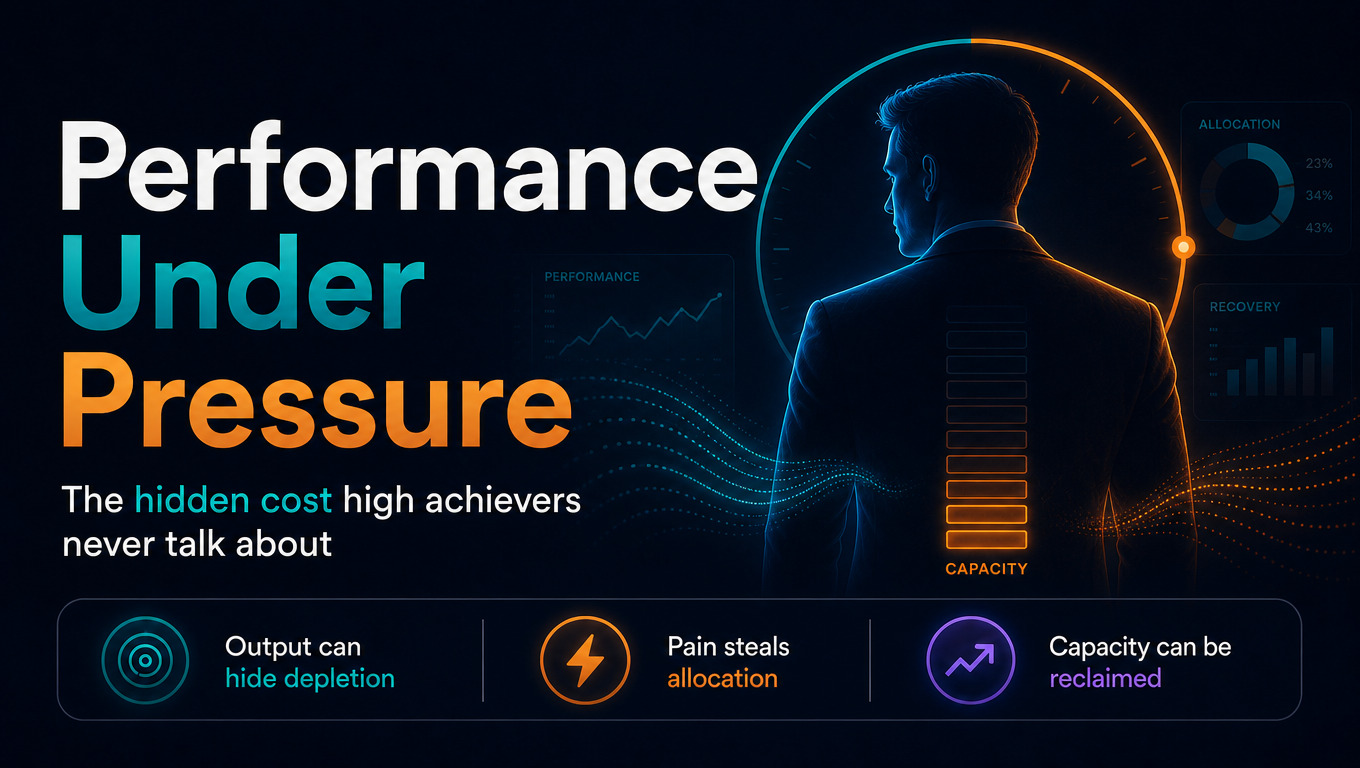
The hidden cost high achievers never talk about
Quick read.
- High achievers often hide pain-related cost behind strong output.
- The deeper cost is frequently not just the sensation, but the capacity permanently assigned to managing it.
- That hidden allocation affects attention, decision quality, and presence.
- Reducing pain-related threat can return business capacity, not just comfort.
- The point is not lower ambition. It is more available bandwidth.
Editorial note. This branded editorial version rewrites and restructures the original source material for clarity. It is educational content and not a substitute for individualized medical care or emergency assessment.
The quiet tax of pain and stress is rarely visible on a spreadsheet. It does not appear as a meeting canceled or a project missed. It shows up as part of a person's bandwidth being consumed all day long by management of the signal.
That is why so many high achievers look fine from the outside while feeling privately spent from the inside. The output still arrives. The cost is simply hidden inside the way the output is being produced.
If leadership and performance are capacity games, then hidden pain allocation is not a side issue. It is a central one.
Where the capacity goes
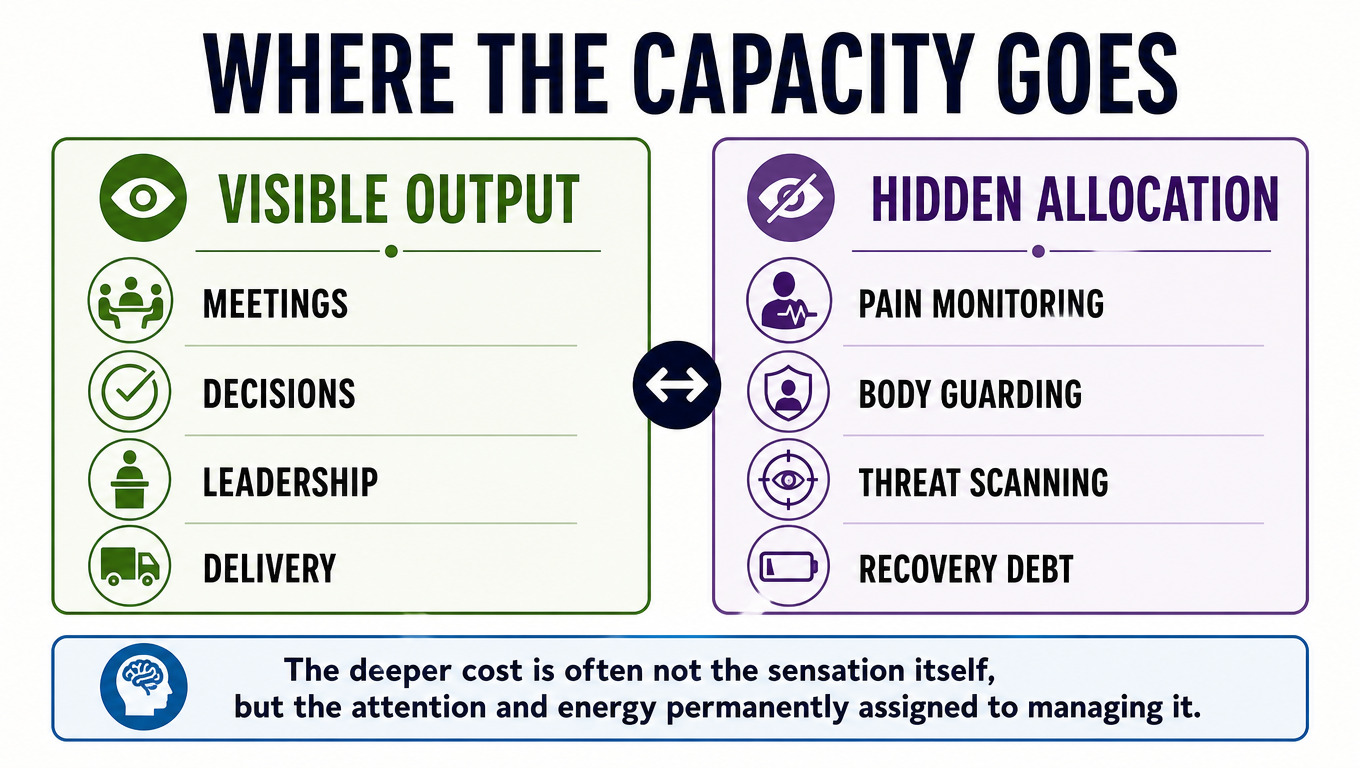
Figure: A two-column visual separating visible output from hidden pain-related allocation.
Visible output includes the meeting, the decision, the presentation, and the leadership presence. Hidden allocation includes body monitoring, bracing, symptom management, threat scanning, position-shifting, and background stress load.
Both draw from the same finite system. That means pain does not only hurt. It also competes for cognitive, emotional, and physiological resources.
Why the cost stays invisible
High achievers are often excellent at producing results despite internal strain. That skill is why the outside world misses the cost. The work still gets done, so the price appears negligible.
But a cost can be real even when it is invisible. If a nervous system is permanently running a background process of vigilance, it is consuming capacity that should be available for clearer decisions, broader thinking, and more genuine presence.
Returning the allocation
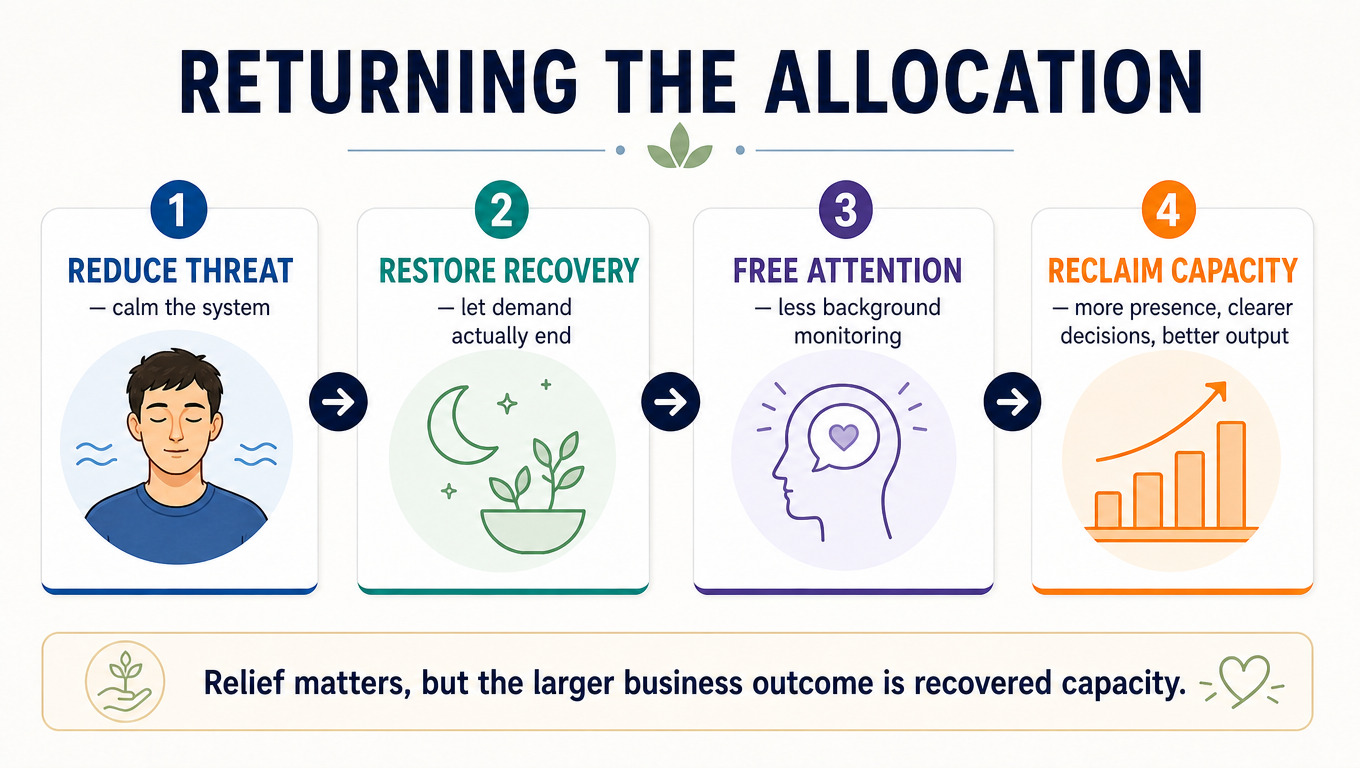
Figure: A four-step sequence showing reduced threat, restored recovery, freed attention, and reclaimed capacity.
The real opportunity is not only symptom reduction. It is the return of allocation. Less threat means less guarding. Better recovery means less background load. That frees more attention for work that actually matters.
When people address the deeper pattern, they often describe the outcome not only as relief, but as reclaimed capacity: more clarity, more patience, better access to judgment, and more room for the people around them.
Why this matters strategically
From a performance lens, a depleted system creates hidden drag across every decision and interaction. From a leadership lens, it limits how much presence a person can truly bring to the room.
That makes pain and stress patterns more than personal discomfort issues. They become strategic capacity issues that affect execution quality over time.
Capacity lens upgrade
| Less helpful pattern | More helpful pattern |
|---|---|
| Pain is only a comfort problem | Pain is also a bandwidth and decision-quality problem. |
| As long as output stays high, cost is acceptable | Hidden cost matters even when output still looks strong. |
| Relief is a lifestyle issue | Relief can be a capacity and performance issue. |
| Recovery is optional when results are good | Recovery protects the ability to keep producing well. |
Final thought
The most expensive cost of pain under pressure is often not what people can see. It is what the system is spending to appear unaffected.
When that allocation is returned, people do not only feel better. They often perform closer to their real capacity.

Rami Bareket
Rami Bareket is an NLP Master Trainer and hypnotherapist with over 30 years of entrepreneurial experience and 20 years as a combat medic. Through NLP, hypnosis, and integrative transformation work, he helps high performers create fast and lasting change from the inside out.
Read Full Bio