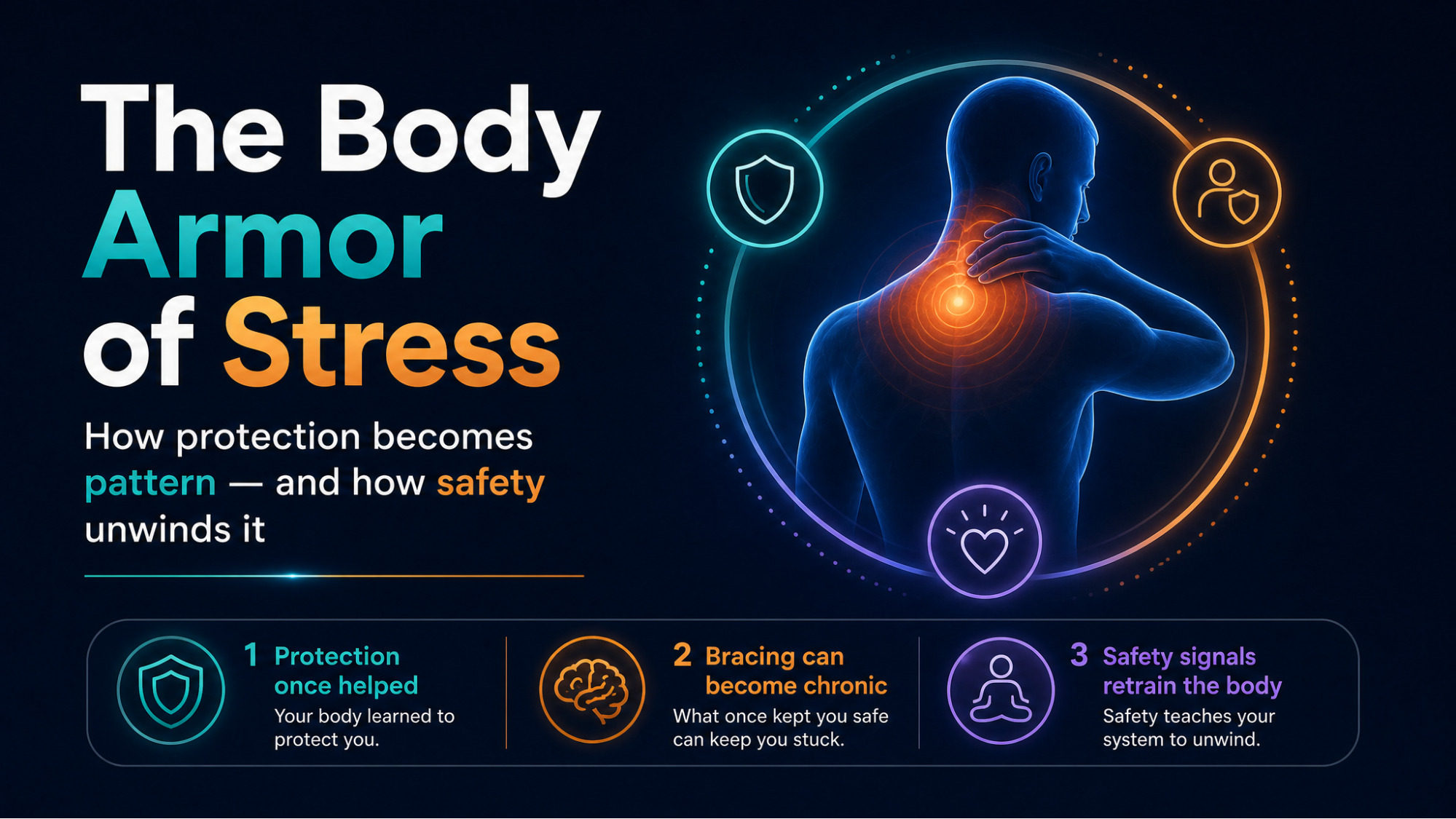
Quick read. This blog explains how chronic bracing becomes familiar, why tension can start feeling normal, and how safety signals help retrain the body over time.
There is a kind of tension that does not feel like tension anymore.
It feels normal.
It feels like your posture.
It feels like your personality.
It feels like the way you sit at your desk, the way you hold your jaw, the way your shoulders rise without permission, the way your stomach tightens before an important meeting, the way your breath becomes shallow when someone asks for “just one more thing.”
At first, this tension may have been useful.
It helped you push through.
It helped you stay alert.
It helped you perform under pressure.
It helped you avoid mistakes.
It helped you survive moments where failure, rejection, criticism, conflict, or emotional pain felt too costly.
But when the body keeps protecting you long after the threat is gone, protection can slowly become pressure.
And pressure, when it stays in the body for too long, becomes a form of armor.
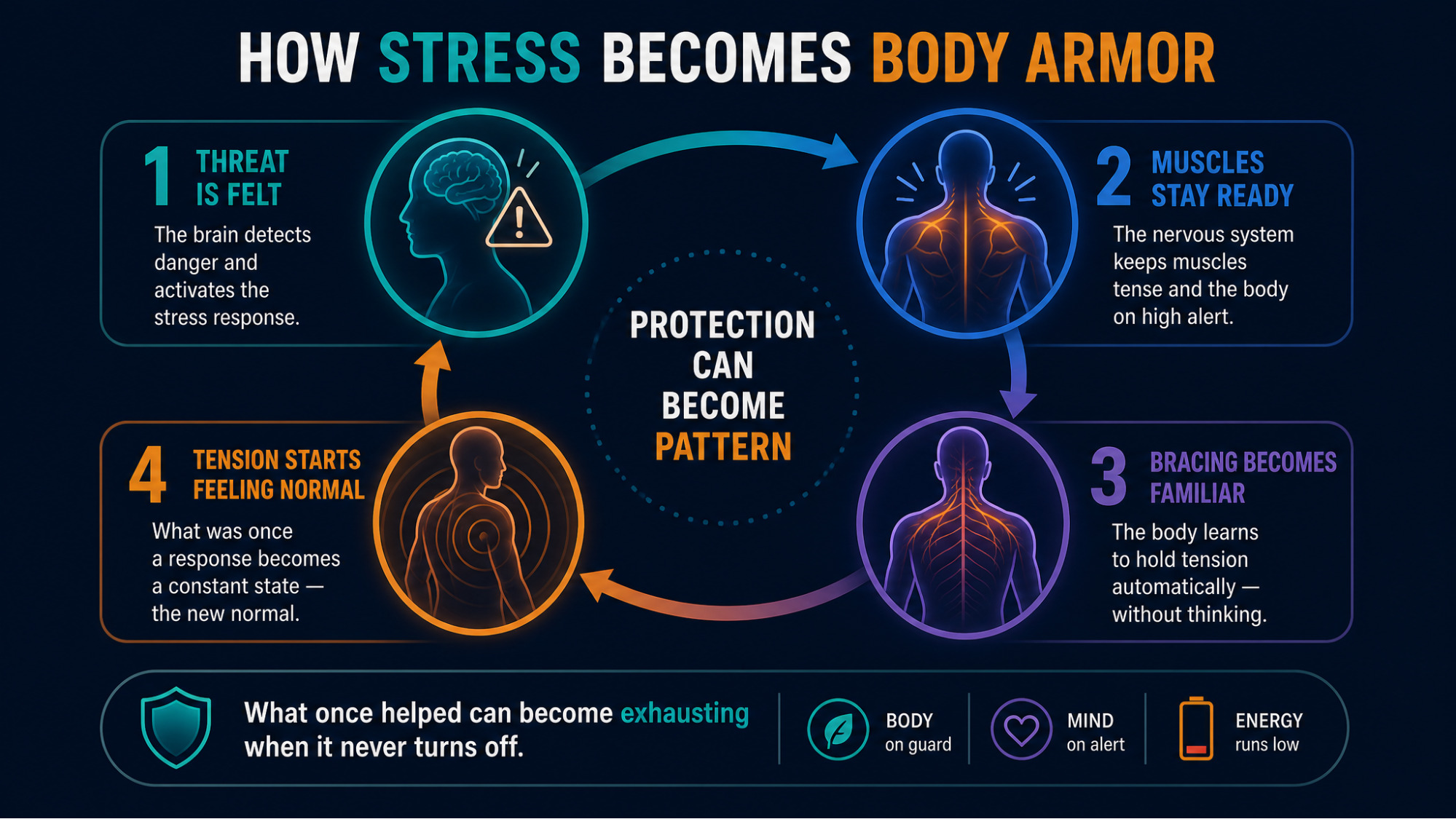
Figure: The core arc moves from useful protection to learned armor — and then toward retraining through safety signals.
Not armor you consciously chose.
Not armor you built because something is wrong with you.
Armor your nervous system created because, at some point, it believed you needed it.
Your Body Learns Protection Before Your Mind Understands It
High-performing people often believe stress is mainly mental.
They think it begins with thoughts.
Deadlines.
Expectations.
Responsibilities.
Pressure.
Fear of disappointing others.
Fear of losing momentum.
Fear of being seen as weak, unprepared, slow, or incapable.
But the body does not wait for a full explanation before it responds.
The nervous system is built to detect possible danger quickly. It is designed to protect you before you have time to think through every detail.
When you experience criticism, rejection, conflict, emotional pain, uncertainty, or even the possibility of failure, your brain and body may interpret it as a threat.
Not always a physical threat.
Sometimes it is a social threat.
A relational threat.
A status threat.
A safety threat.
A threat to belonging.
A threat to identity.
A threat to control.
A threat to the version of yourself you have worked so hard to maintain.
When that happens, areas of the brain involved in threat detection, such as the amygdala, can activate the body’s survival response. The stress system begins to organize the body for protection.
The hypothalamus helps activate the HPA axis, which is one of the body’s main stress-response pathways. Cortisol and adrenaline can rise. The autonomic nervous system shifts the body into alertness.
The body prepares.
Muscles tighten.
Breathing becomes more shallow.
The jaw may clench.
The neck may brace.
The shoulders may lift.
The chest may harden.
The stomach may contract.
But if this happens again and again, the body can begin to learn that protection is not a temporary response.
It can become a default state.
This Is How Emotional Protection Becomes Physical Tension
Many high achievers are not walking around saying, “I feel unsafe.”
They say things like:
“I’m fine.”
“I just need to finish this.”
“I can handle it.”
“I don’t have time to slow down.”
“I’ll rest after this project.”
“It’s not that bad.”
But the body often tells a different story.
The body may say:
Your jaw is still fighting.
Your shoulders are still defending.
Your stomach is still waiting.
Your breath is still guarded.
Your nervous system is still preparing for something.
This is why chronic stress is not only a mindset issue.
It is not only about thinking differently.
It is not only about being more positive.
It is not only about changing your schedule.
Those things can help, but they may not reach the deeper pattern if your body has already learned to hold protection as a survival strategy.
Because the body does not only respond to what is happening.
It also responds to what it has learned to expect.
If your nervous system has learned that pressure is constant, it may continue to prepare for pressure even when you are technically safe.
This is why some people finally take a vacation and still cannot relax.
This is why some people finish the big project and still feel wired.
This is why some people leave the stressful meeting and still feel tight hours later.
This is why some people know, mentally, “I’m okay,” but their body continues to act as if something is still wrong.
The mind may understand safety.
The body may still be waiting for proof.
The Armor Was Intelligent Before It Became Exhausting
One of the most important shifts is this:
It may be your body’s learned protection.
Your body may have discovered that if it tightens, you feel more ready.
If it braces, you feel less vulnerable.
If it controls your breath, you feel less exposed.
If it keeps you alert, you make fewer mistakes.
If it numbs certain feelings, you keep functioning.
At some point, this may have helped.
For the executive who cannot afford to break down.
For the entrepreneur carrying financial pressure.
For the professional who learned that weakness is dangerous.
For the high achiever who learned to earn approval through performance.
For the person whose nervous system learned that slowing down creates anxiety.
But what once protected you can eventually start to limit you.
The same tension that helped you survive pressure can begin to create pain.
The same alertness that helped you perform can begin to disturb sleep.
The same emotional control that helped you stay composed can begin to disconnect you from joy, intimacy, and ease.
The same inner pressure that helped you succeed can begin to make success feel strangely empty.
This is the hidden cost of chronic stress.
It does not only take energy.
It changes the way your body experiences life.
The Price of Staying Armored Too Long
When the stress system is active for too long, the body does not simply “calm down” because you tell it to.
The body may continue operating as if danger is still present.
Over time, this can show up as:
Chronic tightness in the neck, shoulders, jaw, or back.
A heavy chest or restricted breathing.
Digestive discomfort.
Sleep disruption.
Sensitivity to noise, conflict, or criticism.
Fatigue that does not fully improve with rest.
Feeling emotionally flat or disconnected.
Difficulty receiving care, affection, or support.
A sense that your body is always “on.”
For high performers, this can be confusing.
Because from the outside, life may look successful.
You may be productive.
Responsible.
Capable.
Respected.
Reliable.
You may be the person others count on.
But inside, your body may be paying for the performance.
This is why many people do not realize how much stress they are carrying until the body begins speaking louder.
Pain.
Burnout.
Tension.
Headaches.
Gut issues.
Sleep problems.
Emotional numbness.
Sudden anxiety.
Low energy.
The body often whispers before it screams.
But high performers are trained to override whispers.
So the body eventually has to become more direct.
Your Body Is Not Betraying You
When pain, tension, or fatigue appears, many people feel frustrated with their body.
They say:
“Why is my body doing this to me?”
“Why can’t I just push through like before?”
“Why am I so sensitive now?”
“Why does my body react when I know I’m safe?”
But your body is not betraying you.
It may be saying:
I have been holding too much for too long.
I need a different signal.
I need to know the pressure is over.
I need permission to soften.
I need safety, not just logic.
I need you to stop treating me like an obstacle.
The body does not release protection because the mind demands it.
It releases protection when it begins to sense that protection is no longer needed.
That is a very different process.
This is where many people get stuck.
They try to relax from the mind.
They tell themselves to calm down.
They repeat positive thoughts.
They push harder.
They analyze the problem.
They try to convince themselves that everything is fine.
But if the nervous system is still reading danger, the body will not fully let go.
Because the body does not respond only to information.
It responds to signals.
The Body Needs a New Signal
If your body learned tension through repeated signals of pressure, it needs repeated signals of safety.
Not once.
Not perfectly.
Not dramatically.
Repeatedly.
This is not about forcing the body to relax.
That often creates more resistance.
It is about creating a new relationship with the body.
Instead of saying, “Stop doing this,” you begin to say, “I see what you are trying to do.”
Instead of attacking the tension, you begin to listen to it.
Instead of treating symptoms as enemies, you begin to ask what state the body is trying to protect you from.
This is where real change begins.
Not by fighting the body.
Not by ignoring the body.
Not by pushing through the body.
But by communicating with the body in a language it understands.
That language is not only words.
It is breath.
Posture.
Tone.
Attention.
Touch.
Pacing.
Permission.
Safety.
Presence.
Your body is always listening.
The question is whether the signals you send tell it to defend or allow it to soften.
Why High Performers Struggle to Release the Armor
High performers often have a unique challenge.
They are very good at control.
They know how to focus.
They know how to discipline themselves.
They know how to stay committed.
They know how to endure discomfort.
These qualities can create success.
But when applied to the nervous system, the same strategy can backfire.
You cannot dominate your nervous system into safety.
You cannot shame your body into healing.
You cannot pressure your muscles into trust.
You cannot force your body to feel safe by treating it as another performance project.
The body does not respond well to inner aggression disguised as self-improvement.
Many high achievers try to heal the same way they succeed:
More effort.
More information.
More discipline.
More control.
More intensity.
But the nervous system often needs something different.
It needs consistency.
Gentleness.
Clarity.
Repetition.
A felt sense of safety.
The armor did not form in one moment, so it usually does not release through one insight.
It releases as the body learns, gradually, that it no longer has to stay defended all the time.
The Difference Between Relaxation and Regulation
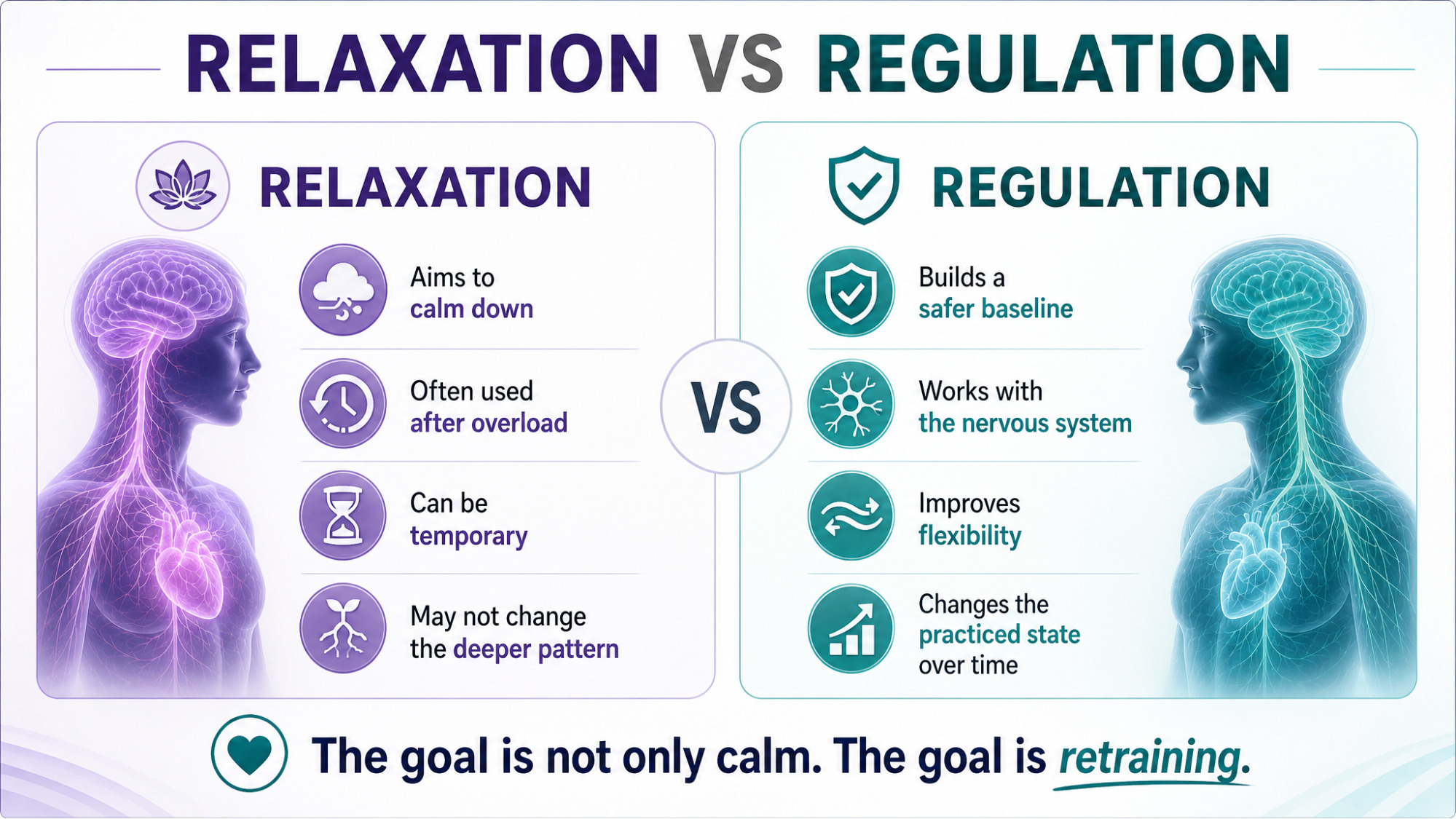
Figure: Passive calm and active nervous-system regulation are not the same; regulation is meant to work in real life.
Relaxation is what most people think they need.
Regulation is often what the nervous system actually needs.
Relaxation says, “Calm down.”
Regulation says, “Let’s help the body find a safer rhythm.”
Relaxation may feel passive.
Regulation is active communication with the nervous system.
Relaxation may happen after a vacation, massage, or quiet evening.
Regulation can happen in the middle of real life, while you are working, parenting, leading, creating, managing, deciding, and dealing with pressure.
This matters because most high performers do not need a nervous system that only works when life is quiet.
They need a nervous system that can return to balance even when life is demanding.
That is the deeper goal.
Not to eliminate challenge.
Not to avoid pressure forever.
Not to become fragile.
But to stop living as if every challenge requires full-body defense.
A Simple Practice: Speaking to the Body Through Safety Signals
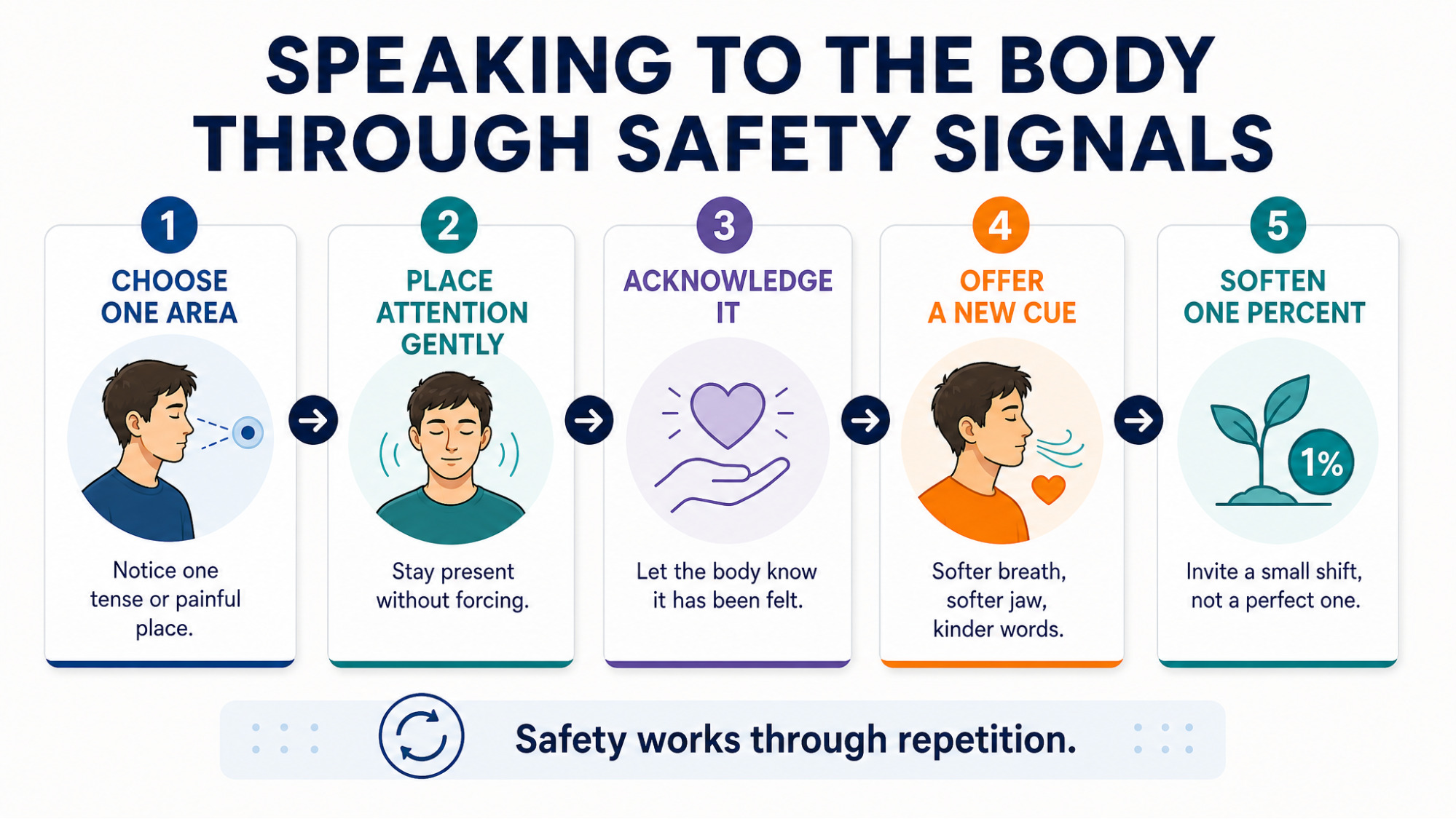
Figure: The practice emphasizes gentle attention, acknowledgment, and one-percent softening instead of force.
Here is a simple way to begin.
Do not try to fix everything.
Do not try to release all tension at once.
Choose one area where your body often holds stress.
Jaw.
Neck.
Shoulders.
Chest.
Stomach.
Lower back.
Place your attention there gently.
Not like a problem to solve.
More like a child you are checking on.
Then say internally:
“I see you.”
Pause.
Let your breath slow slightly.
Then say:
“You do not have to protect me this way right now.”
Pause again.
Let the area respond or not respond.
Do not force it.
Then add:
“We can soften one percent.”
That is enough.
One percent is powerful because it does not threaten the body.
The nervous system often resists big change because big change feels unsafe.
But small change can enter quietly.
A softer exhale.
A lower shoulder.
A little more space in the jaw.
A slower breath.
A different tone toward yourself.
This is how the body begins to learn.
The Question Is Not “Why Am I So Tense?”
A better question is:
“What has my body been trying to protect me from?”
And then:
“Is that protection still needed in this moment?”
This does not mean the original stress was imagined.
It does not mean the pain is fake.
It does not mean the tension is only emotional.
But the body may be running an old protective pattern in a new environment.
That is where healing becomes possible.
Because if the body learned the pattern, the body can learn a new one.
The Body Armor Can Become a Doorway
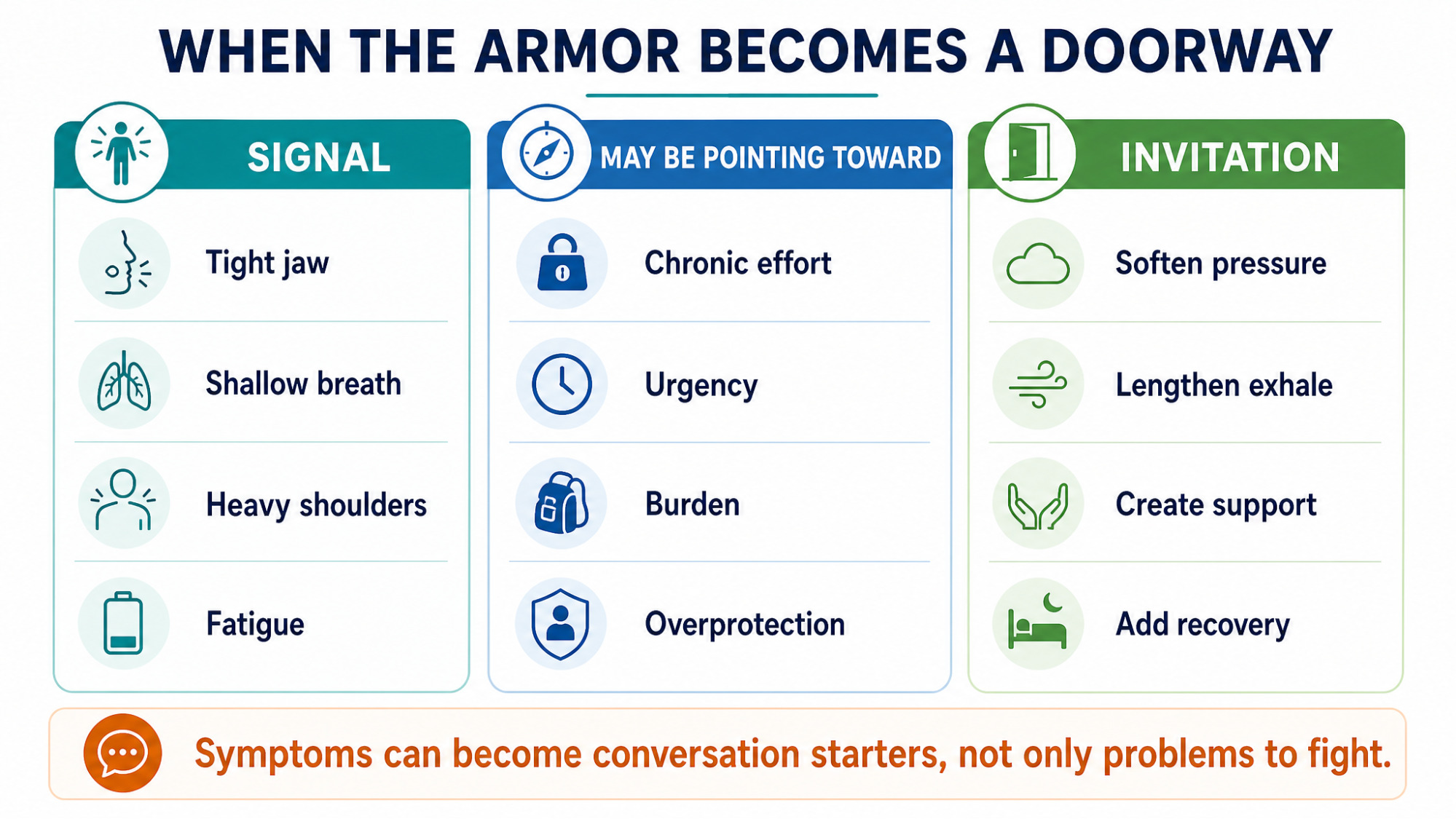
Figure: Symptoms can be treated as meaningful signals without reducing them to simplistic explanations.
Many people see their symptoms as interruptions.
But sometimes the symptom is the doorway.
The tight jaw may be showing where you hold back your voice.
The shoulder tension may be showing how much responsibility you carry.
The stomach contraction may be showing how often you brace for disappointment.
The chest tightness may be showing where closeness has become complicated.
The shallow breath may be showing that your system has not fully believed it is safe to expand.
This does not mean every symptom has a simple emotional cause.
It means the body deserves to be included in the conversation.
Because the body often remembers what the mind has learned to explain away.
And for high performers, that is especially important.
You may be able to explain your stress beautifully.
You may understand why you are tired.
You may know exactly what happened.
You may have language for your patterns.
But understanding is not always the same as release.
The body needs participation.
The body needs experience.
The body needs signals that reach below logic.
Healing Is Not Becoming Unprotected
Some people are afraid that if they release the armor, they will become weak.
But healing is not about becoming unprotected.
It is about becoming appropriately protected.
There is a difference between a body that can protect you when needed and a body that cannot stop protecting you.
There is a difference between strength and bracing.
There is a difference between readiness and chronic alertness.
There is a difference between boundaries and shutdown.
There is a difference between resilience and numbness.
The goal is not to remove your ability to protect yourself.
The goal is to help your nervous system stop living in protection mode when protection is no longer required.
That is where more energy becomes available.
The New Relationship With Your Body
Your body is not just the place where stress shows up.
It is also the place where safety can be rebuilt.
Every time you breathe differently, you are communicating.
Every time you soften your jaw, you are communicating.
Every time you slow down before reacting, you are communicating.
Every time you place a hand on your chest instead of criticizing yourself, you are communicating.
Every time you notice tension without attacking it, you are communicating.
And over time, the body begins to learn:
Maybe I do not have to hold so tightly.
Maybe I do not have to prepare for danger all day.
Maybe I can release one layer.
Maybe I can trust this moment.
Maybe I can let life in again.
Final Thought
The body armor of stress was not created because you failed.
It was created because your system tried to protect you.
But protection that never turns off becomes its own kind of pain.
For high-performing professionals, the next level of healing is not just doing less.
It is learning how to send the body new signals while you live, work, lead, love, and create.
Your body does not need to be forced into peace.
It needs to be shown, again and again, that peace is safe.
And when the body finally believes that, it can begin to release what it has been carrying for years.
If one part of your body tends to brace before pressure arrives, what might shift if you treated that area less like an obstacle and more like a part of you that learned to protect too early and too long?
This article is for educational purposes only and is not a substitute for medical advice. If you have persistent, worsening or severe pain, or symptoms that concern you, please speak with a qualified healthcare professional.

Rami Bareket
Rami Bareket is an NLP Master Trainer and hypnotherapist with over 30 years of entrepreneurial experience and 20 years as a combat medic. Through NLP, hypnosis, and integrative transformation work, he helps high performers create fast and lasting change from the inside out.
Read Full Bio