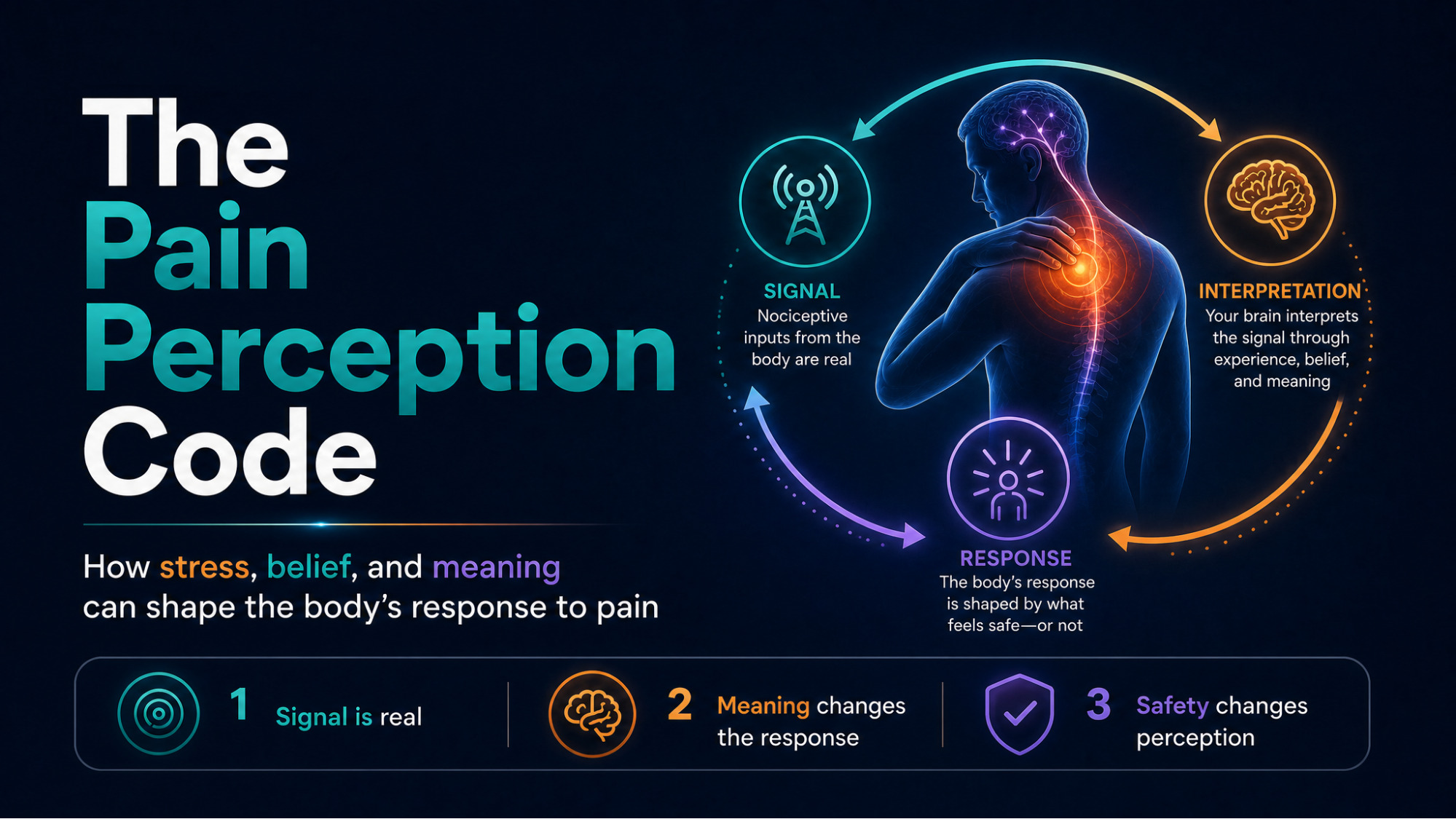
“I know it is probably stress, but my body does not feel safe.”
That is where many high performers get stuck.
The mind understands the explanation.
Stress can make pain worse.
Fear can tighten the body.
Pressure can increase symptoms.
The nervous system can become more sensitive.
But even when the mind understands, the body may still react.
The shoulders still rise.
The jaw still locks.
The breath still becomes shallow.
The pain signal still feels louder.
The body still behaves as if something is wrong.
This is where one deeper question begins to matter:
What is your body responding to?
Not only what is happening.
But what your nervous system believes is happening.
The Body Does Not Respond Only to Reality
In the 1980s, Bruce Lipton became known for emphasizing the idea that cells respond to their environment, not only to genetic programming. The broader scientific field of epigenetics supports the idea that behaviors and environment can affect how genes work, without changing the DNA sequence itself. The CDC describes epigenetics as changes that affect the way genes work, and notes that these changes can be influenced by behaviors and environment.
That point matters.
Because for a long time, many people thought biology was mostly fixed.
Your genes decide.
Your body follows.
Your outcome is written.
But epigenetics introduced a more flexible view.
The environment around the cell matters too.
Nutrition.
Stress.
Sleep.
Toxins.
Movement.
Inflammation.
Safety.
Emotional state.
Life experience.
The National Institute of Environmental Health Sciences explains epigenetics as processes that help direct when genes are turned on or off, like instructions that tell the cell which parts of the genetic "instruction manual" to read.
For PainShift language, we can say it simply:
The body is always listening to the environment.
And part of that environment is not only outside you.
It is also inside you.
Your perception.
Your beliefs.
Your interpretation.
Your meaning.
Your nervous system state.
Same Signal. Different Environment. Different Response.
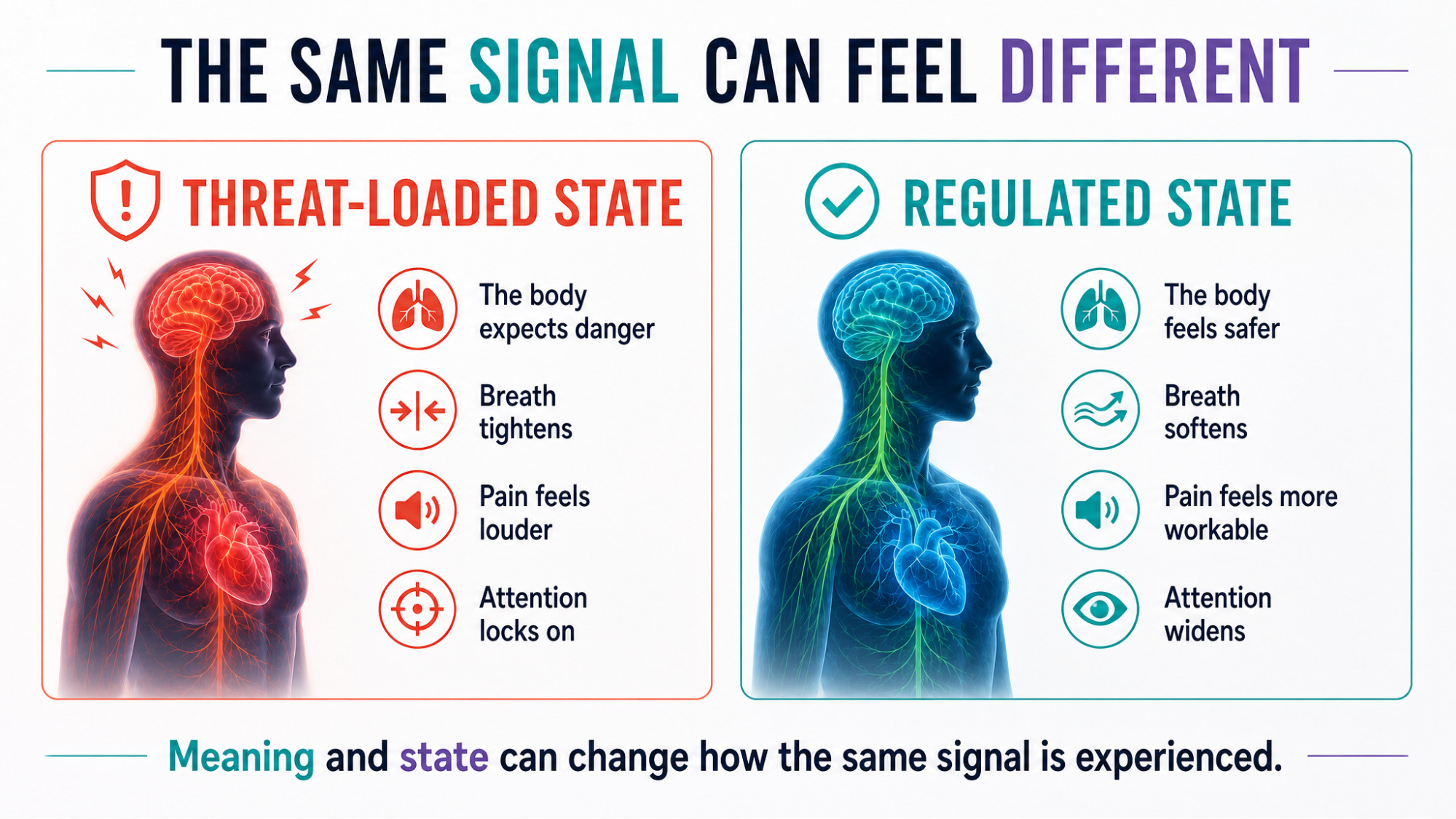
Figure: The same sensation can feel manageable or dangerous depending on the internal environment surrounding it.
Lipton's popular teaching often uses the example of genetically identical cells placed in different environments and developing differently. Whether or not every detail of the social media version is perfectly stated, the core educational point aligns with modern epigenetics:
The environment influences biological expression.
In PainShift terms, this is exactly what happens with pain.
The same sensation can feel very different depending on the internal environment.
A tight neck during a relaxed afternoon may feel annoying.
The same tight neck before a high-stakes presentation may feel threatening.
A back ache after a walk may feel understandable.
The same back ache before a long workday may feel like danger.
A flare on a quiet Sunday may feel manageable.
The same flare during a deadline may feel like a crisis.
The body signal may be similar.
But the environment around the signal is different.
And the nervous system responds to that environment.
The Internal Environment of Pain
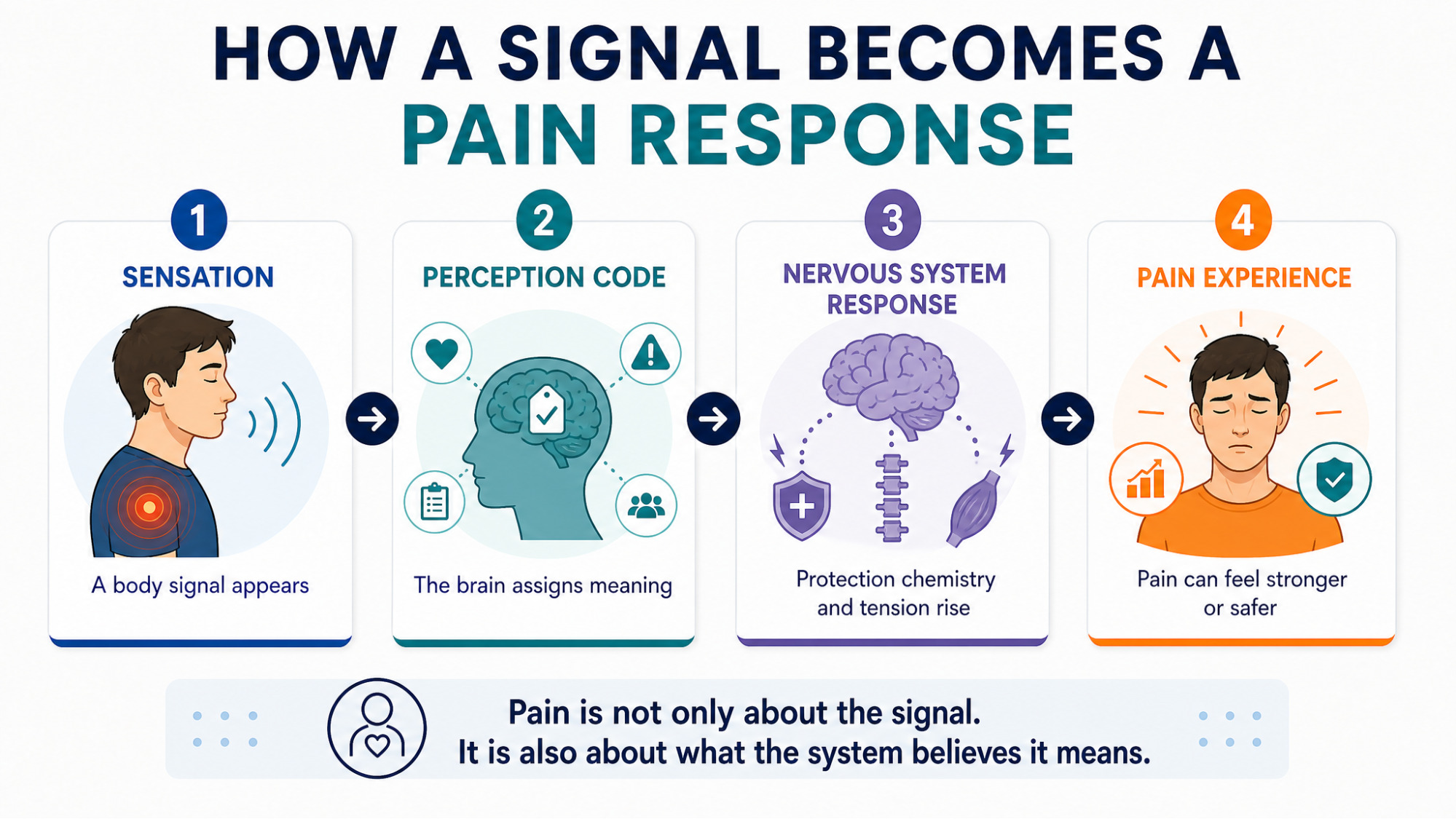
Figure: Pain is not only about the signal itself, but also about what the nervous system believes the signal means.
When a pain signal appears, your body is not only processing tissue information.
It is processing the whole internal context.
What does this mean?
Am I safe?
Have I felt this before?
What happened last time?
Do I need to protect?
Can I handle this?
Will this interfere with my work, my role, my identity, my future?
That is the perception code.
Not a mystical code.
A nervous system pattern.
A learned way the brain interprets body signals.
If the perception is:
“This is dangerous,”
the body may protect.
If the perception is:
“This is a signal I can work with,”
the body may begin to regulate.
The signal matters.
But the perception around the signal can change the whole response.
Fear Changes the Body
Fear is not just a thought.
Fear changes physiology.
When the nervous system detects threat, the body shifts into protection.
Muscles tighten.
Breathing becomes shallow.
Attention narrows.
Stress hormones rise.
The immune system and inflammatory systems may be affected.
Research in psychoneuroimmunology has long studied the relationship between psychological stress and immune function, and reviews have found meaningful links between subjective stress and immune changes.
Stress is also associated with epigenetic changes, and research has examined how different kinds of stress may be linked with dynamic or longer-lasting epigenetic effects.
So when we say:
“Fear changes the body,”
we are not speaking metaphorically.
Fear changes breathing.
Fear changes muscle tone.
Fear changes hormones.
Fear changes attention.
Fear changes the nervous system state.
And that state can change how pain is experienced.
Thoughts Are Not Only Mental
The social media slides say:
“Thoughts were not mental. They were molecular.”
That sentence is dramatic.
A more accurate way to say it is:
Thoughts and emotions can trigger biological responses.
A thought can create fear.
Fear can activate the stress response.
Stress can change breathing, muscle tone, immune activity, and pain sensitivity.
A thought can also create safety.
Safety can soften the nervous system.
The body can receive a different signal.
This matters for high performers because high performers often underestimate the biological impact of their internal dialogue.
They think:
“I am just thinking.”
But the body hears:
Danger.
Pressure.
Urgency.
Failure.
Loss of control.
Threat to identity.
The body does not wait for a full explanation.
It responds to the signal.
The Stress-Based Perception Code
Many people live with a stress-based perception code.
They do not choose it consciously.
They learned it.
Through childhood.
Through pressure.
Through responsibility.
Through pain history.
Through trauma.
Through repeated failure to feel safe in the body.
Through years of pushing through.
The body begins to learn:
Pressure means brace.
Pain means danger.
Rest means guilt.
Symptoms mean loss of control.
Movement means risk.
A flare means failure.
The body becomes trained to interpret life through survival.
This is why the slides say:
Healing is delayed.
Growth is delayed.
Creativity is delayed.
In PainShift language, when the nervous system stays in survival mode, the body has less access to restoration, flexible thinking, emotional regulation, and long-term repair.
The system is busy protecting.
Your Cells Are Not Failing. They Are Listening.
One of the strongest ideas from the slides is:
“Your cells do not fail. They obey the fear.”
I would refine that slightly.
If the signal is fear, the body protects.
If the signal is danger, the body tightens.
If the signal is pressure, the body prepares.
If the signal is helplessness, the body may collapse.
If the signal is safety, the body may soften.
That does not mean fear is the only cause of illness or pain.
It does not mean people are responsible for every symptom.
It does not mean "just think differently" and everything disappears.
It means the nervous system is responsive.
And because it is responsive, it can learn.
Bad Luck or Bad Signal?
The slides say:
People think they have bad luck, but in reality, they have a bad signal.
For your niche, this can be powerful when framed carefully.
Many high performers believe their body is random.
Pain appears at the worst time.
Before meetings.
During deadlines.
After conflict.
When sleep is poor.
When responsibility is high.
When they finally try to rest.
It can feel like bad luck.
But often, there is a signal pattern.
Stress rises.
The nervous system becomes alert.
The body tightens.
The mind scans.
The pain signal becomes louder.
The pain creates more stress.
The loop reinforces itself.
That is not bad luck.
That is a learned stress-pain pattern.
And learned patterns can be retrained.
Perception → Brain → Cells → Result
The slides summarize the "perception code" as:
Perception → Brain → Cells → Result
In a PainShift version, I would say:
Here is how it works.
A sensation appears.
The brain interprets it.
The nervous system decides whether the signal is safe or threatening.
The body responds chemically and physically.
The experience changes.
If the perception is threat, the result may be amplification.
If the perception is safety, the result may be regulation.
So the goal is not to force the body.
The goal is to update the perception that is driving the nervous system response.
The Role of Identity
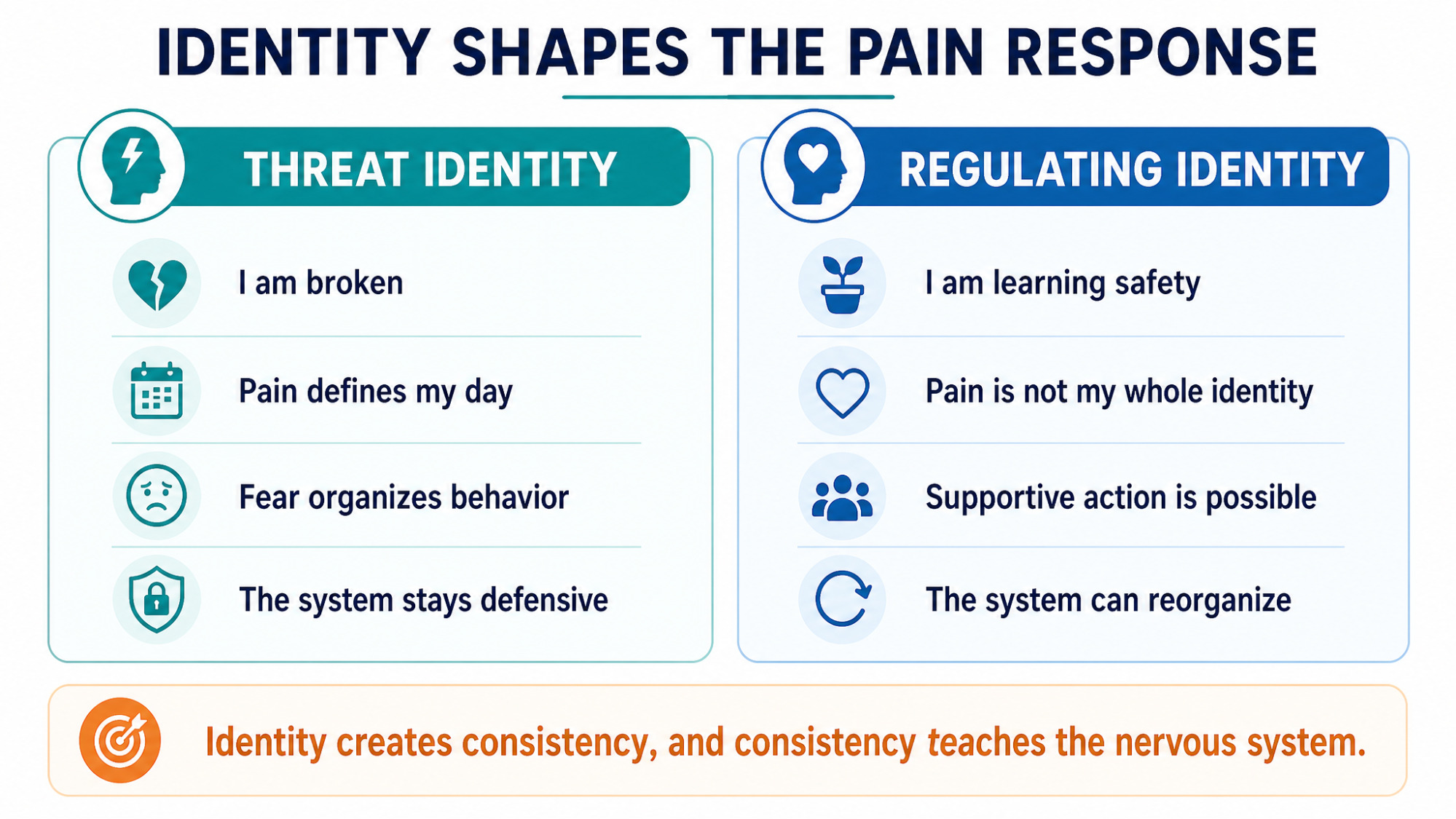
Figure: Identity-level beliefs can direct what the nervous system scans for and what it expects to find.
The slides also say:
Identity ← Perception.
Chemistry ← Identity.
Reality ← Chemistry.
The exact language is poetic, but the principle is useful.
Who you believe you are affects how you respond.
If your identity is:
“I am broken,”
the nervous system may scan for evidence.
If your identity is:
“My body is unreliable,”
each sensation may feel like confirmation.
If your identity is:
“I have to push through,”
the body may stay in chronic pressure.
If your identity becomes:
“I am someone learning to regulate,”
the system receives a different direction.
This is why identity matters in pain work.
Pain does not only live in the body.
It can become part of the self-image.
And when pain becomes identity, the nervous system keeps organizing around it.
The 3-Step Perception Reset
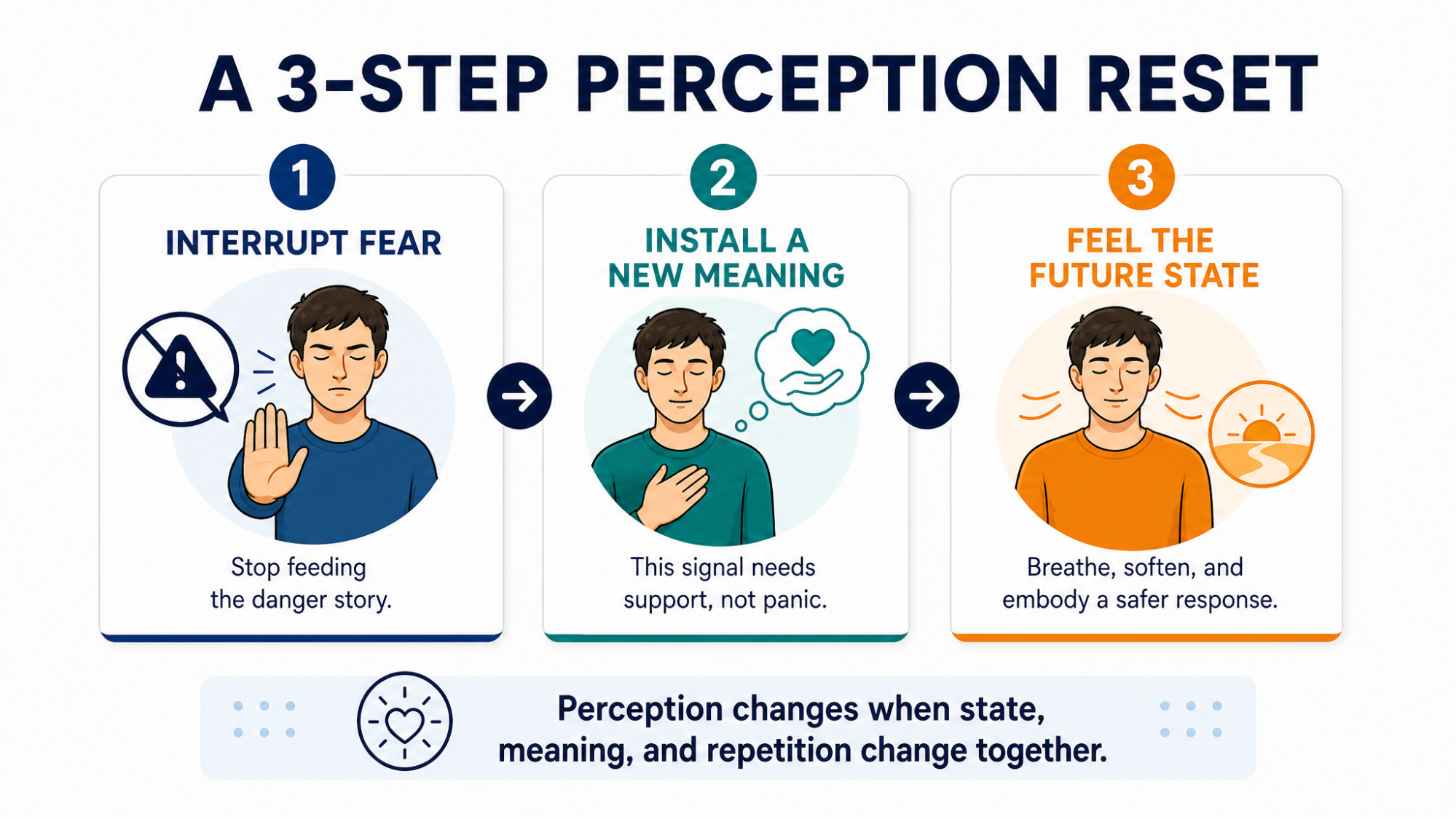
Figure: The reset works by changing fear-based interpretation before the loop fully escalates.
The slides present a three-step method.
Let's translate it into a responsible, practical method for stress-related pain patterns.
Step 1: Interrupt the Fear Signal
The first step is catching the moment when the mind enters a spiral.
This might sound like:
“What if this gets worse?”
“This will ruin my day.”
“I cannot handle this.”
“My body is failing me.”
“I am back to square one.”
The goal is not to shame the thought.
The goal is to notice it.
Name it.
“This is fear.”
“This is catastrophizing.”
“This is the old stress-pain loop.”
“This is my nervous system predicting danger.”
Why does naming matter?
Because you cannot change a pattern you are fused with.
The moment you name it, you create distance.
And distance creates choice.
Try this:
“This is a fear signal, not a final truth.”
“This is my nervous system trying to protect me.”
“I can pause before I believe the whole story.”
That pause is the beginning of regulation.
Step 2: Install a New Perception
Once the fear signal is interrupted, the next step is to offer the brain a different interpretation.
Not fake positivity.
Not denial.
A better perception.
Instead of:
“This is working against me.”
Ask:
“What if this signal is my body asking for support?”
Instead of:
“What if this gets worse?”
Ask:
“What if this is the moment I interrupt the loop earlier?”
Instead of:
“This means I am failing.”
Ask:
“What if this is feedback, not failure?”
Instead of:
“My body is betraying me.”
Ask:
“What if my body is communicating?”
The slides suggest questions like:
“What if this is working for me?”
“What if this is possible?”
“What if this is a turning point?”
Those questions matter because questions open new pathways.
A threat statement closes the nervous system.
A possibility question creates flexibility.
And flexibility is one of the first signs of change.
Step 3: Feel the Future State
The final step is emotional rehearsal.
The slides say:
Emotion is the command.
In grounded PainShift language:
Emotion helps teach the nervous system what state to practice.
If you only think a new thought, the nervous system may not fully learn it.
But when you feel the new state, even briefly, the body receives a stronger signal.
Feel security.
Feel expansion.
Feel possibility.
Feel steadiness.
Feel trust.
Feel calm focus.
Feel your body learning safety.
This is where visualization, hypnosis, and nervous system rehearsal become powerful.
You are not pretending the future is already here.
You are giving the body a sample of the state you want it to learn.
The nervous system learns through repeated experience.
Even inner experience matters.
A High Performer Example
Imagine a high-performing professional before an important meeting.
A familiar pain appears in the neck.
The old perception code says:
“Not now.”
“This will ruin my focus.”
“My body always does this.”
“I cannot trust myself under pressure.”
That perception triggers the system.
Breath shortens.
Jaw tightens.
Shoulders rise.
Attention locks onto the neck.
The pain feels louder.
Now apply the three-step reset.
Step 1: Interrupt the fear signal
“This is the fear signal. My nervous system is predicting danger.”
Step 2: Install a new perception
“This is a stress signal. My body is asking for regulation, not panic.”
“What if this is the moment I shift the loop before it builds?”
Step 3: Feel the future state
The person takes a slower breath.
Feels feet on the floor.
Softens the jaw.
Imagines entering the meeting calm, clear, steady, and present.
The pain may not disappear instantly.
But the loop changes direction.
The body receives a different signal.
And that is how the pattern begins to update.
Why This Matters for Pain and Performance
High performers often try to solve pain with more control.
More discipline.
More pushing.
More analysis.
More pressure.
But the nervous system does not always need more control.
Sometimes it needs a new perception of safety.
Pain under stress is not only a physical event.
It is a perception event.
A prediction event.
A meaning event.
A nervous system event.
When the body believes the moment is dangerous, it protects.
When the body learns that the moment is workable, it can begin to regulate.
This is the bridge between pain relief and performance.
You are not only trying to reduce symptoms.
You are training the nervous system to respond differently under pressure.
Important Clarification
This does not mean your beliefs control everything.
It does not mean every illness is caused by thoughts.
It does not mean people should abandon medical care.
It does not mean DNA changes because of one positive statement.
A more accurate statement is:
Your beliefs, stress responses, behaviors, and environment can influence biological processes, including nervous system regulation and gene expression patterns. Epigenetics studies how environmental and behavioral factors can affect how genes work without changing the DNA sequence.
That is strong enough.
And it is accurate.
You do not need exaggerated claims to make this powerful.
The Practice: Rewriting the Stress-Pain Perception Code
The next time a pain or stress signal appears, try this.
1. Interrupt
Ask:
“What fear signal just came online?”
Name it.
“This is fear.”
“This is urgency.”
“This is catastrophizing.”
“This is the old pain story.”
2. Reinterpret
Ask:
“What else could this mean?”
Try:
“This is a signal, not a sentence.”
“My body is asking for support.”
“This may be stress activation.”
“I can regulate before I react.”
“This could be a turning point.”
3. Embody
Ask:
“What future state do I want my system to practice?”
Then feel it for 30 to 60 seconds.
Security.
Calm.
Expansion.
Possibility.
Steadiness.
Trust.
Let the breath, posture, and attention match that state.
That is how the body begins to learn.
The Deeper Shift
The goal is not to make the body obey the mind.
The goal is to help the mind, body, and nervous system stop fighting each other.
How you interpret the signal changes the state.
How the state changes affects the body.
How the body responds creates new evidence.
New evidence can build a new identity.
And a new identity can create a new nervous system pattern.
Your Practice Invitation
The next time your body speaks, pause before believing the old code.
Ask:
“Is my nervous system responding to what is happening, or to what it believes is happening?”
Then ask:
“What perception would help my body feel safe enough to regulate?”
Because when perception changes, the nervous system receives a new instruction.
When the nervous system receives a new instruction, the body can respond differently.
And when the body responds differently, the old stress-pain loop begins to lose power.
And when it changes, a different biological response becomes possible.
The next time your body tightens, what perception comes online first: danger, urgency, failure, or support? And what changes when you offer the system a safer interpretation before the loop builds?

Rami Bareket
Rami Bareket is an NLP Master Trainer and hypnotherapist with over 30 years of entrepreneurial experience and 20 years as a combat medic. Through NLP, hypnosis, and integrative transformation work, he helps high performers create fast and lasting change from the inside out.
Read Full Bio