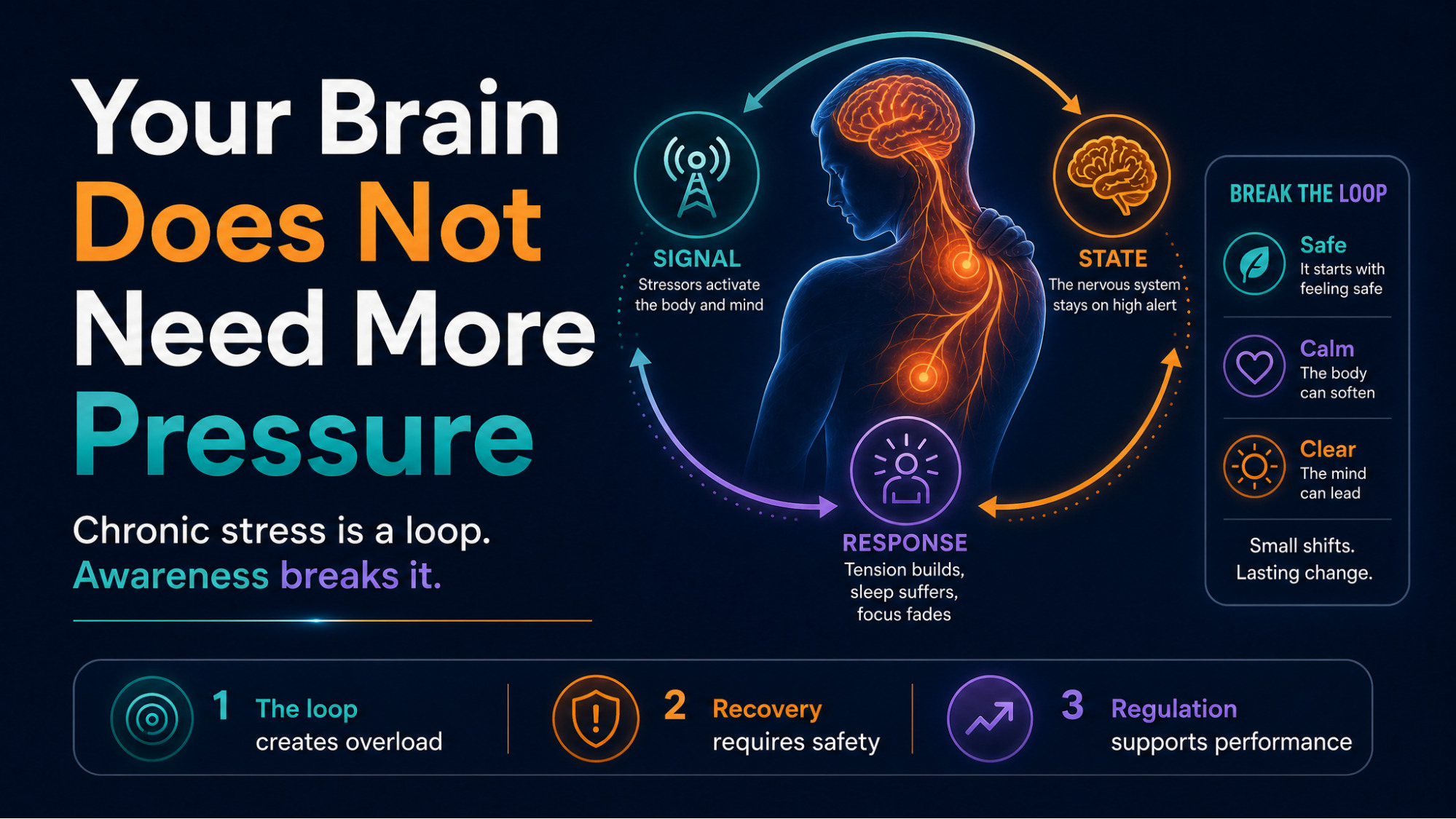
Most high performers think they are exhausted because life is demanding.
More responsibility.
More decisions.
More deadlines.
More people depending on them.
But often, pressure is not what breaks the system.
The real problem is the loop.
The loop of thoughts.
The loop of emotional tension.
The loop of replaying, predicting, preparing, correcting, and scanning for what might go wrong.
And when that loop stays active for too long, your nervous system does not feel safe enough to recover.
This is where stress becomes body tension.
This is where tension becomes pain.
This is where pain becomes distraction.
And this is where high performance starts to feel harder than it should.
Pressure Is Not Always the Problem
A healthy nervous system is designed to handle pressure.
It can respond to a challenge.
It can release adrenaline.
It can sharpen attention.
It can help you act, decide, speak, perform, and move through difficult moments.
That is not the problem.
The problem begins when the challenge ends, but your system does not return to safety.
The meeting is over.
But your mind keeps replaying it.
The conversation is finished.
But your body is still tense.
The deadline passed.
But your chest is still tight.
The conflict ended.
But your nervous system is still preparing for impact.
That is when stress stops being an event and becomes a pattern.
And for many high performers, this pattern becomes normal.
The Brain Can Handle Pressure Better Than Endless Loops
It is responding to what it has been trained to expect.
When your mind keeps repeating the same thoughts again and again, your body can begin to treat those thoughts as if the situation is still happening.
What if I said the wrong thing?
What if tomorrow does not go well?
What if I cannot handle this?
What if this pain means something serious?
What if I lose control?
What if I disappoint people?
What if I am not enough?
Each thought may seem small.
But repeated over and over, it becomes a signal.
And the nervous system listens to signals.
It does not only respond to what is happening outside.
It also responds to what is being rehearsed inside.
This Is Why Overthinking Feels Physical
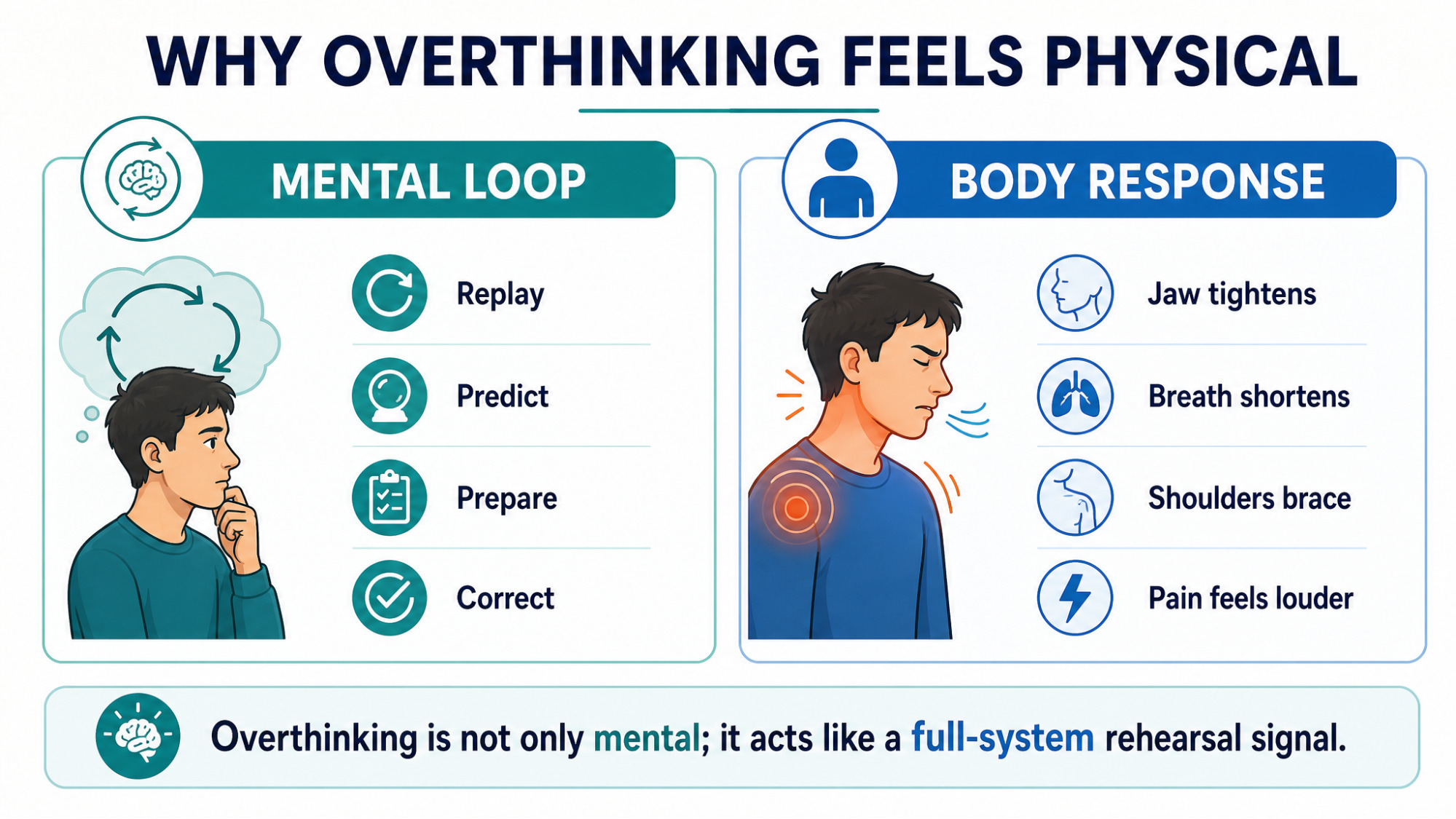
Figure: The article frames overthinking as a full-system rehearsal signal, not just a mental event.
Many people think overthinking is only mental.
But it is not.
Overthinking has a physical cost.
It can tighten the jaw.
Raise the shoulders.
Shorten the breath.
Increase muscle tension.
Disturb sleep.
Sharpen pain signals.
Create fatigue.
Make the body feel heavier.
Make focus feel harder.
And for high performers, this can become especially confusing.
Because from the outside, nothing dramatic is happening.
You are sitting at your desk.
You are answering emails.
You are leading a meeting.
You are driving home.
You are trying to relax.
But inside, your nervous system is still working.
Still scanning.
Still bracing.
Still preparing.
Still trying to protect you.
That is why you can finish the day feeling exhausted even if you did not physically do much.
Your body may have been carrying invisible pressure for hours.
The Stress Loop That Keeps the Body Activated
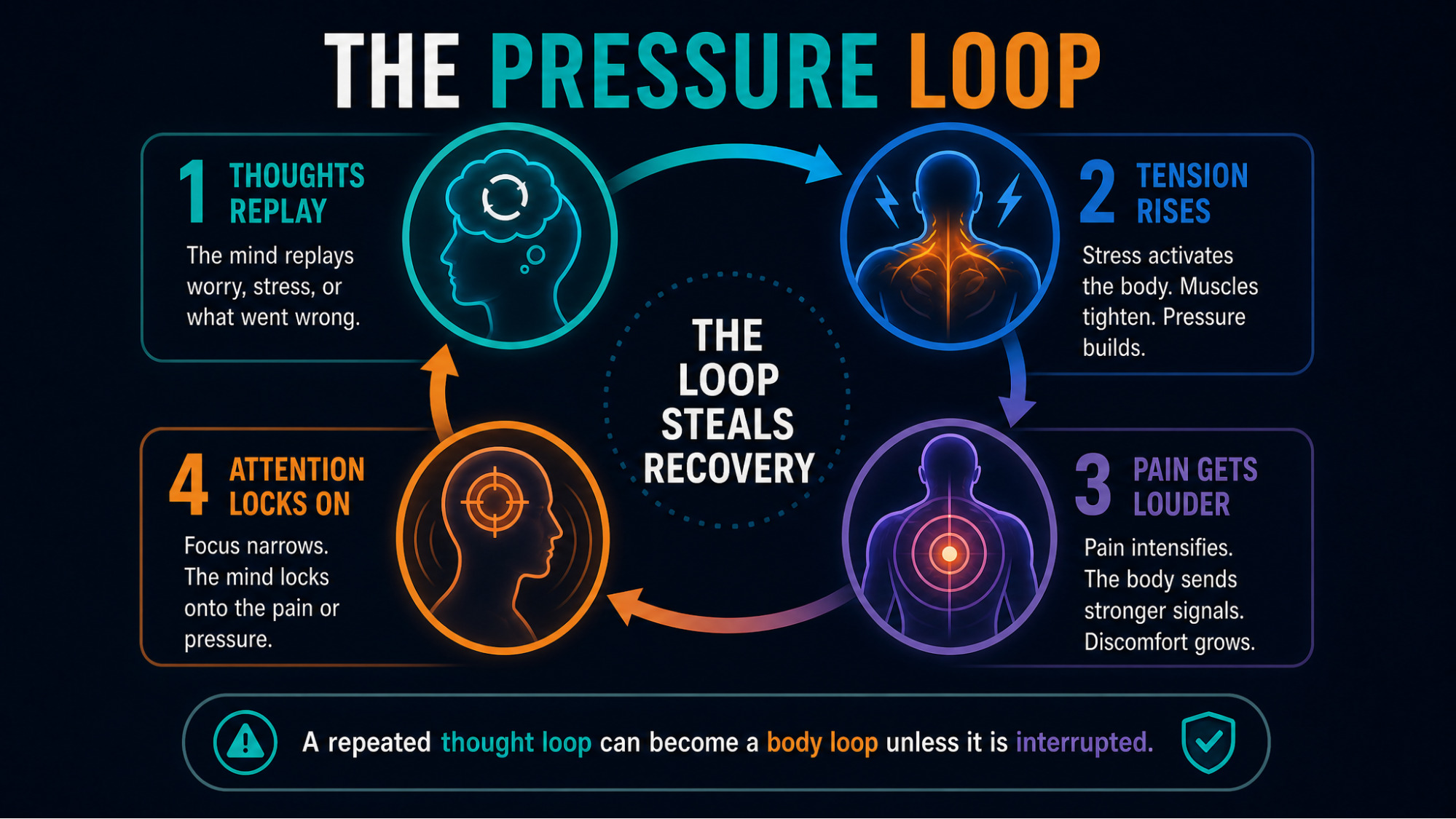
Figure: A repeated thought loop can become a body loop unless the pattern is interrupted and the system is guided back toward recovery.
Here is the sequence many people miss.
A thought appears.
The body reacts.
The nervous system becomes alert.
Attention narrows.
Emotion rises.
Muscles tighten.
Breathing changes.
Pain or discomfort becomes louder.
Then the mind notices the body sensation and creates another story.
Something is wrong.
I need to fix this.
I cannot relax.
I am losing control.
This makes the body tighten again.
And the loop continues.
This is how mental pressure becomes physical tension.
This is how physical tension becomes pain.
This is how pain becomes more stress.
And this is how a person can feel stuck even when they are doing everything they can to move forward.
Burnout Is Not a Character Problem
Many high performers try to solve burnout with more discipline.
More motivation.
More planning.
More productivity.
More effort.
More pushing.
But burnout is not always a motivation problem.
Very often, it is a nervous system recovery problem.
The system has been activated for too long.
The body has been bracing for too long.
The mind has been scanning for too long.
The emotional load has been held for too long.
At some point, the system starts asking for relief.
But because every system has limits.
Even the strongest nervous system needs moments of safety.
Moments of quiet.
Moments of completion.
Moments where the body receives the message:
It is over now.
You can let go.
You can soften.
You can return.
Why High Performers Often Miss the Signal
High performers are often excellent at pushing through.
That is part of what helped them succeed.
They can ignore discomfort.
Delay emotion.
Override fatigue.
Stay focused under pressure.
Keep going when others stop.
But the same ability that creates success can also become the pattern that keeps the nervous system overloaded.
Because the body keeps score of what the mind tries to skip.
You may tell yourself:
I am fine.
I can handle it.
It is not a big deal.
I just need to keep going.
But your body may be saying something different.
Tight neck.
Heavy chest.
Shallow breath.
Tired eyes.
Lower back tension.
Head pressure.
Digestive discomfort.
Restless sleep.
Emotional numbness.
Irritability.
The body is not trying to interrupt your success.
It is trying to show you where your system needs regulation.
Pain Can Become Part of the Loop
For someone dealing with physical pain, the stress loop becomes even more powerful.
Pain appears.
The mind interprets it.
The body reacts.
Stress rises.
The nervous system becomes more sensitive.
Pain feels louder.
Then the mind becomes more concerned.
And the cycle repeats.
This does not mean the pain is imaginary.
It means the nervous system can amplify real signals when it is under pressure.
But suffering often grows when the nervous system feels unsafe, overwhelmed, or stuck in prediction mode.
That is why pain relief cannot only be about the painful area.
It also has to include the state of the system receiving the signal.
A calm nervous system can often process signals differently than a threatened nervous system.
The Body Often Changes Faster Than Thought
One of the most practical insights is this:
You do not always have to think your way out of stress.
Sometimes you need to state-shift your way out of it.
Because the body can interrupt the loop faster than analysis.
This is why small physical changes can be powerful.
Cold water on the face.
A slow walk.
Longer exhale breathing.
Humming.
Stretching the neck and shoulders.
Squeezing and releasing the hands.
Relaxing the jaw.
Opening the posture.
Looking around the room slowly.
Feeling the feet on the floor.
These are not random tricks.
They are ways of telling the nervous system:
We are here.
We are safe enough.
The danger is not happening right now.
You can return to the present.
A Simple PainShift Reframe
Instead of saying:
My brain will not stop.
Try this:
My nervous system is still scanning.
Instead of saying:
I am too stressed.
Try this:
My system needs a reset signal.
Instead of saying:
This pain is ruining my day.
Try this:
My body is asking for regulation before I push forward.
Instead of saying:
I need to think harder.
Try this:
I need to help my body feel safe enough to think clearly.
This is not just positive language.
It is a different relationship with your internal state.
You stop fighting the signal.
You start listening to it.
And when you listen differently, your body often responds differently.
The 30 Second Loop Break
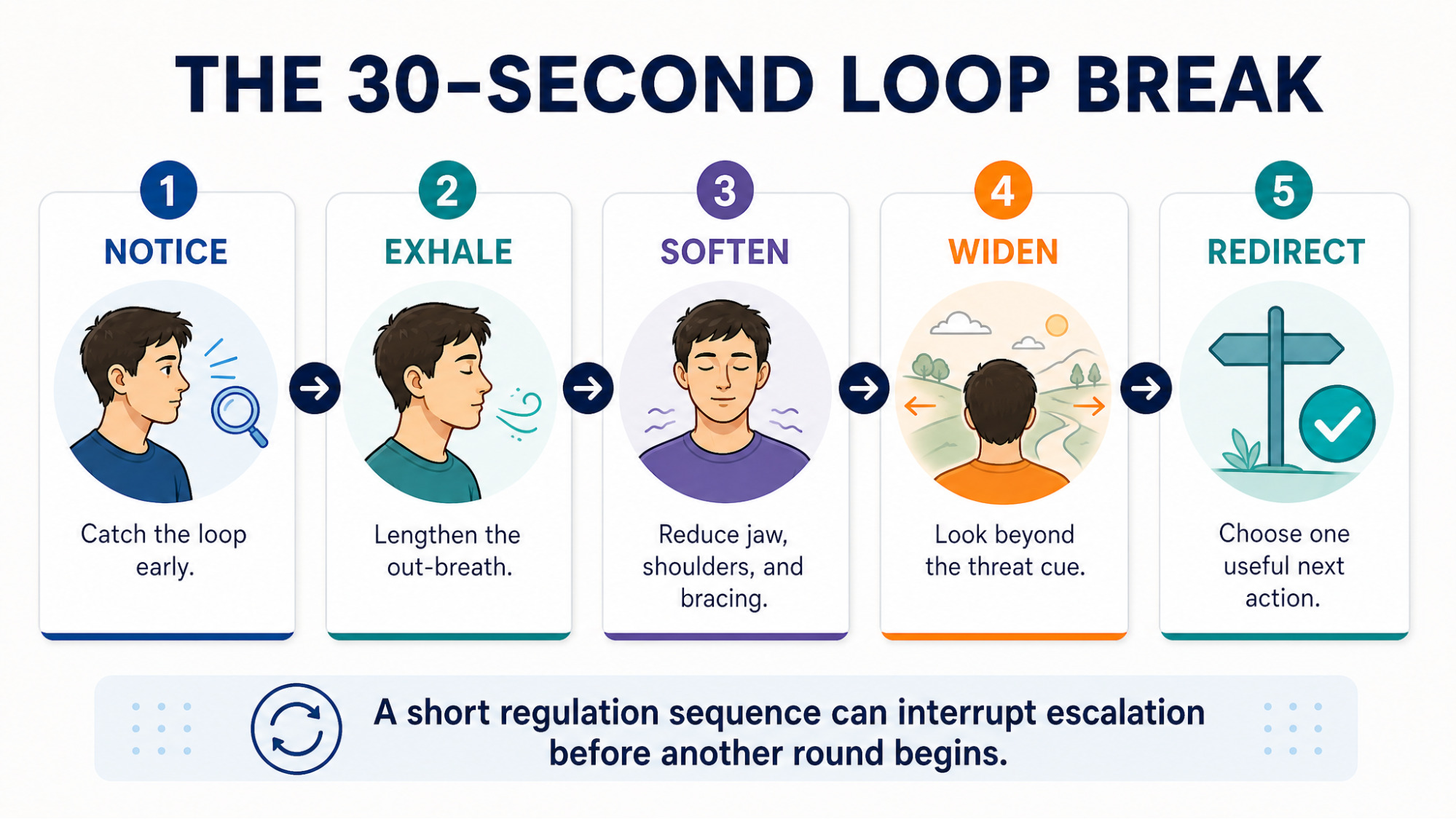
Figure: A short regulation sequence can interrupt the pattern before another round of mental and physical escalation begins.
Here is a simple practice.
Use it when you notice:
mental looping
body tension
pain amplification
emotional pressure
overwhelm
difficulty focusing
the feeling that you cannot stop thinking
Step 1: Pause
Do not rush to fix the thought.
Do not argue with it.
Do not force yourself to calm down.
Just pause.
Say silently:
This is a loop.
Not a threat.
Step 2: Exhale Slowly
Take one slow breath in.
Then exhale longer than you inhale.
Let the exhale be gentle.
Not dramatic.
Not forced.
Just longer.
Repeat this three times.
Step 3: Return to the Body
Feel your feet.
Relax your jaw.
Lower your shoulders.
Let your hands soften.
Notice one point of contact with the chair, floor, or table.
Step 4: Interrupt the Pattern
Choose one physical reset:
walk for one minute
squeeze and release your hands
hum softly for 20 to 30 seconds
place cool water on your face
stretch the neck slowly
press your feet into the floor
Step 5: Re-enter With One Small Action
Ask:
What is the next small useful action?
Not the whole solution.
Not the perfect plan.
Just the next useful action.
This teaches the nervous system that you do not need to stay trapped in the loop.
You can pause.
You can regulate.
You can return.
Why This Matters for Performance
Performance is not only about mindset.
It is also about state.
A person in a regulated state thinks differently.
Decides differently.
Communicates differently.
Moves differently.
Handles pain differently.
Responds to pressure differently.
When your nervous system is in a threat state, your mind becomes narrower.
You become more reactive.
Your body becomes more guarded.
Your pain sensitivity can increase.
Your creativity decreases.
Your patience decreases.
Your recovery becomes harder.
But when your system moves toward regulation, you gain access to more options.
More clarity.
More emotional control.
More flexibility.
More grounded confidence.
More physical ease.
That is why nervous system work is not separate from performance.
It is the foundation of sustainable performance.
The Hidden Cost of Constant Scanning
Many people are not exhausted because of what happened.
They are exhausted because their system keeps preparing for what might happen.
The email you might receive.
The pain that might get worse.
The conversation that might become difficult.
The mistake someone might notice.
The decision that might not work.
The future that might not go according to plan.
This kind of scanning feels responsible.
But after a while, it becomes expensive.
The nervous system stays on guard.
The body does not fully soften.
The mind does not fully rest.
The person is never fully present.
And this is where high performers can lose access to the very qualities that make them strong.
Clear thinking.
Calm leadership.
Creative problem-solving.
Confident execution.
Emotional steadiness.
The goal is not to stop caring.
The goal is to stop living in constant internal alarm.
The Relief Moment
There is a moment many people need.
Not a big breakthrough.
Not a dramatic release.
Just a small inner shift.
The moment they realize:
I do not have to solve everything right now.
I do not have to fight my body.
I do not have to believe every thought.
I do not have to keep scanning.
That moment matters.
Because it gives the nervous system a new experience.
Not pressure.
Not force.
Not collapse.
And choice is where regulation begins.
The New Identity Shift
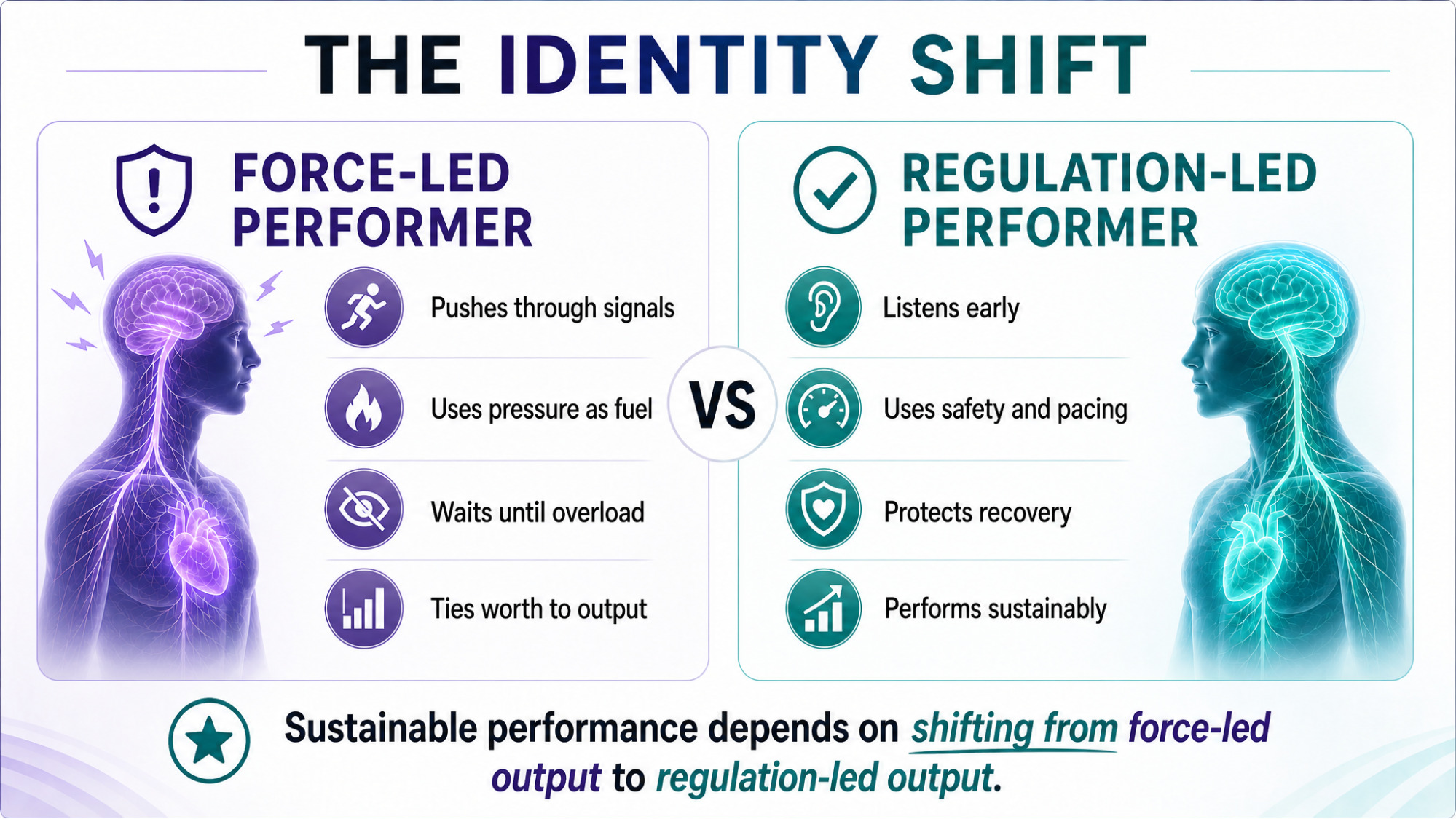
The old identity says:
I push through.
I ignore the signal.
I perform no matter what.
I do not stop until everything is done.
The new identity says:
I perform better when I regulate first.
I listen to my body before it has to get louder.
I know how to interrupt the loop.
I can lead, create, and execute without living in constant tension.
I do not need to wait for pain or burnout to give myself recovery.
This is a different kind of high performance.
A Practical Daily Reset for High Performers
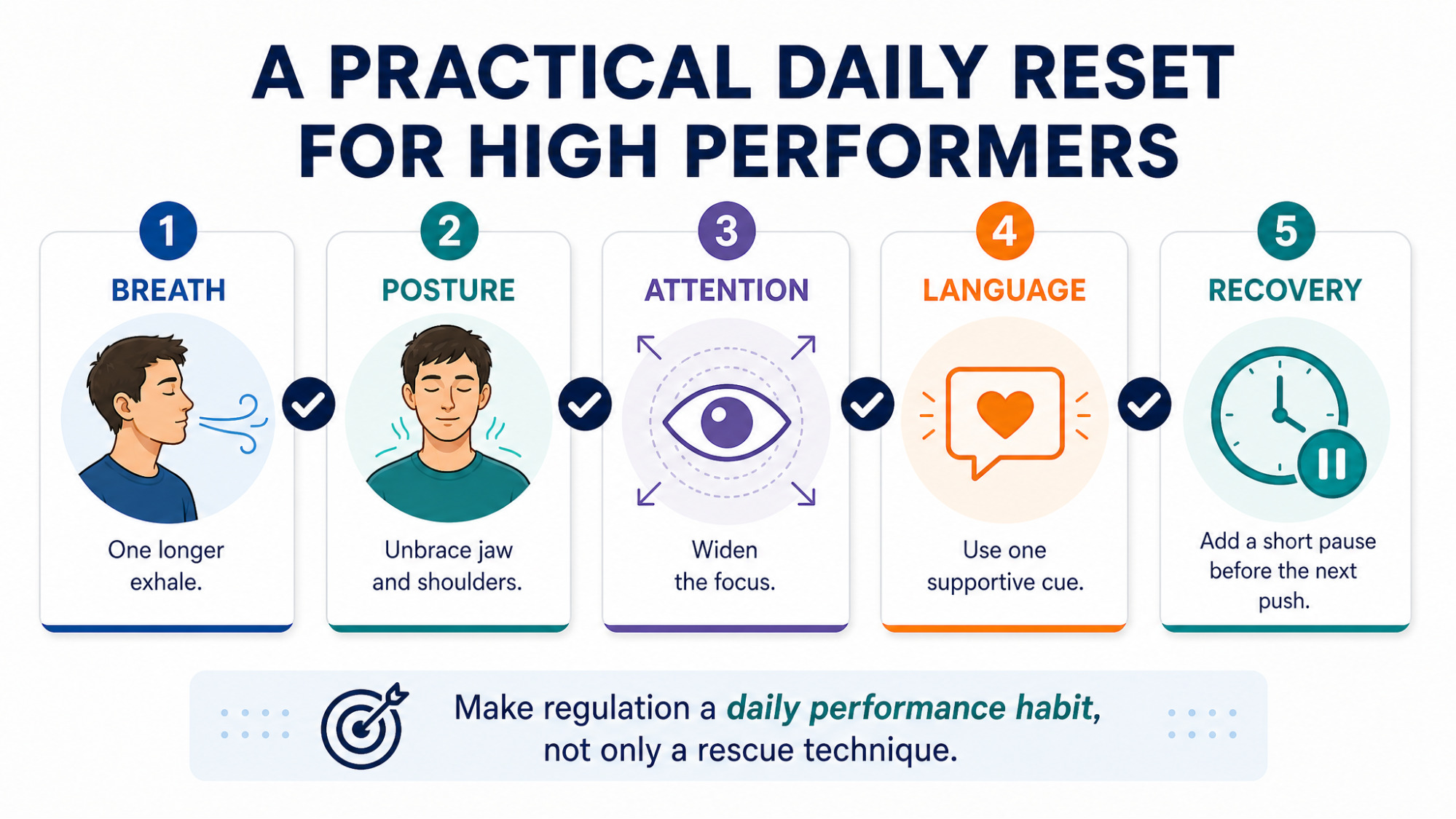
Figure: The daily reset turns regulation into a repeatable performance habit rather than a one-time rescue technique.
Use this several times per day.
Especially before meetings, after stressful conversations, during pain flare-ups, before sleep, or when you feel mentally overloaded.
Notice the loop.
Say:
This is my system scanning.
Name the body signal.
Tight chest.
Jaw tension.
Shoulder pressure.
Head heaviness.
Stomach tightness.
Give the body one reset signal.
Slow exhale.
Cold water.
Movement.
Humming.
Stretching.
Grounding.
Choose one next action.
One email.
One call.
One break.
One decision.
One boundary.
One recovery step.
The nervous system learns through repetition.
Not one perfect practice.
Many small returns.
Final Thought
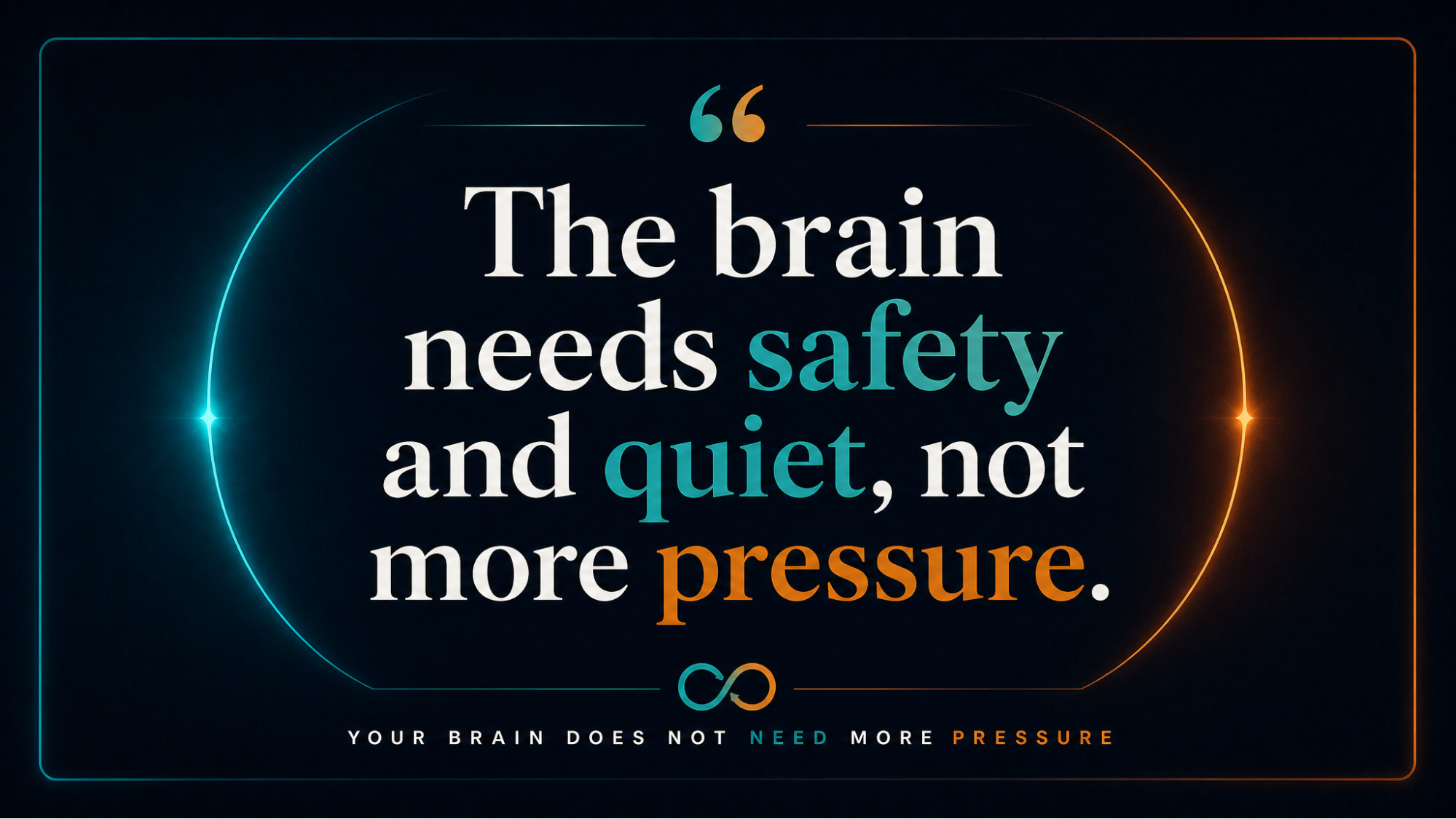
Your brain does not need constant stimulation.
Your body does not need endless pushing.
Your nervous system does not need another reason to stay on guard.
It needs moments of safety.
Moments of quiet.
Moments where the loop stops.
Moments where the body remembers:
I am here.
I am safe enough.
For high performers, this is not just stress relief.
It is pain relief.
It is emotional regulation.
It is clearer thinking.
It is sustainable performance.
Because the people who think the clearest are not always the people who think the most.
They are the people who know when to stop.
And sometimes the most powerful performance shift begins with one simple thing:
Which part of the loop shows up first for you most often: replaying in the mind, tension in the body, pain getting louder, or the urge to push harder instead of reset?
This article is for educational purposes only and is not a substitute for medical advice. If you have persistent, worsening or severe pain, or symptoms that concern you, please speak with a qualified healthcare professional.
Rami Bareket
Rami Bareket is an NLP Master Trainer and hypnotherapist with over 30 years of entrepreneurial experience and 20 years as a combat medic. Through NLP, hypnosis, and integrative transformation work, he helps high performers create fast and lasting change from the inside out.
Read Full Bio