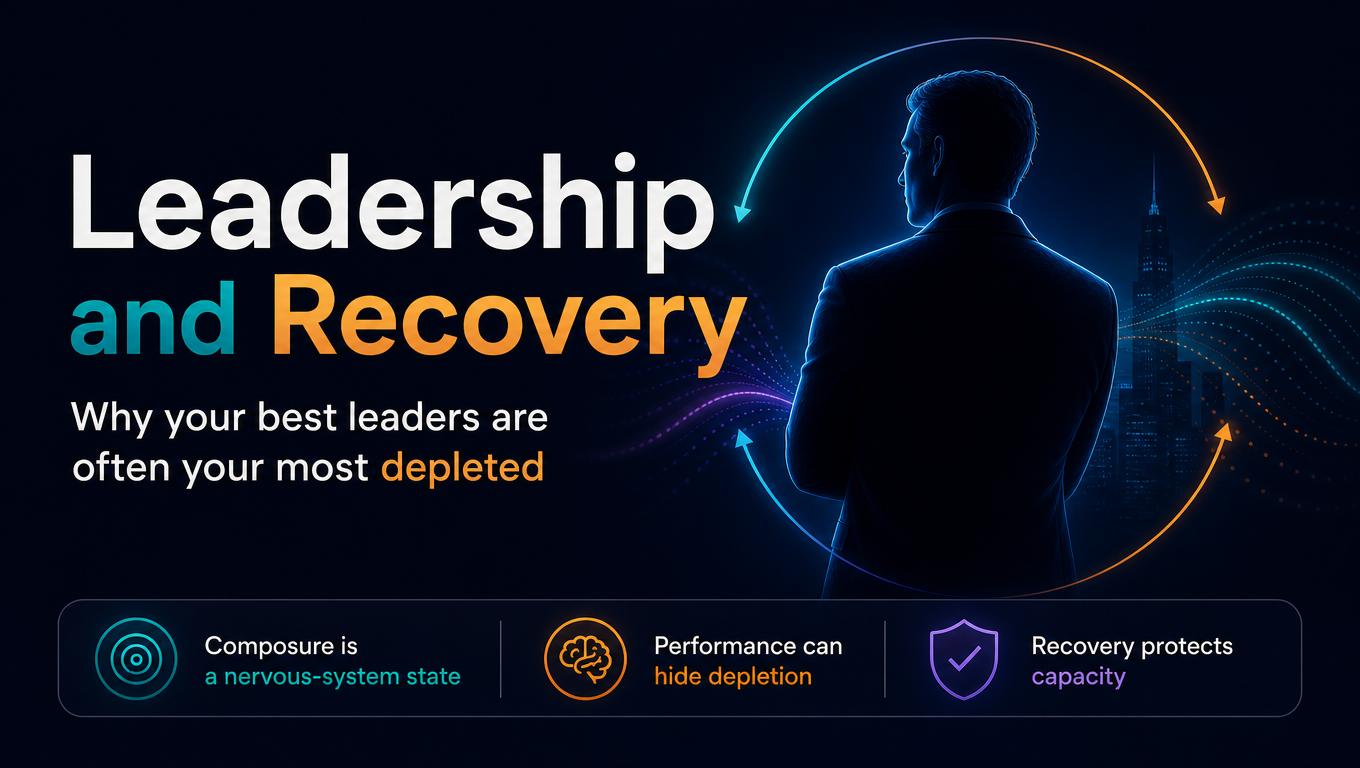
Why your best leaders are often your most depleted
Quick read.
- Leadership presence is not only a trait; it is also a nervous-system state.
- The leaders who look most composed may be paying the highest internal cost to maintain that composure.
- Recovery debt often accumulates invisibly because high performers are rewarded for override.
- The real goal is not less ambition. It is more sustainable regulation capacity.
- The stronger the role, the more costly hidden depletion can become.
Clinical note. This document is an educational editorial resource. It does not replace diagnosis, emergency assessment, or individualized medical care.
There is a pattern in organizations that rarely gets named directly. The people who hold the room together are often the same people quietly running on empty.
From the outside, they look composed, capable, and steady. Internally, they may be carrying recovery debt that no leadership scorecard ever measures.
That is why this conversation matters. Leadership performance is not separate from physiology. In high-pressure environments, leadership presence is partly a nervous-system event.
Leadership presence is a state
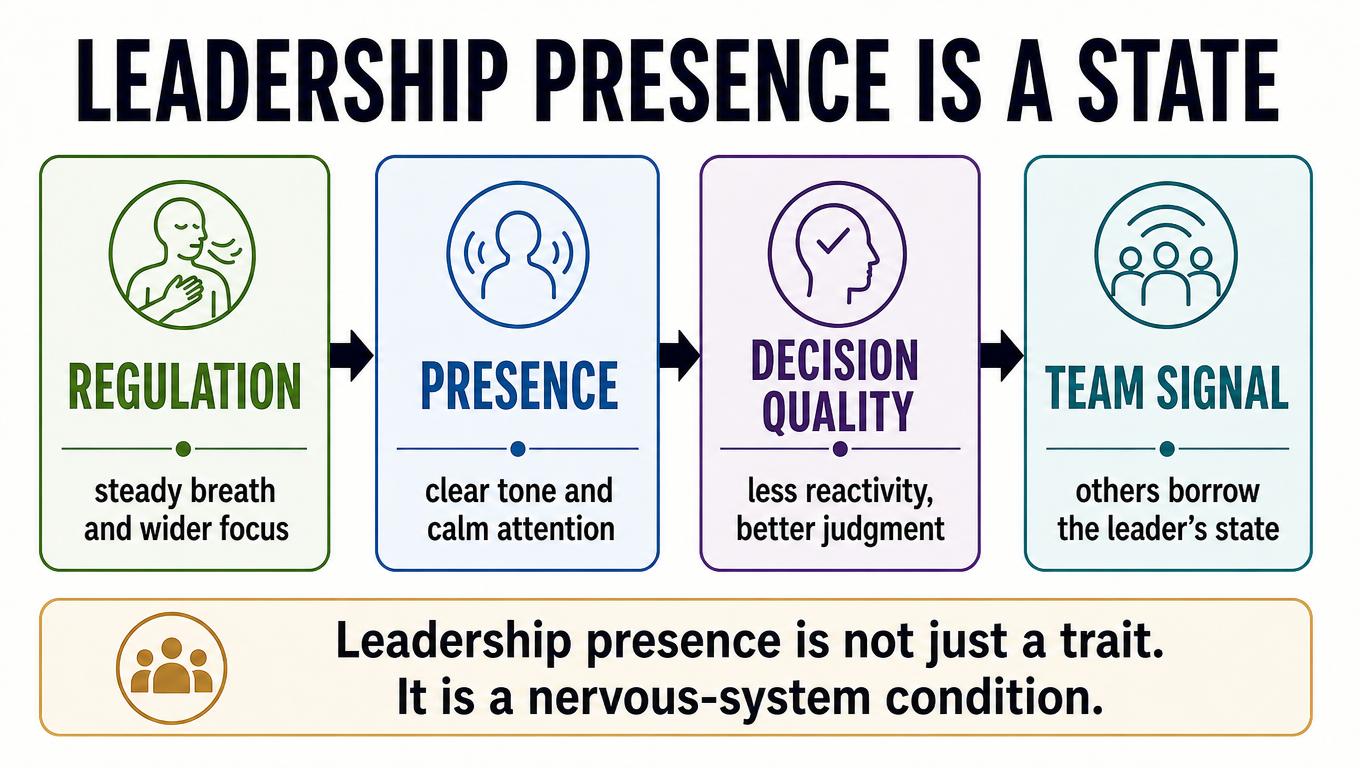
A four-part leadership-state diagram linking regulation, presence, decision quality, and team signal.
A regulated system supports clear tone, wider attention, steadier judgment, and a more grounded form of authority. A dysregulated system narrows focus, increases reactivity, and makes composure expensive to maintain.
That does not mean strong leaders are pretending. It means the performance can be real while the internal cost is real too. Many leaders are using effort to produce a state that should ideally cost less.
The deferred recovery cycle
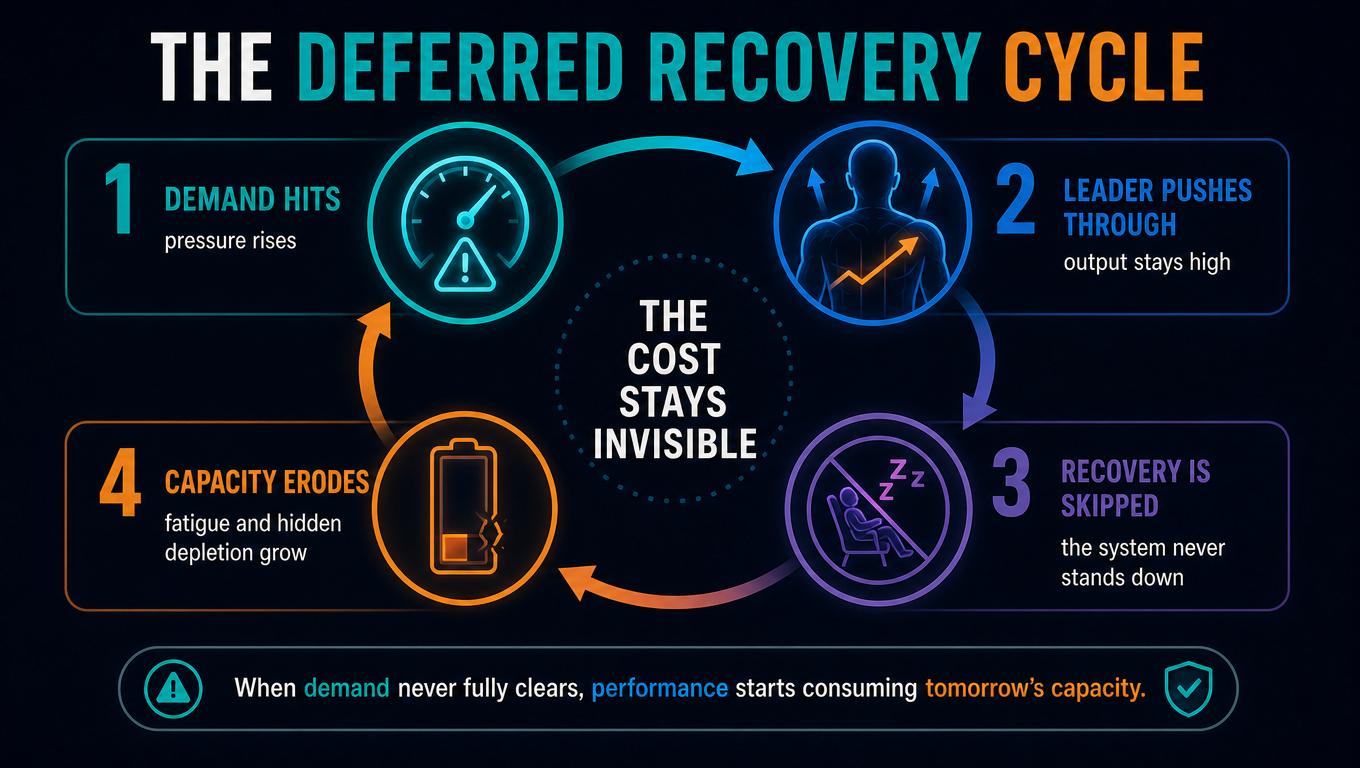
A loop showing demand, push-through, skipped recovery, and eroding capacity.
High performers are often exceptional at finishing the demand. What they are less practiced at is telling the body that the demand has actually ended.
When demand, override, and the next demand arrive too close together, recovery gets deferred so consistently that it begins to feel normal. That is how capable leaders can remain functional while becoming quietly depleted.
Why leadership development misses the real bottleneck
Most leadership development focuses on communication, strategy, judgment, and influence. Those skills matter. But they sit on top of a human system that can be overdriven, under-recovered, and permanently activated.
If the physiology underneath the leader is running in sustained override, even excellent skill training produces diminishing returns. A fatigued nervous system narrows access to the very capacities leadership depends on.
What genuine recovery requires
Real recovery is not only sleep, time off, or a wellness app. It is the system's ability to register that the threat has passed and stand down without being yanked immediately into the next activation cycle.
That often requires more than generic stress management. It requires a repeatable way to reduce internal threat, widen the body's sense of safety, and restore the capacity to recover between demands rather than after collapse.
Executive reset lens
| Less helpful pattern | More helpful pattern |
|---|---|
| More composure through force | More composure through regulation. |
| Recovery after burnout | Recovery between demands. |
| Skills training on top of depletion | Skills training supported by restored capacity. |
| Invisible cost accepted as normal | Invisible cost treated as a strategic risk. |
Final thought
The point is not to make leadership softer. It is to make leadership sustainable.
When recovery becomes part of how performance is built, not how collapse is repaired, the leader stops paying for excellence with hidden depletion.

Rami Bareket
Rami Bareket is an NLP Master Trainer and hypnotherapist with over 30 years of entrepreneurial experience and 20 years as a combat medic. Through NLP, hypnosis, and integrative transformation work, he helps high performers create fast and lasting change from the inside out.
Read Full Bio